Category: Memories

  • Glöggmys

    Glöggmys

    We have stars glowing by our windows. And snow when we look over the roofs of Skellefteå.

    We have a batch of saffron, almond and orange biscotti in the oven. And one of pepparkaksdeg [gingerbread biscuit dough] in the making: there is cinnamon, ginger, cardamom and cloves infusing in water, along with butter too of course! And soon the dough will come together.

    We have two cups of glögg on the table. With almonds and raisins just so.
    Yes, a little earlier today, I unwrapped each of the wonderful little cups that I had excessively wrapped in newspaper a few months ago after we had found them at a loppis [garage sale] in Dalarna over the summer.
    I remember that day; still early in the morning, we stumbled across the largest collection of Duralex tableware outside of my grand-mère’s house. It was at the small green house that stands on Orsa’s centre square, where we’d ventured on the promise of a gammaldagsmarknad [olden day market]. Of the excursion, these cups and many others are the only things that followed us; like a reminder of a past I find myself recollecting more and more often. And just like the ones I grew up with, I now hope to grow older with them too.

  • An autumn day

    An autumn day

    We went for a walk today. And for once, I remembered to take my camera along. Our official purpose was to pick rönnbär [rowan berries], but really, I just wanted to wrap myself in a golden hour that comes everyday a bit sooner.

    We walked by the river. And crossed the dam that seems more of a waterfall at the moment, as water gets released before the snow comes.

    Every step we took over the bridge left traces in the frost. The first that lasts until the afternoon; only in the shadow of course, but still enough to warm my heart for a winter that I’ve longed after for weeks now.
    Yes, winter, you may come now.

    When we came home, coffee was promptly made and we picked through our small harvest. I have rönnbärsgele [rowan berry jelly] and syltade rönnbär [confit rowan berries] in mind, so hopefully I’ll share these with you soon.

  • Bonjour juin, rhubarb edition

    Bonjour juin, rhubarb edition

    Let me tell you the story of yesterday. Or rather, of yesterday afternoon.

    We stopped at the gas station. Two French hot-dogs and bad cups of coffee later we turned right on the old road towards Kusmark. It had only been a couple of weeks since our last trip and yet, the never-ending sun turned the fields into a thousand shades of green. There is the blue-green of the conifers, and the vibrant tarnished-gold of sunrays through the birch leaves.

    A wonderful forest made of apple trees and lilac, bursting and blooming, not unlike a kaleidoscope.

    And just like the road, Svante’s garden had become a wonderful forest made of apple trees and lilac, bursting and blooming, not unlike a kaleidoscope.

    I took my shoes off as I stepped out from the car and ran to the rhubarb plants, wondering how big they would have grown.
    And if it’s anything to go by I’d say that it must have been much warmer this year than last, as they reached a good twenty centimeter above my head.

    We picked and trimmed. And picked again.

    Two bushes gave us a little over twenty kilograms, perhaps even thirty. All while we left the last plant – the one by the mountain of chopped wood, drying for the winter – mostly untouched.

    This is the aftermath. A beautiful mess, of some sort. The bigger-than-I’d-ever-seen leaves went into the compost, and the stalks – at times green, at times red – were washed under ice-cold water, and stuffed into plastic bags.

    I might not be the most frequent blogger, but you can be sure to see me at least once a year as rhubarb season approaches.

    There is something about it that I can’t quite pinpoint. Most likely one of these cliché childhood memories of my grand-parents potager [vegetable patch] in Fouras.
    And just like a forever-carousel of happy recollections, neatly-arranged jars of confiture de rhubarbe [rhubarb jam] and silent wishes, here is my not-so-official June* rhubarb list.

    1. Dipping peeled rhubarb stalks in sugar, just like K. told me about a few years ago, on one of the many summer nights we spend on the south bank.
    2. Cooking rababersaft [rhubarb cordial], which everyone here freezes in small water bottles to bring a bit of summer throughout the winter days.
    3. Maybe, making a batch of rabarberbullar [rhubarb buns].
    4. And an upside-down rhubarb cake.
    5. I’ve been looking forward to trying Tartine bakery’s galette dough; and really, I think a rhubarb galette needs to happen.
    6. Baking my favourite cake: a soft vanilla sponge with bits of chopped rhubarb and a swirl of rhubarb jam, little pockets of cheesecake and a heavy handful of streusel sprinkled over its top.
    7. Of course, rhubarb jam. Not a year should go without.
    8. I’ve been dreaming of creating a simple ice-cream recipe – with no special sugars (hejdå dextrose and atomised glucose) and no stabilisers (with perhaps, cornflour or gelatin as a thickener). And given the state of my fridge-turned-rhubarb-storage, I might have to start with rhubarb creamsicle ice-cream. TBC.
    9. Thick sliced of brioches, French-toasted just so, with a generous spoonful of rhubarb compote.
    10. What’s your favourite rhubarb recipe? How do you deal with your bountiful plants?

    * June because living in the north of Sweden means just that: rhubarb in June. Enough said 🙂

  • Raw carrot cake energy balls

    Raw carrot cake energy balls

    The days are now long again. With the sun setting at ten thirty pm and rising just a short hours later at two thirty am.

    And when I told Svante last Sunday “Det känns som sommar idag.”, he was quick to answer “Det är sommar.”, something that went in unison with his rhubarb plants, which have dramatically grown over the span of a few weeks.

    So I guess summer has started; on a Sunday afternoon.

    With the ice gone from the rivers of north Sweden for what feels a couple of days, K. turned into an almost full-time fly-fisherman. And as the last traces of snow disappeared (although I’ve now seen a little patch, by Bonnstan, which is still covered in a mountain of dirty snow), we packed our car, just so we’d have the essentials ready. All day. Everyday.

    A blanket on the back-seat, in case we drop by Kusmark to pick up K.’s brother’s dog Kaiser. Waders, wading boots (for him) and hiking boots (for me), neatly arranged in a banana cardboard box in the trunk. A couple of rods and reels. Many fly boxes and manier flies.

    Some days, I happily join him, along with our kaffepanna [Swedish coffee pot], two white plastic mugs, and our favourite kokkaffe; a chunky piece of falukorv [Falun sausage], and perhaps a baguette or a few slices of sourdough bread; a knife; a box of matches; and a few energy balls in a little plastic bag.

    Raw vegan carrot cake balls
    I love to make a large batch of these and keep them in the freezer for days when we go on a little fishing/hiking trip. And really, they have now replaced the chocolate wrapped in foil that we used to bring along, at times with bits of roasted hazelnuts, other times with salty nuggets of lakrits [liquorish].

    The last batch I made was this one: carrot cake-ish, of some kind. But the variations are endless.

    You could substitute the carrot for raspberries (a favourite of mine) or bananas. Add a fat tablespoon of raw cocoa powder. Replace the oats for sprouted buckwheat or rye. Add seeds from a vanilla pod, or a grated tonka bean, or a few chopped nuts. And when the stone fruits will be in season, I urge you to try to make these with fresh peach and dried apricots (to replace the dates); and maybe add a pinch of saffron and a small handful of pistachio nuts. Another wonderful option is to use half passion fruit pulp, half grated apples, and roll the balls in matcha powder.

    Raw vegan carrot cake balls

    Makes 8-12 energy balls

    120 g rolled oats
    50 g shredded coconut
    1 tsp ground cinnamon
    1/4 tsp ground ginger
    1/4 tsp ground cardamom
    pinch of salt
    130 g grated carrots (approx. 1)
    90 g pitted medjool dates (approx. 6)
    2 tbsp coconut oil (approx. 30 g)
    1 tbsp agave/maple syrup

    Place the dry ingredients in a food processor and blitz for a minute until coarsely ground. Add the carrots, dates, coconut oil and syrup, and blitz until it forms a dough.
    Transfer to a clean work surface and roll into a log. Cut into 8, 10 or 12 depending on the size you wish your energy bites to be.
    Roll each segment into a ball and coat in shredded coconut.
    Place in an airtight container and refrigerate for at least 1 hour before eating. The raw vegan carrot cake balls will keep in the fridge for around 4-5 days. You could also make a double batch and freeze them for up to 3 months.

  • Fromage blanc cake

    Fromage blanc cake

    There was a day spent in the garden. A rake in the hands, and dead leaves piled high on a wheelbarrow. That day, the sun was high and warm, just like the two eagles we’d seen earlier, right after sunrise.

    The following morning was an entirely different story. A story made of snowflakes and a crackling fireplace. Both lasted all day, for the record.
    I baked the sourdough bread that I had left to proof on the porch overnight. And although it turned out to be much too big for my cast-iron pot, it was restlessly devoured while still warm, with only a few slices left for the next day.

    I painted too. A dalahäst. Although I still need to draw on top of the watercolours, using ink, just like I always do.
    And in the afternoon, when it became clear we wouldn’t leave the house, I whipped egg whites and folded them into fromage blanc, to make the one cake that might have possibly been baked weekly in my kitchen for a little over ten years, which I’ve yet to tell you about.

    Fromage blanc cake

    This recipe is a classic case of natural selection.
    What started with the words tarte au fromage blanc, hastily written with a not-so-steady hand over twenty years ago has slowly turned into a cake – a term close enough, yet, hardly accurately describes the wonder that it really is.

    All it took, really, was to remove the pâte brisée base. And just like that, many childhood memories resurfaced. The tourteau fromagé du Poitou; the burnt crust, the pâte brisée I would leave out in favour of the insane texture of this fresh goat’s cheese “cake”. And perhaps also, the soft cake that came from a cardboard box at the supermarket; halfway between a mousse and a cheesecake.

    And maybe that’s what I should call it: Fromage blanc French cheesecake. But then, it’d sound much more flamboyant that what it is.
    Because it is not. It’s a plain, slightly sour from the fromage blanc (however, Greek yoghurt makes and excellent substitute) and warm with vanilla (by any mean, please use homemade vanilla sugar) cake.
    If eaten piping hot from the oven, it’s the softest thing you’ve ever had. And in the morning, after a night spent on the kitchen counter, it becomes firm and yet delicate; a form, which is without a doubt my favourite.

    You could also add the zest from a lemon or an orange. Or fold in a light jam right before you pour the batter into its tin. I often don’t. For the sake of its plain, unpretentious character.

    Fromage blanc cake

    Serves 8-10

    4 eggs, separated
    a pinch of salt
    100 g caster sugar
    500 g fromage blanc or Greek yoghurt
    100 g cornflour or plain flour
    30 g vanilla sugar

    Preheat the oven to 175°C (185°C for traditional ovens). Butter and line the bottom of a 22cm cake pan with baking paper, and set aside.

    Whisk the egg whites with a pinch of salt until foamy. Add half the sugar and keep on whisking until they reach hard peaks.
    In another bowl, whisk the egg yolks and remaining sugar until light and fluffy. Gently fold in the fromage blanc, cornflour and vanilla sugar.
    Then, using a rubber spatula, fold in the meringue until barely smooth: it’s absolutely fine to still have bits of egg whites in the finished batter.

    Transfer to your prepared tin, and bake for 30 to 40 minutes, until well-domed and golden-brown. The top might have cracked a little and it should feel firm to the touch.

    Allow the cake to cool down to room temperature in its tin, then unmould onto a plate. Serve dusted with icing sugar or with berries, just brought to the boil with a spoonful of caster sugar.

  • A life-changing way to scan watercolours

    A life-changing way to scan watercolours

    This afternoon, I started gathering things I want to bring with us to Åsen (two more days!!). A film camera, and many rolls of my favourite film – Kodak Ektar in case you’re wondering, two bags of stone-ground flour, a glazed ceramic tray, watercolours and brushes.

    And in the center of the block of cold-pressed paper, I found these illustrations I made two summers or so ago. Sat on the patio of our cabin in Åsen, to the sound of raining trees.


    And I thought I’d tell you about the life-changing way to scan watercolours. A simple trick that I read about on Elizabeth’s blog.

    The process, which allows to control the rendered texture of the cold-pressed paper that makes editing a watercolour in Photoshop a pain, has become a favourite. And K. may have had to hear me ramble about it for a week or so, happy-dance included.

    Step one: scan the watercolour

    But scan it twice, rotating the image to 180° on the scanner bed for the second scan.

    Step two: open in Photoshop

    Layer both images, align the content, and set the top layer to 50% ( more or less, it’s up to you how much “texture” you want to show).

    Step three: edit as you usually would

    Which for me means: extracting the illustration using the channel panel, possibly correcting the white balance/saturation/contrast, and exporting.

    For a more detailed instructions, please head over Elizabeth’s for a beautifully illustrated tutorial.

  • Romtårta

    Romtårta

    [Trout roe cheesecake]

    One morning, we left for Byske as soon as K. got home; with, for only reason, the two horses that he’d seen and wanted to show me.

    In the distance, a farm broke through the wall of björkar [birches] that lines the road. As we approached, it became clear that the horses had been moved.

    Instead, we stopped a few hundreds of meters later, way past the runestone that I’m still very curious about (note-to-self: go there again, please). We sat on the car and ate the two apples I had brought along. K. cut some birch branches for the påskris [Easter tree] that was to happen.

    Another day, we sat in the setting sun; to the sound of a crackling fire, and geese heading north above our heads, not unlike a compass of some sort. There might have been korv and baguette, chocolate and kokkaffe. And before dusk settled behind the trees, Kalle threw his first cast into a river that had lost its winter ice.

    Tonight, we heard raindrops against the glass rooftop of our veranda. And really, I had forgotten how wonderful rain can be after months made of silent snowflakes.

    Yes, just like that, spring happened.

    Romtårta
    Adapted from Suss’ recipe in Megafonen n°3 2016.

    From what I’ve gathered, romtårta [litterally, roe cake; a savoury roe cheesecake] is a summer classic.
    It does, however, get made as soon as the sun makes its return in the north; perhaps, not unlike a rain dance.

    This recipe comes from my friend Suss, and I fell in love with it when she made in at the café for an Easter du jour special.
    The earthiness of the bread, which I highly recommend to be a sunflower seed-heavy rågbröd, meddles beautifully with the lemon and the sea-saltiness of the roe.
    Make sure to top your tårta with plenty of vegetables to add texture and freshness. I went for thinly shaved radishes and cucumber, sliced sugar snap peas, and bits of lemon segments.

    You can make it either as a large tart, which I think would look stunning on a dinner table, or like I did, smaller individual tarts.

    In any case, I truly think it will become an Easter tradition in our house. And perhaps in yours too.

    A note on the gelatin

    As you may know, I’ve been trying to write an article about gelatin for – literally – years. And every now and then, I become obsessed with it again.
    I’ve been thinking about it a lot lately, as it’s an ingredient that is so tremendously different from one country to another that it makes my job as a chef and a food writer quite difficult.
    I won’t get into details about it now, but let me just tell you that in between France, the UK, and Sweden, I’ve had to adjust my recipes a lot to fit the gelatin available in each place.

    When I first made this recipe, it called for 4 gelatin leaves. The gelatin we get from the supermarkets here is extra guld [extra gold], so I’m assuming its on the higher end of the bloom spectrum for gold gelatin, perhaps 220-230 bloom.
    However, I have found that 4 leaves was slightly too much in this case, so I’ve reduced the gelatin in the recipe below to 3 leaves, bringing it to 5.1g of 220-230 bloom gelatin.

    Please, note that the gelatin here in Sweden is much stronger than the gelatin found in French or English supermarkets, so you might need more. In fact, one leaf here seems to be almost the equivalent of a professional gelatin leaf, both in strength and weight.

    If in doubt, go by weight: 5 grams; and add a couple of grams if your gelatin has a strength comprised between 160-190 bloom.
    However, remember to start with less, as a cheesecake with a creamier texture – although it might look a bit messy – will always be better than an over-set one.

    Romtårta

    Makes 8 individual tarts or one 24cm.

    For the base
    200 g rye bread, pumpernickel, or even crackers
    75 g butter, melted
    a fat pinch of salt

    For the “cheesecake”
    3 gelatin leaves (around 5g, see note above)
    300 g cream cheese
    200 g crème fraiche
    1/2 red onion, finely minced
    juice and zest from a lemon
    a pinch of salt
    freshly ground black pepper
    80 g fish roe

    To finish
    300 g cocktail prawns, shelled
    radishes, sugar snap peas, cucumber, dill, chives

    Make the base
    Prepare eight 8cm-wide rings or a large 24cm ring on a tray that fits in your fridge, and is lined with baking paper.

    Blitz the bread into crumbs, and add the melted butter and salt. Divide the mixture in between the prepared rings, and press to form a base.
    Set aside in the fridge until needed.

    Make the filling
    Soak the gelatin leaves in ice-cold water.

    In a large bowl, mix half the cream cheese with the crème fraiche, lemon juice and zest, salt and pepper.
    Heat the remaining cream cheese – either in the microwave or over a bain-marie – until around 60°C.

    Dissolve the gelatin in the warm cream cheese, and incorporate it into the crème fraiche mixture using a whisk.

    Gently fold in the roe, and divide this cream into the prepared ring.

    Refrigerate for at least an hour.

    Unmould by running a small knife around the rim of your rings and top with prawns and sliced vegetables of your choice.

  • Our favourite cinnamon shortbreads

    Our favourite cinnamon shortbreads

    winter walk-3

    It’s still very much winter here in Skellefteå. In fact, we’ve had a blizzard over the weekend; snow, at times twirling around with the winds; and at other times, falling almost horizontally. A western under the snow. Not unlike the Dyonisos album that lullabied my teenage years.

    Oh love me, Oh kiss me,
    I’m lying on western under the snow
    You’re the sky of my heart
    So come to me and take off your clouds

    But there’s been something different in the air. It might have started on a Monday, almost a month ago.

    There are the birds. And a sun warmer and brighter than it’s been for months. There are the morning walks by the river. And the temperatures that have risen from -26°C to -10°C.

    Today, we opened our windows as the sun rose – the crisp air filled our flat while we were safely nested under the duvet. A make-believe spring of some kind. Something only we know; or perhaps, something only we make up.

    Not much has happened in our kitchen. Dinners made of glass noodle salad with barely-warm roasted salmon. A few nights made of crispy rice and red wine. And Kalle’s wonderful breakfasts; the latest edition involving tomato sauce with plenty of onion and garlic, golden-brown bacon, eggs – with a yolk runny as it should be, perhaps some beans too. But most importantly, the råg or vete-kakor [soft polar bread] that he cuts into four and fry in the rendered bacon fat until almost burnt.
    You’d also find a glass-jarful of biscuits on the counter. Sometimes, drömmar or syltkakor; but mostly our favourite cinnamon shortbreads.

    And just like we were in love with a crispy cinnamon biscuit recipe last year (which you should try too as they’re on the opposite spectrum of the shortbreads I’m showing you today), 2016 has been about kanelkakor.

    Our favourite cinnamon shortbreads
    Adapted from Leila Lindholm’s A Piece of Cake.

    In Swedish, these shortbreads are called spröda kanelkakor; literally brittle cinnamon biscuits. And they are just that. Crisp and golden. With cinnamon just so. And when bitten, they’ll crumble into tiny morsels.

    I like to bake them until golden-brown, which would be considered an offense by any Swedish mormor [grand-mother]. Yes, here, most biscuits are likely to be baked into the palest shade of gold; when the base just starts to brown around the edge.
    But no matter how far north I now live, you can’t take the French in me away from deep-caramel tones.

    The original recipe calls for a tablespoon of water, which I of course replaced with vanilla extract. Yes, vanilla never is a bad idea. And yes, you can forever-quote me on that.

    The dough itself comes together in a minute or so. And perhaps, that’s why we’ve baked these shortbreads more than any other over the winter.
    And although the recipe rightfully suggests to leave the dough wrapped in clingfilm in the fridge for at least an hour before baking, I haven’t found it necessary when I used cold butter. However, if your kitchen temperature exceeds 18°C, I’d recommend going ahead with this step to make sure your shortbreads won’t spread too much.

    Our favourite cinnamon shortbreads

    Makes 12 larges biscuits or 16 smaller ones.

    For the dough
    225 g plain flour
    75 g icing sugar
    60 g potato starch
    1 tsp sea salt
    1 tbsp vanilla extract
    225 g cold butter
    , cut into 0.5cm cubes

    For the eggwash
    one egg, beaten

    For the cinnamon sugar
    Combine:
    100 g granulated sugar
    1 tbsp ground cinnamon

    Line two baking trays with baking paper and preheat the oven to 175°C (165°C for a fan-assisted oven).

    Place all the ingredients in the bowl of a stand-mixer fitted with the paddle attachment, and mix on low speed until it forms a dough.

    Roll the dough into a log and cut it into either 12 or 16 even slices, depending on the size you want your shortbreads to be.

    Roll each slice into a ball, then flatten it onto the prepared baking tray. Repeat with the remaining slices.
    Press a fork into each shortbread, then brush with the beaten egg and sprinkle with the cinnamon sugar.

    Bake in the pre-heated oven for 20 to 24 minutes, or until golden-brown. Allow to cool down completely before placing them into an airtight box. These will keep for at least a week; although they’ve never lasted this long in our home.

  • Canelés au beurre noisette et au bourbon

    Canelés au beurre noisette et au bourbon


    [Brown butter and bourbon canelés]

    There are stories that never get old, no matter how many times you tell them. Here is a collections of the ones I never-ever want to forget.

    Every evening, we go to the pond by the house on the other side of the path. Just before the sun sets. From there, we overlook the far-away lake. But really, all I care for are the frog’s eggs floating on the surface not unlike tapioca or soaked basil seeds. For some reason I find them absolutely captivating, and I’m crossing my fingers for us to stay here long enough to see them turn into tadpoles.

    One morning, Svante asked me if I had woken up early. I had, but I very well knew that he meant 4am early. Yes, he’d heard some noise coming from the forest.
    After we’d had coffee, and a tartine of sourdough bread smeared with butter and topped with hard-boiled eggs and pickled herring, we put our gumboots on and walked through the moss and woods and snow.
    As we followed the tracks, dipper and dipper into the woods, the three of us knew one thing for sure. It was a lynx.

    Yesterday, as I was sitting on the front steps of the little house – my favourite morning spot to catch the sun and drink up that mug of too-hot coffee – Svante called me from the path. A few metres from us: two rådjur [deers, don’t ask me for the plural form of their Swedish names as I’m still very confused about it all] were eating the grass that the snow-melt made alive again.

    The shooting stars we see at night. When it’s so dark we can almost make out the Milky Way.

    Every morning, I wake up early. The oven gets turned on and the loaf of bread – of dough, really – that has been slowly fermenting in the fridge overnight, is taken out and left on the counter. Some days, I’ll make coffee. Others, I go back to bed with a book, and – more often than not – I fall back asleep for an hour or so.
    The bread goes in the oven and I patiently wait. One morning, we carried firewood from the shelter where it dries up to the main house. On a wheelbarrow. Another time, we went on the rock at the top of the road, where you can watch the sun rise, almost like no other place I’ve ever been.

    Bonus campagne tale: I’ve found out that it’s actually way easier to drive on snow and ice rather than mud. The rest should probably remain untold.

    Canelés au beurre noisette et au bourbon
    Adapted from Pierre Hermé.

    I didn’t grow up eating canelés. In fact, I can’t even remember the first time I ever had one. But if I was to guess, I’d say it came frozen, from a box of miniature ones found at Picard (and if you’re not French, I should add that Picard is a frozen-product shop found everywhere across the country).

    But somehow, they’ve always seemed fascinating. A crisp almost-burnt-but-not-quite crust and custard-like crumb.

    I can’t say I’ve tried a lot of recipes, as when I first tried the ones at Pierre Hermé – back in the summer 2007 during the three-month stage that would change my life – I never even wanted to look back.
    Yes, Pierre Hermé’s recipe is my favourite.
    I’ve made them traditional, with Tahiti vanilla and aged rum. Or at times, with chocolate in the batter too. Even some pumpkin and cinnamon ones, replacing the milk with roasted pumpkin flesh and a large tablespoon of milk powder, and adding bourbon and brown butter.
    I loved this combination so much that I’ve decided to make some simpler ones today.

    I’m not going to lie, it’s not quite easy to get them right. But here are a few notes that will help you get those beauties perfect every single time.

    1. The batter must be made in advance. In a pinch, I’ve made it rest for only an hour with great results, but they are considerably better if the batter is left to rest at room temperature for at least 12 hours or in the fridge for up to 3 days.

    2. As you make the batter, the milk should be around 55°C when you pour it onto your egg mixture. This will start to cook the eggs and the starch, and will prevent the canelés to form too much moisture when they bake, hence reducing the risk of them “growing” out from their moulds as they bake.

    3. No matter what I do, I’ll always have at least one canelé trying to escape from its mould during baking. If you let it be, you’ll end up with a white-topped canelé as the batter won’t be in contact with the mould; you do not want this, trust me. My sauve-qui-peut solution is very simple. As soon as the canelés are set enough – around 20 minutes usually – I’ll carefully take out the faulty ones out from the oven, then turn them upside-down – unmoulding them really – then place them back into their moulds. This seems to do the trick every time and they won’t try to escape again.

    4. Many people stress about using a mixture of oil and beeswax to grease the moulds. Yes it does give them a special matte finish, but more than that, I think the kind and quality of the moulds matter. I know they’re expensive but Matfer copper moulds make the difference for me.
    You see here, I didn’t use any beeswax, just melted butter, brushed inside the moulds, and they came out beautifully. You could also use some cooking spray, I’ve only ever tried OneSpray which worked great.

    5. The most fundamental part is – in my opinion – the baking. In professional fan-assisted ovens, I usually preheat to 210°C, then bake for 10 minutes at this temperature, before reducing it to 190°C to finish the baking for an hour or so. At home, in my traditional oven, I’ve found that they are considerably better if I preheat the oven to 270°C and bake them for 10 minutes then reduce the temperature to 200°C for another 45 to 55 minutes depending on the size of my moulds.
    I haven’t tried baking them in a home oven with fan, but I’m assuming that preheating to 250°C and baking at 190°C would work fine. Let me know if you try 🙂

    But mostly – please please please – have fun while baking. This makes all the difference.

    Canelés au beurre noisette et au bourbon

    Makes 20 small canelés (4.5cm wide) or 12 large ones (5.5cm wide).

    500 g whole milk
    50 g brown butter
    2 vanilla pods, sliced lengthways
    2 eggs
    2 egg yolks
    250 g icing sugar
    40 g bourbon
    100 g plain flour
    a pinch of salt

    q.s. melted butter, to grease the moulds

    In a medium pan, bring the milk, brown butter, vanilla seeds and pods to the boil. Off the heat, cover with a lid and allow to infuse for at least 15-20 minutes while you get on with the rest.
    In a bowl, mix the eggs and yolks with the icing sugar until smooth, slowly pour in the bourbon. Add the flour and salt.
    Then, pour the warm milk, a little at a time over the egg mixture, mixing as you do so – but trying not to incorporate too much air into the batter. You could pass the batter through a fine-mesh sieve, I don’t.

    Cover the bowl with clingfilm and leave at room temperature overnight.

    Preheat the oven to 270°C/fan 250°C (read note above).
    Prepare the moulds. No matter which kind of fat you’re using (read note above), brush a thin layer into the moulds (or in the case of the spray, spray it). Turn the moulds upside-down onto kitchen paper to allow the excess fat to drip, then place in the freezer. If using butter, I like to repeat this one more time.

    Mix the batter for a couple of minute to homogenise. Then fill your prepared moulds almost to the rim, leaving 2 or 3 mm on top.
    Bake for 10 minutes, then reduce the temperature to 200°C/fan 190°C and bake for a further 45 minutes for small canelés or 55 minutes for large ones.

  • I’ll be left with cinnamon croissants

    I’ll be left with cinnamon croissants

    I guess like all good things, Sundays have to come to an end too.

    Today was a good Sunday. We went to bed late enough to wake up mid-morning. Crumpets happened. I might have eaten two with homemade raspberry jam from last summer.

    And we braved the rain – the mostest perfect excuse for a lazy day in – for a trip to the corner shop. In our basket: milk and butter, lots of. Yeast too. And strong flour. We also got a bottle of our favourite white wine and some salmon we knew we’d have for dinner tomorrow.

    Croissants were to be made.

    Find the recipe here.


    We moved the kitchen table by the window and took mostly blurry pictures. And in all measures, that’s more than fine by me. Since when did blog have to be so editorially perfect? Maybe, I miss the early days when it was more misses than hits.

    So yes, I made dough for cinnamon bun croissants. Or is it cinnamon croissant buns? I wanted to do a step-by-step. With – of course – gifs as tokens of my love for the old-school.
    It might happen. It might not.

    In the meantime, cross your fingers for me tomorrow. I have a book coming out and I can’t quite believe it! And it case it was all just a dream, I’ll be left with cinnamon croissants. Life isn’t too bad at the moment.

  • Le fondant au chocolat

    Le fondant au chocolat

    [The ultimate chocolate fondant]

    In London, we’ve had winter in July. Air damp with rain. Kitchens warm with soup on the stove. Oven smelling like chocolate cake.

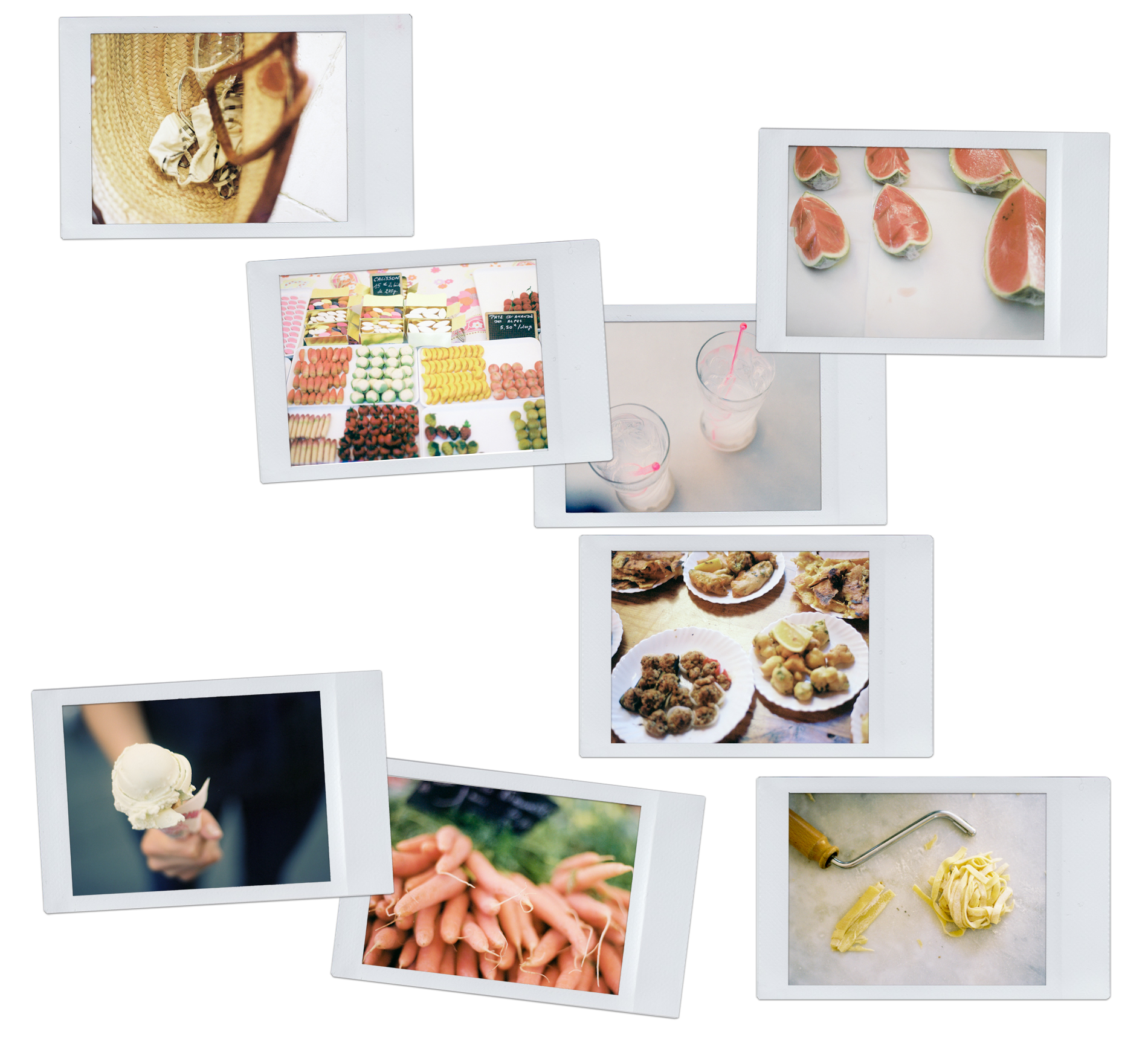
    And now, in the south of France, we’re having summer in September. Walks through the markets. Sirops d’orgeat at the terrace of the village café. Afternoons at the beach. Ice-cream, in a cone, please. Flip-flops at the feet. Deep-fried is a must, especially when it involves fleurs de courgettes. Watermelon; full-stop.

    It seems that whenever I come down here it’s summer. A summer of the out-of-season kind.

    It also seems that whenever I’m down here, I always return to the same cake. A cake of the homecoming kind.

    It certainly is my go-to. Because, let’s be honest, we all need one.

    One we make on Mondays. One we slice when still warm and slightly runny for a late afternoon indulgence. One we have for breakfast – the day after – cold from the fridge and dipped into the latte we overlooked as we were flipping through the pages of the newspaper. One we finish on Wednesdays after a dinner made of crusty baguette with a side of sliced tomatoes in their juices; perhaps with a scoop of yoghurt ice-cream.

    This cake is dark and dense. The very definition of a fondant.

    And since we’re at it, I shall let you know that what we – French – call fondant is somehow different to the fondants I’ve been known to bake à la minute for the restaurant.
    In fact, if you’re thinking about small little cakes with a melted chocolate centre, we call them coulants in good old France.

    So please, mind your French, will you 😉

    Fondant au chocolat

    Fondant au chocolat
    Adapted from Pascal Lac.

    I’ve told you about this cake before. It is, as I’ve mentioned above, a keeper. If you’re after a moist chocolate cake, then this is the one.

    Plus, it’s damn easy to make. Just chocolate, butter, eggs, sugar, and flour.
    Oh yes, ok, eight eggs and four hundred grams of sugar. Just forget about this and bake it in a 28cm pan for thinner wedges.

    It is worth it!

    When it comes to the chocolate, I like to use a slightly bitter, most possibly 70%. And I have to admit Valrhona Guanaja is especially great for cakes of all kinds.

    The only tricky – and when I say tricky, I mean very merely – step is to bring the eggs and sugar mixture to room temperature-ish over the heat.
    You can either do it straight over the gas, making sure to mix at all time while turning the bowl to ensure heat distribution. Or do it over a water-bath (which should not stop you from mixing and turning the bowl!).

    This step is done, as we say in French, to casser le froid [break the coldness]. And it will incorporate a little air in the eggs.

    Fondant au chocolat

    Makes one 24 to 28cm cake.

    200g dark chocolate
    240g butter
    8 eggs

    400g sugar
    130g flour

    Preheat the oven to 170°C, and generously butter a 24 to 28 cm springform pan.

    In a bowl, melt the chocolate and butter.

    In a heatproof bowl, mix the eggs and sugar – using a whisk – and place over medium heat (or as said above, on a water bath). Keep on mixing until not cold anymore. It shouldn’t be hot either.
    Pour the chocolate over the egg mixture, and mix to homogenise. Sprinkle the flour over and using a rubber spatula, gently incorporate it until just smooth.

    Pour the batter into the prepared tin and bake for 30 to 40 minutes (if you’re using a smaller tin) until just set.

  • My second week as a stagiaire at Pierre Hermé, into the macaron universe

    My second week as a stagiaire at Pierre Hermé, into the macaron universe

    How does one prepare to work in the macaron team? That was exactly what I asked myself on the RER ride home after my first day with the afternoon team – the macaron makers.

    I was exhausted, but also in awe. How could the team be so fast, precise, and professional, while still managing to be funny and kind?

    I arrived at the Vaugirard shop well in advance, around 1:30pm, wanting to make a good first impression. The routine was now familiar: uniform on, aprons tied, hands washed, greetings exchanged. And then, I stepped into the macaron universe.

    The rhythm of macaron-making

    First, the ganaches. I started with jasmine, a delicate and fragrant batch, but by the time I had finished, the others had already made two, sometimes three.

    Then, sorting the coques – the delicate macaron shells. Any broken ones were set aside, baking papers flipped onto racks, and the coques lined up: 12 across, 8 down. It might sound simple, but after a few hours, I felt like a macaron-sorting machine. My tired brain blurred the sizes together, and I realised how quickly repetitive tasks can play tricks on perception.

    Next came filling and closing. One or two chefs piped the luscious ganache onto the waiting coques, and I followed, closing them as quickly as possible. The ganache sets fast, and if not closed in time, it doesn’t form the perfect little belly. This was my favourite part – until we got to the Ispahan macarons.

    Not only did these need to be closed, but before that, each one had to be topped with a tiny square of homemade raspberry gellant. The sticky fruit jelly, made with agar agar instead of gelatine, added an extra step that required precision and patience. The result, though, was worth it. Biting into a perfectly round, glossy macaron, only to discover a hidden raspberry surprise, was nothing short of magic.

    Pierre Hermé’s signature touch

    This hidden centre is what sets Pierre Hermé’s macarons apart. Each one holds a little unexpected treasure:

    – Olive oil and vanilla – two tiny pieces of green olive.
    – Ispahan – a raspberry gellant square.
    – Mosaic – two griotte halves (this one is my favourite).
    – White truffle and hazelnut – three crushed hazelnuts.

    It’s a brilliant idea, elevating each macaron beyond just a shell and a filling, making every bite a layered experience. And then there’s the ganache itselfgenerous, rich, the true focus of the macaron.

    Closing time (or so I thought)

    By the time we finished the last of the 6000 to 8000 macarons, it was already 11pm, and I assumed it was time to go home. I was wrong. Totally wrong.

    Cleaning time.

    Surprisingly, I didn’t mind. Cleaning the fridge felt almost refreshing after hours of standing in the heat. I hadn’t realised just how warm the room had become until I stepped inside. Who said macaron-making isn’t a sport?

    The days after

    Despite the tiredness, the heat, the repetitive motions, something shifted after that first day.

    I got faster, more precise. I learned the rhythm of the team, the flow of the work. I made ganache after ganache, filled and closed hundreds of macarons, and worked alongside some of the kindest people I’ve ever met.

    By the time my week with the macaron team ended, I almost didn’t want to leave (almost). The whole experience felt like a blur – a week that somehow lasted a minute.

    The reward

    Of course, I had to celebrate all the hard work. And what better way than with a selection of macarons from the current collection?

    The tasting

    01. Arabesque
    Macaron sprinkled with pistachio, filled with apricot ganache and pistachio praline. The ganache, thickened with dried apricots, contains no cream. The pistachio praline? Absolutely out of this world.

    02. Café fort [strong coffee]
    A clean, well-balanced coffee ganache, wrapped in beautiful shades of brown.

    03. Thé au jasmin [jasmine tea]
    A floral, fragrant ganache with a distinct jasmine taste.

    04. Caramel au beurre salé [salted caramel]
    A rich caramel buttercream filling. Decadent. Impossible to resist.

    05. Chocolat amer [bitter chocolate]
    Dark chocolate macaron with a 70% dark chocolate ganache. The first macaron we make each day, as the high cocoa butter content means the ganache sets quickly. Rich, deep, slightly bitter – a classic.

    06. Mogador
    Milk chocolate and passion fruit ganache. At first, I wasn’t sure. Now, it’s one of my favourites. The sharp tang of passion fruit against the smoothness of milk chocolate is irresistible.

    07. Ispahan
    Rose and lychee ganache with raspberry gellant. I’m not the biggest fan of rose and lychee together, but the sharpness of the raspberry gellant makes this macaron sing.

    08. Mosaic
    Pistachio and cinnamon ganache with two griotte halves. Looks beautiful, tastes even better. The cinnamon warms the pistachio, while the griottes add a sharp contrast.

    09. Olive oil et vanille
    An olive oil and vanilla ganache, with two tiny green olives hidden inside. If you think olive oil in dessert is strange, this will change your mind. The slight bitterness of the oil against the sweetness of the vanilla is unexpectedly perfect.

    10. Rose
    Macaron with rose crème au beurre.
    Tasting notes: Yummy in pink. This macaron is really fragrant and delicate.

    Next week: back to the morning team.

    (First written in July 2007, edited February 2025.)