Tag: breakfast and brunch

  • New Orleans beignets of my dreams

    New Orleans beignets of my dreams

    I might have never been to New Orleans, but every time I make these beignets, I almost inevitably feel like I’m right in the heart of the French Quarter – where the air hums with music, and the scent of chicory coffee drifts from the iron-lace balconies.

    New Orleans beignets

    Beignets – French for doughnuts – are made much like brioche. Flour, milk, eggs, sugar, yeast, and salt. A smooth dough, easy to work with.
    I like to place my shaped ones, ready for their final proof, onto parchment-lined trays, lightly sprayed with oil. And just before frying, I cut the paper into squares, each holding a beignet or two, and lower them into the hot oil, paper and all.
    They puff and turn golden in moments, crisp at the edges, impossibly light within. Straight from the fryer, they’re tossed in icing sugar, which melts into a delicate, fudgy glaze. Best eaten warm, while the sugar still clings to your fingertips.
    Bon Mardi Gras!!

    Notes

    On timing
    These beignets are best eaten the same day – preferably hot, fresh from the oil, when they’re at their lightest and crispest. If you need to plan ahead, you have two options: you can proof the dough overnight in the fridge, then shape, do the final rise, and fry the next day, which deepens the flavour and fits neatly into a morning schedule. Or, for a longer make-ahead option, freeze the shaped dough on a silicone mat until firm, then transfer to freezer bags, pressing out as much air as possible. When ready to fry, place the frozen beignets onto lightly greased baking trays, cover with clingfilm, and proof until doubled – around 4 hours (to account for the thawing time as well) – before frying as usual.
    On coating
    The traditional way to coat beignets is to toss them into a brown paper bag filled with icing sugar and give it a good shake – quick, effortless, and wonderfully nostalgic. A large bowl works just as well, allowing for a more controlled dusting, but either way, the goal is the same: a generous flurry of sugar while they’re still warm.
    Author: Fanny Zanotti
    Prep Time1 hour
    Cook Time30 minutes
    Total Time3 hours
    Makes 24 beignets

    Ingredients

    • 250 g whole milk
    • 2 eggs
    • 510 g plain flour
    • 55 g caster sugar
    • 20 g fresh yeast or 7g instant yeast
    • 3 g fine sea salt
    • 90 g salted butter thinly sliced
    • neutral oil for frying
    • 400 g icing sugar to coat

    Instructions

    • In the bowl of a stand mixer fitted with a dough hook, add the milk, eggs, flour, sugar, yeast, salt, and butter. Knead on medium speed until smooth and elastic. The dough should pass the windowpane test.
    • Lightly spray a baking dish with cooking spray – my favourite is a 23×30cm Pyrex glass dish. Transfer the dough to the dish, turning it to coat the surface. Flatten it to fill the dish evenly, and cover with clingfilm.
    • Leave to rise in a warm place until nearly doubled in size, approximately 1 hour.
    • In the meantime, prepare 2 baking trays lined with parchment paper; spray lightly with cooking spray.
    • Lightly flour your work surface. Pat the dough into a slightly larger rectangle – around 2cm thick – and dust with a little flour.
    • Using a long knife, cut the dough into 24 pieces. Place them onto the prepared trays, loosely cover with clingfilm or clean kitchen towels, and leave to rise again for around 30 minutes.
    • While the beignets are rising, heat a generous amount of neutral oil in a deep-fryer or a heavy-bottomed pot to 180°C.
    • Put the icing sugar into a brown paper bag or a large bowl.
    • Fry 4–6 beignets at a time, turning with a metal spider or tongs, until deep golden brown, around 1-1½ minutes per side.
    • Transfer the hot beignets straight into the bag of icing sugar, close tightly, and shake well to coat. Place on a cooling rack over a tray. Repeat with the remaining beignets, adding more icing sugar as needed.
  • Three-day strawberry jam, à la Christine Ferber

    Three-day strawberry jam, à la Christine Ferber

    I first made this recipe a few weeks before my mom came to visit from the south of France last autumn. She loves her morning toast – always a baguette, always unsalted butter, thickly spread. I can’t quite agree – I want salted butter, the kind that pushes back against the sweetness of the jam.

    Most times, I make my usual recipe, the one I’ve relied on since 2009, back when I first worked with Andrew Gravett. But this time, I felt like trying something different. Christine Ferber’s method – slow and deliberate. Pierre Hermé has always sworn by her jams, and he’s never wrong.


    PRINT

    Three-day strawberry jam

    Adapted from Christine Ferber's Mes confitures: jams and jellies.
    There’s a quiet kind of magic in slow preserves – the way sugar and time work together to turn fruit into something more than itself. This one starts with strawberries, small and fragrant, macerated overnight until they glisten. The process takes three days, like most Christine Ferber's jams and preserves – an institution in itself.

    Notes

    A note on using frozen strawberries:
    I always – always – freeze strawberries in the summer. I wash and hull them first, then freeze them on a tray before packing them into freezer bags. They work exceptionally well in smoothies, compotes, and of course, jams.
    I use them straight from the freezer – no need to defrost – keeping them whole. The sugar and lemon juice draw out their juices as they macerate, turning them into something almost candied. The result is a jam that’s less spreadable, with whole strawberries suspended in a thick, glossy syrup.
    Author: Fanny Zanotti
    Prep Time10 minutes
    Cook Time45 minutes
    Total Time3 days 55 minutes

    Ingredients

    • 1 kg hulled and quartered strawberries
    • 850 g caster sugar
    • Juice of one small lemon

    Instructions

    Day 1

    • Place the strawberries into a large non-reactive bowl. Add the caster sugar and lemon juice, stir, and cover with clingfilm. Leave to macerate overnight in the fridge.

    Day 2

    • By morning, the strawberries will have given up their juices. Tip everything into a pot and bring it to a gentle simmer. Pour it all back into the bowl, cover, and return to the fridge for another night.

    Day 3

    • Strain the strawberries, letting the syrup run through a fine sieve. Bring the syrup to a boil, skimming off any foam, and let it cook until it reaches 105°C.
    • Add the strawberries back in and bring everything to a rolling boil.
    • Skim again, stir gently, and let it cook for 5 more minutes. The syrup should be thick enough to coat a spoon, and the strawberries should shine – translucent and almost candied.
    • Spoon into warm jars, seal, and let cool. Then, find a reason to open one – some good bread, a spoonful over yogurt, or just because.

  • Buttermilk biscuits

    Buttermilk biscuits

    Buttermilk biscuits

    Adapted from Sally’s Baking Recipes.
    This recipe is a staple in our home for late week-end breakfasts and quick school-night dinners. I love to serve them with bacon and fried eggs, and loads of freshly-sliced vegetables.
    They also make for a perfect afternoon fika, with whipped cream, jam, and fresh berries.
    As with every biscuit recipe, it is fundamental not to overmix the dough. I usually mix in the butter until rather large chunks are left, then add the buttermilk and mix until JUST combined.
    This produces very soft and flaky biscuits, exactly as they should be.
    Author: Fanny Zanotti
    Prep Time30 minutes
    Cook Time20 minutes
    Total Time50 minutes

    Ingredients

    • 310 g plain flour
    • 2 tbsp baking powder
    • 1 tbsp caster sugar
    • 1 tsp flaky sea salt
    • 120 g salted butter very cold and cubed
    • 240 ml cold buttermilk
    • whipping cream to brush

    Instructions

    • Preheat the oven to 220°C / fan 200°C. Line a baking tray with baking paper.
    • Make the dough. In a large bowl, whisk together the flour, baking powder, sugar, and salt. Add the cubed butter and rub it into the flour with your fingertips until the mixture resembles rolled oats.
    • Make a well in the centre, and pour in the buttermilk. Gently fold everything together with a spoon or spatula until it just starts to come together. The dough should look rough and slightly crumbly in places.
    • Tip the dough onto a floured surface and bring it together using your hands. Pat into a 2cm thick rectangle and do 3 consecutive letter folds, rotating the dough 90 degrees between each turn.
    • Cut the biscuits. Roll or pat the dough to 2cm thick, then cut into a 3x6cm biscuits. Gather any scraps, reshape, and cut out more until all the dough is used.
    • Bake. Arrange the biscuits close together on the prepared tray, so they support each other as they rise. Brush the tops with whipping cream, and bake for 15–18 minutes or until golden-brown.
  • Chez Ma Tante’s pancakes

    Chez Ma Tante’s pancakes

    I’ve always been fascinated by fluffy American-style pancakes, perhaps because I didn’t grow up on them. In my childhood, pancakes, crêpes, really, were thin and delicate, the kind you’d fold into four with sugar and lemon or jam from my grand-mère’s wooden cabinet in the garage. The golden, towering stacks always felt like something from a storybook – indulgent, almost impossibly decadent.

    I already have two favourite recipes. One is a buttermilk classic by the great Marion Cunningham, who knew her way around the simplicity of breakfast like no one else. Her recipe reads like a letter from a friend, gently nudging you towards the joy of the everyday. The other is a five-minute wonder, a batter I can whisk together with my eyes closed on mornings when hunger wins over patience.

    And yet, when I stumbled upon Chez Ma Tante’s recipe one morning, I couldn’t resist. It felt like an invitation to try something new. The batter is looser than both of my regular recipes, and the results are ever so wonderful: a light and airy crumb with edges that cook to crisp, caramelised perfection.

    The original recipe calls for a full cup of clarified butter for cooking, but I couldn’t quite commit. A couple of tablespoons did the trick, yielding pancakes that were delicate yet indulgent. I had mine plain, marvelling at the texture and buttery caramelisation, but I can only imagine how they’d taste with a drizzle of maple syrup and a pat of butter melting into every crevice.

    Chez Ma Tante’s pancakes

    Adapted from the New York Times.
    This is a recipe that doesn’t ask much but rewards you with pancakes that feel a little extraordinary. Perhaps it won’t replace my tried-and-true favourites, but it’s found its place – for mornings when I want pancakes that are both simple and a little special.
    The method is straightforward but with its own charm: sugar, salt, and a surprising 2 ½ tablespoons of baking powder whisked directly into an egg and yolk, before alternating in the milk and flour, finishing with melted butter.
    Serve them plain or with maple syrup and a pat of butter, and you’ll understand why this recipe deserves a spot in your morning repertoire.

    Notes

    On butter and cooking the pancakes:
    Chef Jake Leiber cooks his pancakes in a whole cup of clarified butter, but I prefer a simpler approach. I slice a generous piece of salted butter and stick it to the tines of a fork, using it to butter my cast-iron pan as I go. The butter browns gently, leaving the edges dark, crisp, and delightfully salty.
    On cast-iron:
    When it comes to pancakes, I always reach for my cast iron pan. Preheated over medium-high heat for 5-8 minutes to ensure an even surface, then lowered to medium-low for cooking, it produces pancakes with a light and airy crumb and caramelised edges that crackle under the fork.
    Author: Fanny Zanotti
    Prep Time15 minutes
    Cook Time20 minutes
    Makes 6 large pancakes

    Ingredients

    • 1 egg
    • 1 egg yolk
    • 2 ½ tablespoons 35 g baking powder
    • 2 tablespoons 25 g caster sugar
    • 1 teaspoon 5 g flaky sea salt
    • 300 ml whole milk
    • 130 g plain flour
    • 30 g salted butter melted
    • 60 g cold salted butter for cooking

    Instructions

    • Pre-heat your cast-iron pan on medium-high heat for at least 5 minutes, then reduce to medium-low.
    • In a large bowl, whisk together the egg, sugar, salt, and baking powder.
    • Gradually add the the milk and flour in alternating turns, whisking gently until a lumpy batter forms – do not overmix the batter. Finally, whisk in the 30g of melted butter.
    • Stick the cold butter to the tines of a fork and use it to butter you pan – it should start foaming and sizzling. Pour about 100 ml of batter for each pancake, letting it spread naturally.
    • Cook for about 1 1/2-2 minutes, or until golden brown with crisp edges, then flip and cook for another 1 minute or so on the other side.
    • Repeat with the remaining batter, adding more butter to the pan as needed. Serve warm with extra butter and maple syrup.

  • Kaiserschmarrn

    Kaiserschmarrn

    [Austrian scrambled pancakes]

    In the embrace of late January, breakfasts are the essence of comfort. Through our kitchen windows, we see acres of treetops covered in snow. A tableau that stretches as far as the eyes can see.

    And every weekend morning is the same, almost like a celebration of foreverness. There is the sound of the coffee brewer, a subdued gurgle, akin to a whisper of some sort. There is the crispiness of the icy air through our bedroom window. And the sun that sets before its risen above the hill across the river.

    Our breakfast typically revolve around two cherished options: sunny-side-up eggs on golden toast, sometimes served with kimchi-pickled cabbage, and stacks of fluffy hotcakes draped with maple syrup and bacon – pan-fried until almost too crisp. On Sundays, a full English is practically a necessity.

    Yet, of late, our plates have welcomed the rekindled presence of an old favourite: Kaiserschmarrn – Austrian scrambled pancakes, something I used to make the first year after Sienna was born and nearly forgot about, not unlike a nostalgic symphony on our morning table.

    Austrian scrambled pancakes

    Kaiserschmarrn [literally, Emperor's mess] is a quintessential Austrian dish that can be best described as a hybrid between a pancake and a fluffy omelette.
    My recipe, adapted from Deb Perelman, has become a true favourite for weekend breakfasts over the years.
    The preparation begins with a basic pancake batter made from eggs, flour, milk, and a touch of sugar. What sets Kaiserschmarrn apart is the technique – the batter is initially cooked as a large pancake before being torn into bite-sized pieces. These torn pieces are then further cooked until golden brown on the outside and delightfully soft and airy on the inside.
    I used to flip the pancake onto a plate, then shred separately, but lately, I've been doing it all in the pan using a wooden spatula, and it's much less messy, which is always a bonus.
    They are traditionally served with a dusting of icing sugar and compote, however I am partial to cottage cheese or fromage blanc, and berries.

    Notes

    On salted butter: After having lived in Sweden for the past nine years or so, I almost exclusively pan-fry and bake using salted butter. And really, I’m not ever going back, EVER. Although I must admit it makes writing recipes harder as the salt content in butter varies greatly across the globe. Here in Sweden it is usually 1.2%.
    There is something rather magical about pan-frying pancakes and crêpes in salted butter. You should try!
    Author: Fanny Zanotti
    Prep Time10 minutes
    Cook Time10 minutes
    Makes 2 as a main breakfast

    Ingredients

    For the batter

    • 4 eggs separated
    • 30 g caster sugar
    • 1/2 tsp flaky sea salt
    • 1 tsp baking powder
    • 100 g plain flour
    • 120 mL whole milk

    To pan-fry

    • 50 g salted butter

    To serve

    • berries
    • icing sugar
    • fromage blanc or cottage cheese

    Instructions

    • Whisk the egg whites with a pinch of salt until they hold firm peaks.
    • In a large bowl, whisk together the egg yolks, caster sugar, and salt. Add in the milk. Then the flour and baking powder, whisking just until just smooth.
    • Gently fold the whipped egg whites into the egg yolk mixture.
    • Heat a large frying pan over medium heat. Add the butter and pour batter into pan, spreading it into a large pancake.
    • Cook for approxiamtely 3 minutes, checking underneath occasionally to make sure it doesn’t burn, until it’s a golden brown; reduce the heat if the pancake is browning too quickly.
    • Using a wooden spatula, divide the pancake into 4 and flip each fourth over. Continue cooking until golden underneath on the second side, around 3 minutes.
    • Now, add more butter to the pan, and tear the pancake into smaller pieces. the inside of the pancake will still be runny at this point. Cook, adding more butter if needed, until just cooked through.
    • Serve with a dusting of icing sugar and berries. I'm partial to cottage cheese, but also love a dollop of fromage blanc.

  • Best buttermilk pancakes

    Best buttermilk pancakes

    There is the snow that fell all day long, winds shaking the pines behind our living room windows. There are the tea lights on every shelf. There is the glazed Christmas ham we have been slicing from the fridge before lunch and after dinner. And as with every Christmas day morning breakfast, there was buttermilk pancakes with maple syrup and raisins plump with rum for those who have this kind of fondness.

    This buttermilk pancake recipe is one I’ve started making last year and is very much not a Christmas exclusive. Adapted from Marion Cunningham’s The Breakfast Book, it does make the best pancakes we’ve ever had. And really, I don’t know why I still haven’t written about these. Or bought the book. So here I am, crossing things off my to-do list, on Christmas evening. First the recipe, along with a quickly-taken over-the-stove picture that does not do these justice. And then a late present to myself, because those who love all things rum-and-raisins also happen to love anything by Marion Cunningham.

    I hope you had a lovely Christmas! Here is to snow and all-day breakfast. Surely nothing goes better with that than a day spent in pyjamas.

    Best buttermilk pancakes

    Adapted from Marion Cunningham.
    There it is. The last pancake recipe you’ll ever need. And really, I’m not one to make such statements lightly. But after a year of weekend breakfasts, I’ve concluded that this recipe is indeed our favourite. It makes pancakes of the thick fluffy kind.
    We love to eat them plain or with eggs and bacon. Or even with a tablespoon of boozy raisins, which I like to keep in my fridge. Raisins are soaked in a light sugar syrup and a dash of dark rum.
    Sometimes I will add wild blueberries to the batter or even a handfull of corn kernels and a generous scoop of grated cheese.
    For an extra Christmas feel, I’ve sometimes had a teaspoon of my saffron syrup in the batter and then coated the still warm pancakes in granulated sugar for make-believe krabbelurer, something that I must tell you about some day in the near future.

    Notes

    ON BUTTERMILK
    If like us you can’t find buttermilk at the supermarket, I recommend to use the following:
    – in France, kéfir or lait ribot
    – in Sweden, filmjölk sometimes diluted with a touch of milk if I’m not feeling lazy
    Author: Fanny Zanotti
    Prep Time10 minutes
    Cook Time20 minutes
    Makes 12 pancakes

    Ingredients

    • 200 g buttermilk (read note above)
    • 1 egg
    • 50 g butter melted
    • 90 g plain flour
    • 1 tsp baking soda
    • 1/2 tsp salt

    Instructions

    • Place the buttermilk, egg and melted butter in a bowl and whisk until smooth. Mix the flour, salt, and baking soda together in a separate bowl, then stir into the buttermilk mixture until just mixed.
    • Heat a frying pan over medium to high heat. Grease lightly with butter and spoon the batter into small pancakes. Cook until bubbles start to appear, flip and cook for a further minute or so.
    • Serve immediately with the topping of your choice.
  • Fullkornsskorpor

    Fullkornsskorpor

    [Wholewheat rusks, a Swedish twice-baked bread]

    Skorpor are a traditional twice-baked bread from Sweden. And although I haven’t had time to do much research, I can only imagine that, like many other rusks, they originated from the need to either use old loaves or to conserve bread over an extended period of time.

    Often made with white flour and cardamom, you can now find many different kinds of skorpor on the shelves at the supermarket. I’ve even seen people make them out of leftover kanelbullar; which is something I might try but we rarely have uneaten bullar and when we do, they almost always end up as a French toast.

    Here in Sweden, skorpor are eaten as a mellanmål [afternoon tea], with butter and cheese, perhaps a spoonful of orange marmalade. Sometimes even dipped in warm rosehip soup.

    I must admit I’m partial to butter and marmalade. And the slight nuttiness of wholewheat flour. Perhaps it was the breakfasts made of Krisprolls and thé au lait [milk tea] that I fondly remember from my childhood.
    And yet, it took me almost thirty years to make skorpor in my kitchen. I think I started a couple of years ago. It was the end of blood orange season.
    That day, I took out the old Swedish baking books I had collected and went through every skorpa recipe I could find. I made blood orange marmalade too.

    I wrote weights down and calculated bakers’ percentages. I compared, and tasted, and made notes. And from them came the recipe that now sits in my notebook, the one I’m sharing with you today.
    I didn’t really consider doing so. But then, the other morning, a week or so ago, as I kneaded butter into the dough of my monthly batch, I thought that perhaps you’d like to make your own too.

    Notes

    – If graham flour isn’t available where you live, you can use 300 g wholewheat flour and 60 g wheatgerm.

    – All the recipes I’ve found use around 60 g of fresh yeast for each kilogram of flour; and while it may seem like a lot, it does reduce proofing times tremendously.
    You could get away with using half the yeast and allowing a longer proof. I have however decided to stay true to the recipes I’ve used to develop this formula and the amount of yeast did not cause any noticeable shortcomings.

    – I think it is fundamental to use a fork to make deep indents in each bread around its entire perimeter before breaking it in half; and I wouldn’t recommend slicing with a knife, no matter how much faster it would be.
    It is precisely the rugged surface created by the fork that makes for an interesting texture and flavour, due to the uneven browning.

    Fullkornsskorpor

    Makes around 80 pieces.

    485 g milk
    420 g plain flour
    360 g graham flour
    40 g fresh yeast
    14 g salt
    100 g butter, thinly sliced

    Place all the ingredients aside from the butter in the bowl of a stand-mixer fitted with the dough hook.

    Mix on medium speed for 10 minutes, or until medium gluten development. Add the butter, one slice at a time and knead for a further 10 minutes or so until the dough is smooth and elastic.

    Cover with clingfilm, and leave to proof at room temperature until doubled in size, around 30 minutes.

    Line 2 baking trays with baking paper.

    Place the dough onto a lightly floured work bench. Press to get rid of the gases, and divide in 40 pieces, at approximately 35g each.
    Ball each piece and place onto the prepared baking trays. Flatten each ball to 5-6cm in diameter using the palm of your hand.

    Cover with clingfilm and proof until doubled in size, around 45-60 minutes.
    While the bread if proofing, preheat the oven to 250°C/fan 230°C.

    When ready to bake, reduce the oven temperature to 225°C/fan 200°C. And bake, one tray at a time for 14 minutes, rotating halfway through baking if needed.

    Allow to cool down slightly, and using a fork, make deep indents in each bread around its entire perimeter; then break in half.

    Arrange the halves on the baking trays, and return to the oven for 8 minutes, then reduce the temperature to 120°C/fan 100°C and bake for a further hour, or until fully dried.

    The skorpor will keep beautifully in an airtight jar for well over a month.


  • My ultimate kanelbullar

    My ultimate kanelbullar

    Tomorrow is the 4th of October. A date that doesn’t go unnoticed in Sweden. Yes, tomorrow is kanelbullens dag [cinnamon roll day].
    I must have felt that this post – which I promised to share with you long before I even knew kanelbullar had their own day – was waiting in my drafts for a reason.

    This is a recipe I first made in Åsen, the summer before last. I kneaded the dough in the evening, as we came back from a day by the lake. And by the time breakfast was ready the next morning, the buns had proofed and were ready to go in the oven for a mid-morning fika.

    Later that day, I realised we’d forgotten my camera charger in Kusmark so I ended up taking some pictures using the film camera Kalle gave me.

    We rushed on the road to Mora – through the forests and the bridge that goes over the lake, through the little stress I’ve come to cherish and the rails by which we always get to see a train pass by – to bring the roll to the only lab we knew of.

    And because it was not fully exposed, I quickly took a few pictures of what was around me. In fact, the one below – of Kalle – is, to this day, one of my favourites.
    Yes, it’s not without a certain sense of both love and reserve that I’m proud to tell you that my 79th roll of film has pictures of bullar, one of K., one of the sky, and one of flowers. The dream roll?

    But let go back to that morning. When I rolled the dough and topped it with a thick layer of cinnamon butter. I don’t always say this, but salted butter really does wonder here.
    Yes, that morning, is to be forever remembered. The table covered in a thick layer of white paint. And the blue chairs around it. The spitting sound of the fire in the wood stove. This is where I learnt how to roll kanelbullar.

    A year has passed since then – days made of snow and walk through leafless trees, a spring that only lasted a second and a summer that is now starting to turn into autumn. Many more bullar have been rolled. At home. At the café.

    And while my rolling techniques have definitely improved, the recipe has received only a few tweaks. That’s how much I’m in love with it. And I hope you will be too.

    Kanelbullar, un peu comme des brioches

    I love my bullar to be soft and fluffy, so instead of using a traditional recipe (which I always find slightly dry), I go for a cross between a doughnut and a brioche dough.

    Although I’ve shared a recipe for kanelbullar in the past, these ones are different. They are my favourites. The ones I make at home and freeze into small plastic containers, ready to be thrown into a lunchbox or popped in the microwave for an almost-instant fika. The ones I make everyday at the café too (when I’m not off – and for the first time in a long time, I shall say: YES to the weekends).

    The old ones were of the spur-of-the-moment kind. Made late, during our last night in Sweden the first time we visited. Eaten by Byske river, just a few hours before our flight back to London. They had whole wheat flour and I remember how long it took to develop the gluten by hand.
    I also remember how wonderful it was to unwrap the not-so-neatly folded foil and dip them into a forever-hot cup of kokkaffe.

    Making a sticky dough by hand is always a challenge; it takes time, a good scraper and hands being cleaned every so often. But trust me, I’ve done it many times and it doesn’t only produce beautiful results, it’s also wonderfully relaxing.

    EDIT 5 October

    After a few of you reported butter leakage, I’ve noticed I had missed a modification, which I made a few months ago: I now use a reduced amount of butter in the dough – 130g instead of 200g; a leaner dough absorbs the butter better, but I couldn’t remember why I had reduced it as I love the texture of the buns made with 200g of butter so much!
    Thank you for your feedback! Also, make sure the bullar are proofed until doubled in size before baking them. It takes around 2 hours at 24°C but can take 3-4 hours if the room temperature is colder. Lots of love and sorry for the caramelised cinnamon butter 🙁

    EDIT 6 October

    I’ve tried both batches today, with 130g and 200g butter. While I love the texture of the buns with 200g of butter, they do leak during baking; a quick fix, if you’re after melt-in-your-mouth bullar, is to bake them in muffin paper-cases so you won’t end up with a puddle.
    As for the batch with 130g of butter, they’re a bit lighter and almost no butter leak 🙂 Sending you all my cinnamon-love X

    EDIT 8 December 2016

    After having made this recipe daily for well over a year, I think an update is in order.
    I have modified it slightly, mostly because I make it using 3.2 kg of flour, and that the flour here has a slightly higher absorption power.

    Here is my updated recipe:

    Kanelbullar 2.0

    Kanelbullar, un peu comme des brioches
    Every year, on the 4th of October, Sweden celebrates Kanelbullens dag: Cinnamon Bun Day. It feels like the perfect excuse to revisit one of my favourite recipes. These buns have been with me for over a decade now. The first version I baked in the summer of 2014 was a little more rustic.
    Since then, I’ve spent countless hours calculating baker’s percentages, testing variations and tweaking until I found what felt just right.
    What follows is my current go-to recipe (let’s call it version 2.0), followed by the 1.0 recipe for those who want to see where it all began.
    Author: Fanny Zanotti
    Prep Time1 hour 30 minutes
    Cook Time15 minutes
    Total Time1 day 1 hour 45 minutes
    Makes 14 buns

    Ingredients

    For the dough

    • 600 g flour
    • 75 g caster sugar
    • 18 g fresh yeast
    • 7.5 g sea salt
    • 4 g hand-ground cardamom
    • 225 g whole milk
    • 150 g eggs
    • 190 g unsalted butter

    For the filling

    • 190 g salted butter at room temperature
    • 150 g caster sugar
    • 3 tbsp ground cinnamon

    To top

    • 2 eggs beaten
    • pearl sugar

    For the syrup

    • 75 g caster sugar
    • 75 g water

    Instructions

    • In a large bowl, combine flour, sugar, yeast, salt, and cardamom. Add the eggs and milk. Mix until a dough forms.
    • Knead by hand for around 20 minutes, or in a stand mixer fitted with a dough-hook for about 10 minutes, until smooth, elastic, and just tacky. The dough should stretch into a thin membrane without tearing.
    • Add the butter gradually. By hand, work it in 3–4 additions, smearing and kneading until fully incorporated. In a mixer, add small pieces one by one. The dough will look split at first – keep going until smooth again.
    • Place in a large bowl, cover, and chill. Either proof 1 hour at room temperature, then refrigerate for 2 hours, or refrigerate straight away for at least 8 hours (and up to 24 hours).
    • The next day, line two trays with baking paper. Mix the filling ingredients until smooth.
    • On a lightly floured bench, roll the dough to a 30 × 60 cm rectangle, about 5–6 mm thick. Spread with cinnamon butter. Fold the dough into thirds (like a letter), giving you a rectangle about 30 × 20 cm.
    • Cut into 2 cm strips. Twist and tie each into a knot. Place on trays. Cover loosely and proof until doubled – around 2 hours.
    • Preheat oven to 200°C / fan 180°C. Brush the buns with egg wash, sprinkle with pearl sugar, and bake 12–16 minutes, until golden.
    • For extra shine, brush with hot syrup as soon as they come out of the oven. Cool slightly on a wire rack.

    Glad kanelbullens dag!

    The 1.0 recipe from my 2014 summer:
    For the dough
    530 g strong flour
    70 g caster sugar
    16 g fresh yeast
    10 g sea salt
    1 tsp ground cinnamon
    3 eggs
    (150 g)
    190 g whole milk
    130 g to 200 g (read note/edit above) unsalted butter
    , at room temperature

    For the cinnamon butter
    250 g salted butter, at room temperature
    170 g caster sugar
    3 tbsp ground cinnamon
    1 tsp ground cardamom

    For the topping
    1 egg, beaten, to glaze
    a handful of pearl sugar

    For the syrup
    75 g caster sugar
    75 g water

  • Small-batch rhubarb jam

    Small-batch rhubarb jam

    I made this jam a week ago today. Of course, I had planned on telling you about it straight away, but exciting projects, a redesign, and kick-ass grades in my Swedish classes (insert thumb-up emoji here) got in the way.

    With Lisa’s comment in mind, I stirred the fruits into the hot syrup. She wanted a simple jar recipe. And here it is. No endless canning, since we’re only making three 250mL jars. No fruits soaking in sugar for 24 hours. No fancy teas or flowers added.

    Simply sugar and water boiled down to a syrup. A generous handful of chopped fruits. A pinch of pectin (optional, although I do love the thicker texture it produces). And a drop of citric acid (or lemon juice).

    Yes, of the many things I look for in a jam, a sharp fruit flavour is possibly my favourite. And yes, I’m not going to pretend otherwise, I do like my confiture [jam] on the sweet side; you know, the French way.

    Many times, I see people wrongfully call jams what are, in fact, fruits and sugar – most likely anywhere between 10% and 20% by weight. These are a whole other subject, and something that should be classified as compotes, not jams, s’il-vous-plaît!

    Terminology aside, this recipe here is perfect for anyone with a backyardful of rhubarb stems. Here in Sweden, rhubarb just started getting out of control, the same way it usually does in France, only a few months later.

    You could make three jars, like I did here with some of the rhubarb that I picked from Svante’s beautiful garden in Kusmark, or multiply the recipe according to how much fruit you have around.

    For the record, if making big batches, I tend to go for 4-5kg of fruits at a time as I’ve found that if using more, the jam, which will take longer to cook, won’t have such a vibrant colour and flavours due to some of the sugar caramelising.

    Small-batch rhubarb jam
    This recipe is adapted from my basic jam recipe, which was itself adapted from Andrew Gravett’s beautiful raspberry confiture. Merci Chef!

    The sugar – which should be of the thicker granulated kind, as it contains less impurities, and thus creates less foam to skim – and fresh rhubarb juice get cooked to 120°C before the fruits are added.
    This step which I see as fundamental has one major impact on the jam cooking time. Which makes it not only convenient, but also reduces the time during which the fruits are cooked, maintaining a fresh flavour.

    A note on the citric acid: I like to use citric acid powder and not lemon juice, as I’ve found that it keep the fruits’ flavour more intact. No matter which one you go for, always add it at the end of the cooking process – off the heat.

    A note on the pectin: I use a HM (which stands for High Methyl) pectin which has the property to set rather quickly and enables a clean flavour release.
    Differences between the many types of pectin (which I could tell you about, let me know in the comments if you’re interested) can affect the finished product, however, I’ve found that this recipe could bear various pectins; from LM to HM to pure fruit pectin powder.
    It will set slightly looser or firmer – nothing drastic – but if you’re about to make a 5kg batch, then I can only recommend to try with a smaller quantity of fruits to adjust the pectin levels as needed.

    You could also go without pectin, and I did a very small pectin-less batch just a few days ago, to try; and although the texture is definitely less thick, I was pretty happy with the jam generously spread on toast for breakfast the next day.

    Small-batch rhubarb jam

    1/2 tsp (2.5 g) citric acid powder
    1/2 tsp (2.5 g) water
    550 g trimmed and washed rhubarb, chopped into 5mm slices
    500 g granulated sugar
    120 g freshly-made rhubarb juice (or water)
    30 g caster sugar
    1/2 tsp (3 g) pectin powder
    , optional (see note above)

    Sterilise 3 x 0.25L glass jars and their lid.

    In a small bowl, mix the citric acid and water, and set aside until needed.

    Place the sugar and water in a pan larger than you think you’d need. Cook over medium heat to 120°C. Add the rhubarb slices and cook to 105°C, mixing every two or three minutes – I like to use a whisk for this. For this quantity it should take around 15-20 minutes; every now and then, skim off the foam that forms using a small ladle.
    While the jam is cooking, combine – very very well – the caster sugar and pectin in a small bowl (make sure it is very dry).

    Once the jam has reached 105°C, sprinkle the pectin mix (if using, otherwise, jump to the next set of instructions) off the heat, whisking as you do so. Return over medium heat and simmer for 3-5 minutes.

    Off the heat, add the citric acid mixture and whisk well. Immediately transfer to sterilised glass jars, to around 1-2cm up to the rim. Screw the lids on and turn the jars upside down. Allow to cool down completely and store.

  • Brioches feuilletées au sucre

    Brioches feuilletées au sucre

    [Flaky sugar brioches]

    Today, it hailed three times. Rained once. And snowed twice. With the sun being at its brightest in between. Yes, I think April showers take a whole new meaning here.

    Some other things do too.
    In fact, I started this post in my head – perhaps yesterday, or even the day before – by telling you how busy this week has been. But as I’m writing this now – dressed with wool from head to toes, and sitting at the little wooden table that stands by the stacked firewood; hot chocolate in one hand, computer in the other, pink sunset and all – I’m forced to re-evaluate my Swedish version of busy.

    Especially when, just a few months ago, busy meant an eighteen-hour day on a three-hour night. A few hundreds of covers and the mise-en-place to match.

    These days, busy has been more like taking walks and pictures. An occasional visit to the city we’ll call home from this Monday. Perhaps, a batch of croissants; twelve of them. Or some choux, with a vanilla cream just so. A few hours spent unpacking the boxes we brought from London. And packing the essentials again. A loaf of bread; a large one mind you, but still: one. Uploading all my recipes (well, as of now, I’m about one percent into the process) to – what I think is going to be – the best/easiest/cleanest recipe database ever.

    Brioches feuilletées au sucre

    Adapted from Philippe Contincini's Sensations.
    One day last week, after yet another croissant batch, I thought I give myself a break and make Philippe Conticini's brioches feuilletées. They'd been on my must-make list for ages, and I think they'll stay on my weekend-breakfast list for ever.
    Not only the dough – slightly drier than my go-to brioche – is a wonder to work with while laminating, but the brioches still taste amazing the day after; which makes them perfect for lazy Sundays.
    You could make the dough on Friday night, laminate and shape on Saturday. And either bake them in the afternoon or proof them overnight in your fridge (although the pearl sugar might melt from the humidity). The next morning, leave them well covered at room temperature for an hour or so, while you preheat your oven.
    While I won't cover lamination today, as you can see a step-by-step over here; there is a few important points for these brioches.

    Notes

    On adding the butter from the beginning
    Since the quantity of butter in the dough is so small, I add it along with the rest of the ingredients at the beginning of the mixing stage. It’s not something I’d ever do for my usual brioche as it has 10 times more butter which would slow down gluten development, even making it impossible to form in some parts of the dough, which would result in a patchy non-emulsified mess.
    On my process for brioche dough
    As with every brioche dough I make at home, I like to place my dough in a container and clingfilm it to the touch with several layers of clingfilm; and chilling it in the freezer for 30-45 minutes, before I leave it in the fridge overnight. This cools down the dough quickly – a necessity to avoid over-fermentation, which might happen since the dough gets fairly warm with the kneading friction (especially if like me, you’re kneading by hand).
    On pearl sugar
    The best pearl sugar for this recipe is Beghin Say Sucre Grain, which I always stock up whenever I’m in France! You can order some online here. 
    Make sure that once you’ve sprinkled the dough with pearl sugar, you run your rolling pin over it to make the sugar stick to the dough; and don’t forget to brush the edge of the dough with syrup; this makes sure your rolls stay tight as they bake.
    On using a muffin tin
    In fact, I think those would be amazing proofed and baked in a muffin tin – although I haven’t tried since I don’t have one here. I did try to bake the brioches in rings though, but I didn’t get the lovely domed shape as my rings were too small and compressed the dough slightly.
    Author: Fanny Zanotti
    Prep Time1 hour
    Cook Time30 minutes
    Total Time13 hours 30 minutes

    Ingredients

    • 510 g strong flour
    • 40 g caster sugar
    • 20 g fresh yeast
    • 7 g sea salt
    • 150 g whole milk
    • 150 g eggs
    • 50 g soft butter
    • 300 g butter for tourage

    For the simple syrup

    • 100 g caster sugar
    • 100 g water

    To fill

    • 150 g pearl sugar

    Instructions

    • Place all the ingredients aside from the tourage butter in a large bowl, and mix until it forms a dough. Transfer to a clean work surface and knead until smooth and elastic; around 15 minutes by hand (if you're using a stand-mixer fitted with the hook attachment, check the dough after 10 minutes as gluten will develop considerably faster). Wrap in clingfilm and chill in the freezer for 30 to 45 minutes, until hard but not frozen; then transfer to the fridge overnight.
    • Make the syrup: bring the sugar and water to the boil, and allow to cool down at room temperature.
    • The next morning, cut the butter into 5mm thick slices and arrange on a large piece of baking paper. Roll to a 20x30cm rectangle.
    • Lightly flour your work surface and roll the dough into a 20x60cm rectangle. Place butter on lower half, then give the dough three tours simples, with at least 30 minutes of rest in between each.
    • Chill the dough for an hour, then roll into a 35cm wide rectangle, around 5mm thick and 60cm long.
    • Sprinkle the dough with the pearl sugar leaving a 5cm margin on one edge. Roll lightly using your rolling pin for the sugar to stick to the dough; then brush the “naked” edge with syrup.
    • Roll tightly, then wrap in clingfilm and chill in the freezer for 30 minutes, seam-side down.
    • Trim and slice into 4.5cm logs; or divide the dough in 12.
    • Place into two muffin tins, 6 rolls in each so they have plenty of space.
    • Cover loosely with clingfilm and proof for around 2 hours (at 24°C for me).
    • Bake at 190°C / fan 170°C for 30-35 minutes, or until golden-brown. Brush with the remaining syrup when still warm.

    PS. The pictures above were taken when I made half a batch of brioche. So, in case you wondered, that’s why my finished log of dough is only around 30cm long and not 60 as yours would be if you decide to make a full batch.

  • Cake à la banane rôtie

    Cake à la banane rôtie

    [Roasted banana cake]

    I once read that the universe didn’t need another banana cake. In that case, the universe and I might have to disagree.

    We don’t disagree often though.
    In fact, most of the time, we’re in a symbiotic agreement that all is in its place.

    Let me tell you about a few nights ago.
    It might have been Monday or Tuesday, I don’t know for sure, although I’d think it was Tuesday.

    K. and I took a walk at dusk. With very diffuse clouds above our heads. And right after K. told me they might – perhaps – be northern lights not clouds, the sky turned into a beautiful firework of magnetic fields. Greens and purples. Right above. Reflecting in the snow around us.

    And just like last week, when I saw norrsken for the very first time, I stayed there. Looking up until they melted back into the sky, leaving place to constellations and satellites.

    On our way back, we could still see them in the distance. And as a truck drove past – carrying wood that would become something else – it smelled of walks in the forest. Those of the kind I cherish so much now that the snow is slowly melting, uncovering – everyday a bit more – grass and bushes. Yes, I never want to forget the snow.

    I don’t want to forget this morning either. When I sat in the sun, with a cup of coffee and a slice of banana cake. I was wearing leggings and a thick sweater, oh, and the scarf my mum gave me right before we left France.
    Because, you see, I had bananas on the kitchen counter – the one made of the somewhat retro plywood – ripe and spotted. And we all know it can only mean one thing: banana cake.

    Yes, perhaps the universe doesn’t need another banana cake. But I did.

    Cake à la banane rôtie
    This cake will keep for days, well wrapped in clingfilm. In fact, I think it’s even better a day or two after. In fact, it keeps so well, that I almost always make a double batch to have cake all week long.

    Some of you might want to skip the roasted banana purée if you’re in a hurry, and although I love the combination of roasted and fresh bananas, it will work almost as well if you choose to use only mashed fresh bananas. In this case, simply use three large ones, around 300-320g.
    You could also make a rum glaze or a mascarpone frosting, but I think banana cake is one of the many things that are better eaten naked.

    A few notes on method, the honey, piped butter, and baking temperature:
    I do not let the butter come at room temperature whenever I cream it, as it will soften as you work it. And especially, in this recipe, because we add the warm banana purée which makes the whole softening process much faster.

    The honey in this recipe, because it is an invert sugar, is used to bind with the water contained in the bananas, and make sure the cake will keep moist but not soggy for almost ever.
    The flavour of honey is fairly subtle and complements the banana well.

    As you now know, I’m very fond of this technique to get a neat crack on top of loaf cakes. I always pipe a thin line of soft butter on top of my unbaked loaf, using either a piping bag or even easier a paper cornet (remind me to show you how to fold one).
    When the batter starts to rise, the butter will sink in, creating a neat crack.

    When it comes to loaf cakes, I always like to bake them at high temperature and then reduce to finish the baking. I usually do 5 minutes at 180°C, 10 minutes at 170°C, and 25-30 minutes at 160°C.
    For this banana cake, given how much moisture there is, I’ve found I get better results with 20 minutes at 180°C and then around 30 minutes at 160°C.

    Cake à la banane rôtie

    makes one large loaf cake

    For the roasted banana purée
    2 large bananas, with skin on
    50 g caster sugar

    For the caramelised roasted bananas
    160 g plain flour
    1 1/2 tsp baking powder
    1 tsp sea salt

    180 g butter
    130 g light brown sugar
    50 g creamy honey
    200 g roasted banana purée
    1 banana
    , (approximately 100 g) mashed with a fork
    3 eggs, at room temperature

    10 g butter, at room temperature, to pipe on top of the cake

    Start by making the roasted banana purée.
    Preheat the oven to 180°C and place the bananas – skin-on – on a baking tray lined with baking paper. Prick a few holes into the fruits using a small paring knife and roast for 15 minutes, or until black with juices coming out. Allow to cold down until cold enough to handle.
    In a small pan, cook the sugar over low heat to make a light caramel. While the sugar is cooking, peel the bananas, being careful not to burn your fingers.
    When the caramel is just light brown. Take off the heat and add the bananas. Return to the stove, and cook slowly – stirring frequently to dissolve any bits of caramel that might have seized – until you can see the bottom of the pan as you stir, not unlike jam. Transfer to a bowl and allow to cool down for 15-20 minutes.

    In the meantime, butter and line a 1L loaf tin.
    In a bowl, combine the flour, baking powder and salt. Set aside.
    Place the cubed butter, sugar and honey in a large bowl, and cream for around 3 minutes. Add the banana purée and the mashed banana, and mix for a further minute.
    Add the eggs, one at a time, mixing for a minute after each addition.
    Add the flour and mix until just smooth. Scrape the batter into the prepared loaf tin, pipe a line of soft butter on top of the cake.
    Bake in the preheated oven for 20 minutes, then reduce the temperature to 160°C and bake for another 30 minutes or until a knife inserted in the centre of the cake comes out clean.
    Unmould immediately, placing the cake on its side. Cool down completely.

  • Kanelbullar croissants

    Kanelbullar croissants

    There was that weekend, many-many months ago. I had told you about the days when blogs were not so editorially perfect and how I miss them; about the two crumpets with raspberry jam that I had had for an early afternoon breakfast; and about how we’d moved the kitchen table by the window and took way too many pictures.

    Because, you see, my book was coming out the day after. And I guess that – as pretty much the entire universe – when I’m about to step in the unknown I like to delve a bit deeper in my comfort zone.
    It might be just a breath. Or as it happened, it might be croissants.

    There is this one thing I know for sure though. It’s that there are many rainy weekends ahead of us. And really, I thought I’d take you with me.
    A time machine of some sorts.

    Making the détrempe under the grey light of a drenched morning.
    Rolling turns later that day during the blue hour.
    And waking up to gold through our windows to finish shaping the croissants.

    By twelve, we had hot coffee – much hotter than I’d usually care for, and freshly baked croissants. And perhaps, you’ll have some too.

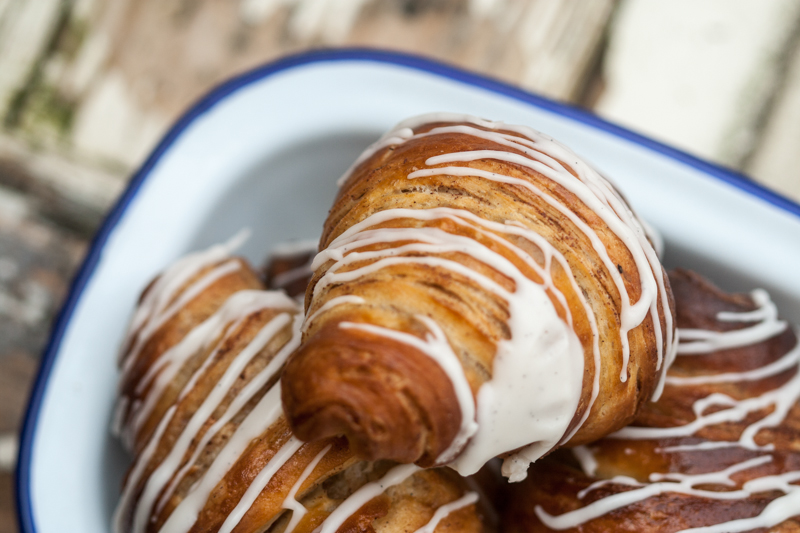
    This recipe doesn’t make traditional croissants. But more of a beautiful cross between a kanelbulle and a croissant. Soft and slightly flaky, as I only gave the dough two simple turns, as opposed to my usual croissant routine: three simple turns. In fact, a look at the insides will give it away: the membranes are thicker, and cinnamon speckles dot them throughout.

    Perhaps, if you want to, I could make some regular flaky croissants, just like the ones I grew up on, and show you too. Yes, croissants are nothing new. But I guess, in the constant chaos that surround us all, there is still some wisdom left.

    The ingredients.

    For the détrempe
    300 g strong flour
    200 g plain flour
    80 g caster sugar
    12 g instant yeast
    10 g milk powder
    10 g sea salt
    250 g cold water
    45 g butter
    , melted and cooled down

    For the butter
    300 g unsalted butter, at room temperature
    2 tbsp ground cinnamon

    For the glaze
    200 g icing sugar
    boiling water
    seeds from one vanilla pod


    twelve pm.
    Mix the flours, sugar, yeast, milk powder and salt in a large bowl. Add the cold water and butter; and mix until a dough starts to form.


    ten minutes past twelve pm.
    Transfer the dough to a clean work surface and knead for around ten minutes or until the dough feels elastic and smooth.


    twenty minutes past twelve pm.
    Place the dough back in the bowl and clingfilm tightly. Leave in a warmish place for an hour or so, or until doubled in size.


    twenty-five minutes past twelve.
    While the yeast is working in magic, work yours with the butter. In a bowl, mix the soft butter (you could flash it in the microwave for ten seconds at a time until soft but not melted) with the ground cinnamon. Perhaps a pinch of cardamom too.


    half past twelve.
    Scrape the butter onto a piece of piece of baking paper and top with another one. Roll it until you get a rough 40x30cm rectangle. Transfer to a baking tray and chill in the fridge.
    Have a cup of coffee. And kisses. And maybe, even tickles down your neck. I highly recommend the latter. That’s what dream-Sundays are made of.

    half past one.
    The détrempe is proved when it’s almost doubled in size. When you take it, it will be very smooth and elastic.

    half past one.
    Place the détrempe onto a lightly floured work surface and roll into a rough rectangle. Wrap in clingfilm and freeze for twenty-five minutes to stop the yeast. Then transfer to the fridge and let it be for a few hours.

    five o’clock.
    Tea time for some. And feuilletage for others. I can’t help but feel a little sad for the former who’ll never know the calmness only rolling dough can bring.
    Take out the butter sheet on your bench to soften it ever so slightly. Place the détrempe onto a lightly floured work surface and roll to a 40x60cm rectangle. Flour more as needed but always make sure to brush off the excess afterwards.

    ten past five.
    Place the rectangle of butter on the lower half of the détrempe – patching it as you do so to cover any naked corner – then fold the upper half over.

    fitfteen minutes past five.
    Flatten the dough with your hands to get rid of any air bubbles, and rotate counter-clockwise so that you have a “book” its spine on your left hand-side.


    twenty minutes past five.
    Roll the dough before the first turn.

    For that, I like to press my rolling pin into the dough to create some indents. This step – if done gently yet with sufficient pressure – allows to distribute the butter evenly.
    I then start rolling the dough in long movements, from the centre up and then from the centre down. Those two techniques can be applied to any laminated dough.
    If the dough starts to stick, don’t hesitate to flour your work bench and reposition the dough.

    twenty-five minutes past five.
    Once the dough has been rolled to – ideally – around seven millimetres, brush off any excess flour, and fold in three, like you would do with a letter.
    This is a tour simple [simple turn].

    Wrap the dough tightly in clingfilm and chill in the fridge for at least an hour.

    twenty-five minutes past five (of the am kind).
    I went for another simple turn as I’ve told you before. Because fluffy meant something special to me that day, or so it seems.
    Of course Karl wouldn’t wake up, so pictures didn’t happen, but here is what I did: I rolled the dough to around seven millimetres thick, then folded it in three, exactly like shown above.
    After that, I placed the dough back in the fridge – again, wrapped in clingfilm.
    If you wanted a flakier texture, I would advise to go for another tour simple [simple turn] now.

    half past six (of the am kind).
    Get two baking trays lined with baking paper.
    Roll the dough on a lightly floured surface to a rough thirty-centimetre-wide rectangle. Cut the dough in half width-wise (if that’s even a thing) and place one half onto one of the prepared baking trays. Chill while you get on with the other half.
    This will make the dough easier to handle and roll thinner, while the other part stays cool.

    Keep on rolling the dough, maintaining a width of around thirty centimetres, until it’s about four or five millimetre-thick.
    Cut triangles using a sharp knife, making sure their base is eight to ten centimetre wide.
    As you cut the triangles, place them onto the prepared baking tray; and keep in the fridge until needed.

    Repeat the rolling and cutting process with the other half of dough.

    seven am.
    Get two baking trays lined with baking paper.

    Take out a couple of dough triangle out at a time. Gently stretch them, then roll without putting any pressure on the layers. And place them with the “point” underneath on the prepared baking tray, generously spaced out.

    twenty minutes past seven.
    Layer two large pieces of clingfilm, chasing any air bubbles and lightly brush with vegetable oil.

    twenty-five minutes past seven.
    Place the layered clingfilm – oiled side down – on top of your croissants, to cover them loosely. Allow to prove at room temperature for around two hours or until wobbly and doubled in size.
    If butter starts leaking, then you might want to find a slightly cooler place to prove your croissants. If I’m at the restaurant, then 26°C is the temperature I go for (with 65% humidity for the ones of you who are lucky enough to have a prover).

    Once the croissants have proved, brush gently with a beaten egg, making sure not to put any egg-wash on the cut edges, which would prevent the rise of the feuilletage.

    Bake at 200°C for seventeen to twenty minutes. Allow to cool down slightly, then transfer to a wire rack.

    ten thirty.
    Make the sugar and vanilla glaze: mix the icing sugar with enough water to form a pourable icing; stir in the vanilla seeds, and drizzle over the croissants.

    THE END. Of life as you knew it.