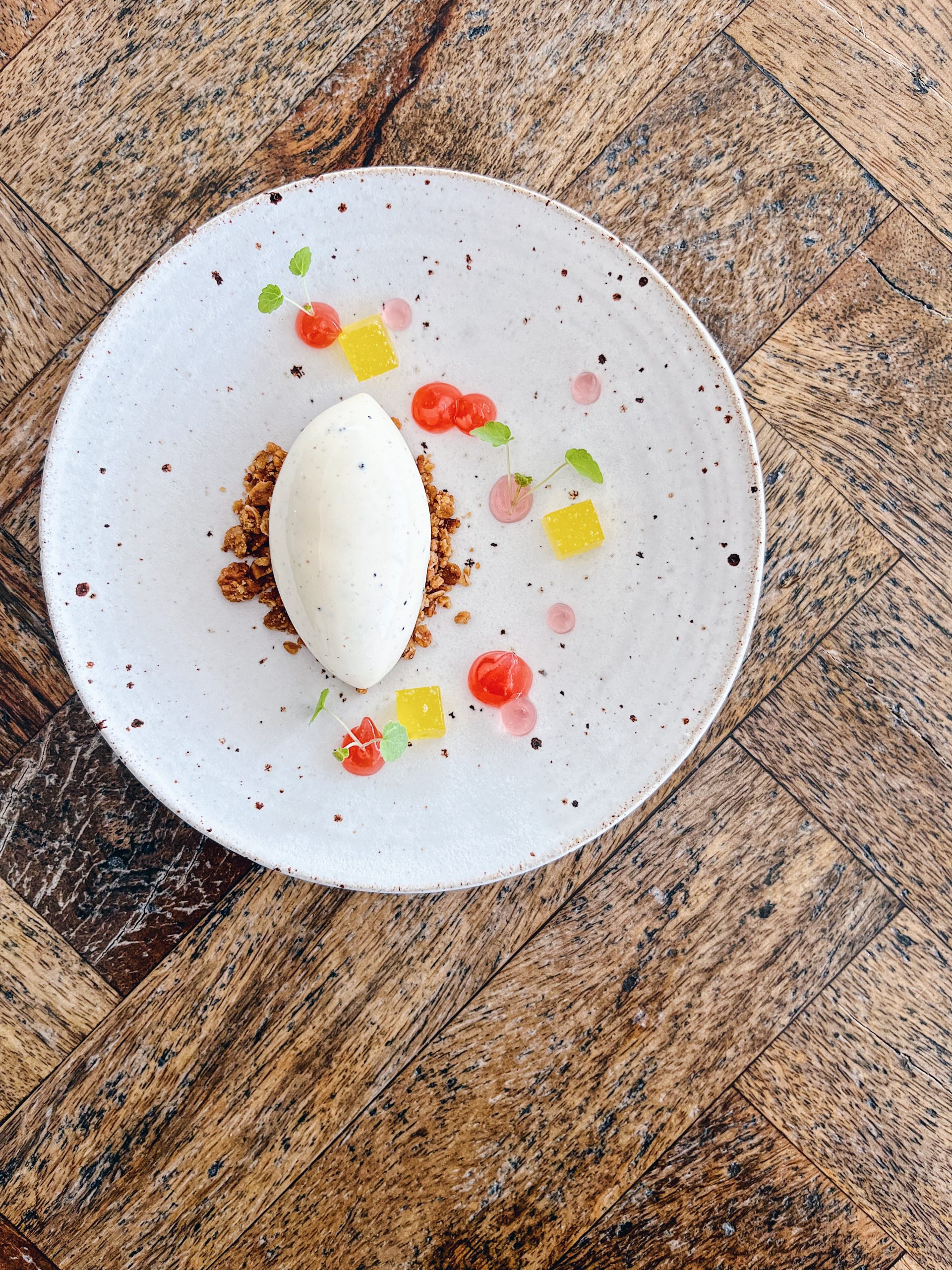
Year: 2012

  • Tarte à l’abricot et à la pistache

    Tarte à l’abricot et à la pistache

    [Apricot and pistachio tart]

    I had a pâton of pâte sucrée in the fridge. And a little bag of roasted pistachios a friend brought back from Lebanon. And of course, too many apricots sitting on the counter.

    An hour later, all this turned into a tart.

    The kind of tarts that are simple and rustic. And yet, ever so delicious. We had a piece still warm from the oven for lunch. And another for dinner, after a baguette garlic steak sandwich that was so good I want to remember it forever. Inside, thick slices of juicy steak with plenty of grated garlic, a dollop of cancoillotte, and salad leaves from the garden.

    With a glass of rosé and a few radishes we’d just picked, it was fairly close to the perfect summer dinner.

    A few hundreds kilometres away, my friend Anna-Sarah* is having her very own perfect dinner. On a péniche [houseboat] with never-ending glasses of champagne. It’s her birthday and I wish her the happiest one ever.

    And if I’m lucky enough, I might even join her on the boat next week-end. Just before I fly back to London. And step into whites again. At the Capital, to give a hand to my friend Richard Hondier who’s now running the kitchen and plating the most delightful dishes I’ve ever seen. And really, I can’t wait.

    * You might know that Anna-Sarah hates apricots, she’s already told me off when I posted this a few days after she’d left (of the I-see-you’re-waiting-until-I’m-gone-to-write-about-apricots kind), so sharing an apricot recipe on her birthday, let’s hope she forgives me!

    Tarte à l’abricot et à la pistache

    This tart is super-quick to put together. Especially if you have some pâte sucrée ready in your fridge or your freezer. I know I always do, and this way, dessert is almost always less than an hour away.

    There is nothing tricky. Pastry, crème d’amandes, fruits, and a little glaze. Ah, yes, just a quick word on crème d’amandes, a stapple in French pâtisseries. I forgot to include it in this list, and really it should be there. The mistake has been corrected since more often than not, you’ll find crèmes d’amandes that feeleither too buttery or too spongy. And most of the times, it even gets called frangipane, and trust me, crème d’amandes in no frangipane.

    To make a gorgeous crème d’amandes, you just have to make sure the eggs are at room temperature. I keep my eggs in the fridge, so they never are. If you add them fridge-cold to the creamed butter, the mixture will split and might leak butter during baking. The trick I use is so simple it hurts. I just place the eggs in hot water – of the tap kind – while I cream the butter and sugar for several minutes. And then, one egg at a time, with a good two minutes of beating in between to bind the emulsion, and make it smooth and airy.

    Now, enough words for such a doodle of a recipe…

    Tarte à l’abricot et à la pistache

    serves 8

    For the pâte sucrée
    130 g butter, at room temperature
    95 g icing sugar
    1 teaspoon sea salt
    1 teaspoon vanilla extract
    30 g ground almonds
    1 eggs
    250 g plain flour

    Cream the butter, sugar, salt and vanilla extract for a few minutes, until light and fluffy. Add the ground almonds. And the egg and beat well for around 3 minutes.
    Tip in the flour and mix until just combined.

    Flatten the dough and wrap in clingfilm. Chill for at least 3 hours – or up to 5 days – before using. Or keep frozen, for up to 3 months.

    On a lightly floured work surface, roll the dough into a 4mm-thick rectangle. Carefully wrap the dough around your rolling pin and place on top of a 10x30cm tart tin. Line the tart case with the dough, then trim the edges. Place in the freezer while you get on with the crème d’amandes.

    For the pistachio crème d’amandes
    80 g butter, at room temperature
    100 g caster sugar
    2 eggs
    , at room temperature
    60 g ground almonds
    60 g roasted pistachio
    , roughly ground
    30 g plain flour

    For the montage
    8 apricots, halved and stoned
    1 tablespoon apricot jam

    Preheat the oven to 180°C.

    Cream the butter and sugar until light and fluffy, for 8-10 minutes, scraping the sides of the bowl every now and then. Add the eggs, one at a time, beating well – at least 2 minutes – after each addition.
    Tip in the ground almonds and pistachios, then the flour and mix until just combined. Scrape the crème d’amandes into a piping bag fitted with a 12mm nozzle and pipe the cream at the bottom of the prepared tart case.

    Arrange the apricots halves, cut-side up onto the crème d’amandes and bake for 40 to 45 minutes, or until golden brown.

    In a small pan, place the apricot jam with a little water (around a tablespoon) and bring to the boil. Gently brush this glaze over the hot tart, and allow the tart to cool down at room temperature. Slice into wedges and serve, perhaps with a scoop of ice-cream or a dollop of whipped cream.

  • How to become a pastry chef? – The checklist

    How to become a pastry chef? – The checklist

    Being a pastry chef is most possibly the best decision I’ve ever taken. Everyday, I have no words to describe the bliss I feel when I’m busy making things. Yes, making. With my hands dirty, and more often than never, with my apron too.

    So yes, many say you can judge how good a pastry chef is by the look of his/her apron. In the books, it should be clean at all times.

    Well, let me tell you one thing. I strongly think that if you can tell every bits and pieces of mise-en-place that’s been made with just a look at a chef’s apron, then it’s a good thing. Perhaps, it’ll become a joke. But I will know deep-inside that this chef gets things done.
    And to me, that’s a very good start. The clean apron will come later, as every move will become smoother, faster and more precise. And if it never comes, you can always change it ten times a day (and I speak from experience on this point).

    So today, I’d like to focus on skills and techniques that are the very essence of what makes a good pastry chef, in a kitchen or at home.
    Because at the end of the day, I strongly believe it’s not about your position, or whether you trained in the most expensive schools, or simply love to spend your days off making pastries.

    It really gets down to passion. A passion with no boundaries.
    In fact, I know many passionate people who know more than the head pastry chef next door.

    And that’s really the matter. To know, to be curious, to strive to learn always and forever more. To experiment, to fail, to success.

    This is the very first step to becoming a pastry chef.

    The list is not exhaustive, but should be considered as a checklist. You want to become a pastry chef? Then do some research and learn about:

    doughs

    – pâte brisée
    – pâte sucrée
    – pâte à foncer
    – pâte feuilletée (perhaps, even inversée)
    – pâte feuilletée levée
    – pâte à choux
    – brioche
    – savarin

    Is you pâte brisée crisp and flaky? Is your pâte sucrée melt-in-your mouth?
    Do you know the difference between pâte brisée and pâte à foncer?

    And what about your puff pastry? Is it light and break into million pieces in your hands? Do you know how to caramelise its top?

    Are your croissants and pains au chocolat light with even layers and thin membranes? Do you see a honeycomb pattern when you slice into them? As for the technique, do you know a great tip that ensures even laminating?

    Are you choux puffs consistent and hollow? Not wet and yet not dry? Can you glaze an éclair, shiny even after a few hours in the fridge, neat around the edges? Do you know that technique for fondant, the one that involves freezing it into small disks then letting it defrost over a choux?

    Do you know brioche dough is an emulsion? Do you treat it as such? Can you knead it by hand or in a mixer without over-heating it? And which temperature should the butter be?

    Are your savarins and babas light as a feather, with holes just so?

    biscuit

    – génoise
    – pain de Gènes
    – dacquois
    – joconde
    – biscuit cuillère
    – macarons
    – crème d’amandes

    Do you know the difference between a génoise and a pain de Gènes? Is your génoise light and fluffy? Can you tell when it’s just baked, not overly so?

    Can your dacquois holds its shape? What’s the purpose of the many different ratios of caster sugar versus icing sugar?

    And the biscuit joconde. Why do you have to beat the mixture for so long? Can you spread it thinly enough in an even layer?

    Are your biscuits cuillère soft and spongy rather than dry? Is your batter firm enough to keep its shape when piped? Do you always dust it with icing sugar at a 10-minute interval?

    Can you tell when a macaron appareil has been macaronné enough? French or Italian meringue? Or even, as I now see it more and more, Swiss meringue? Which syrup temperature is best for the Italian meringue? Can you pipe macarons consistently? Are they shiny with a crisp crust and melt-in-your-mouth inners? Do they have beautiful feet? Do they crack in the oven, and why?

    Is your crème d’amandes light and fluffy? Does it split and feel too buttery once baked? Is it too spongey?

    chocolaterie

    – temper chocolate
    – ganache

    Can you temper chocolate so that it snaps into shiny shards? Can you do it without a probe? Without a marble? Can you spread it to make décors with just a palette knife?

    Do you know how to make a simple ganache? And how each ingredient works towards a smooth supple ganache?

    creams

    – crème pâtissière
    – crème mousseline
    – crème diplomate
    – crème Chiboust
    – crème anglaise
    – bavarois
    – sabayon
    – crémeux
    – crème au beurre

    Is your crème pâtissière super-smooth, not grainy? How do you do, just bring it to the boil or let it bubble for a few minutes to relax? Do you just pour the hot liquid over the egg mixture and let the magic happen?

    Does your crème mousseline feel light? Does it split? And do you know what to do in case it does? Do you add the butter to the crème pâtissière, or the crème pâtissière to the butter? What about that story that says half of the butter should be incorporated into the hot pastry cream?

    Do you know the right temperature to fold your whipped cream into the crème pâtissière to make a crème diplomate? How much gelatine is just enough to set it?

    When making a Chiboust, hould you use a whisk or a maryse when folding the Italian meringue into the hot crème pâtissière? In fact, how hot should the pastry cream be when you do so?

    Is you crème anglaise eggy? Is it smooth and just thick enough?

    As for the bavarois, two things: how whipped your cream should be? How hot your anglaise or fruit purée?

    Is your sabayon thick and glossy?

    What is a crémeux: lemon, chocolate or other fruits? Does it hold its shape and yet melts in your mouth? Is it set just enough or could you kill someone with it?

    Is your crème au beurre made with Swiss or Italian meringue? Which temperature do you need the meringue to be at before incorporating the butter? And how cold the butter should be? Why does it split? What to do if it splits?

    quenelles

    Can you make the perfect quenelle with one spoon? Always the same size, with a pointy tip and a round back?

    other techniques

    How to whisk, mix, combine, fold? Spread with a palette knife or an off-set palette knife? How to tell when a sponge is baked? How to whisk egg whites, fast or slow? And cream? Until which point for a mousse, a Chantilly?

    How to glaze an entremet, with no air bubbles and a shiny glaze?

    How, how, how… This is what should go through your mind every single second of every single day.

    I’ll try and make step-by-steps for each and every of the above items, but in the meantime, get your aprons out, find recipes and compare them to each other, and get dirty.
    Yes, definitely get dirty!

  • Les abricots

    Les abricots

    Yesterday, we found a basket on our fence. The third this week. It’s made of osier and hung by a metal hook.

    Inside, we could see apricots. And at times, cherries.

    Most of the fruits have been eaten already. Fresh, torn in halves, with their juices running on our fingers. Really, why mess with perfection?

    But we have still a few kilograms of apricots left. Golden plump jewels. I’ve made an upside-down apricot and camomile cake. It was all sorts of wonderful. A crumb loaded with camomile leaves. The juices of the apricots turning into compote with the heat.

    The recipe will be in the book of course, as most things that happen in my kitchen right now. Really I can’t wait to tell you more about all those words I write and all those cakes I bake. It should be all sorts of wonderful too!

    But in the meantime, I have a question or two. What are your favourite recipes with apricots?

    I have some gathered some notes already, in case you have more apricots that you can possibly eat (is there such thing?).

    apricot crème crûlée tart.
    baked apricots with limoncello, from the ever-gorgeous what katie ate.
    apricot and chocolate baby clafoutis.
    apricot tart with brown sugar and cinnamon pastry, from BBC goodfood.
    grilled apricots with honey and olive oil, on Taylor’s beautiful blog.
    apricot and matcha tiramisu, on – need I say more – my friend’s, Keiko, blog: nordljus which has been an absolute favourite for years.
    – and her roasted apricots with camomile too, a recipe I remember dreaming over six years ago now.
    rosemary and apricot tarte tatin.

  • Custard-filled cornbread

    Custard-filled cornbread

    Yesterday, two am.

    Tonight, we ate al fresco. In our garden. Who said you’re not allowed to play make-believe anymore?

    I made dessert. One strawberry tart, only it’s so much more. Black olives, vanilla, and olive oil shortbread. White chocolate crémeux. Strawberries from the little patch that somehow resisted the month of May; or perhaps, I should say the month of rain. Strawberry coulis and jam, just so. I topped it with borage flowers, and basil blossoms. And it was pretty amazing. We had a slice each. And then a second.

    By that time, mosquitos began dancing around us. And every star started to rise into the sky, not unlike a slow-motion time-lapse.

    After dinner, I read. A lot. And sometime, between one and two am, I found the following quotation from We Girls: A Home Story about spider cakes:

    “Barbara got up some of her special cookery in these days. Not her very finest, out of Miss Leslie; she said that was too much like the fox and the crane, when Lucilla asked for the receipts. It wasn’t fair to give a taste of things that we ourselves could only have for very best, and send people home to wish for them. She made some of her “griddles trimmed with lace,” as only Barbara’s griddles were trimmed; the brown lightness running out at the edges into crisp filigree. And another time it was the flaky spider-cake, turned just as it blushed golden-tawny over the coals; and then it was breakfast potato, beaten almost frothy with one white-of-egg, a pretty good bit of butter, a few spoonfuls of top-of-the-milk, and seasoned plentifully with salt, and delicately with pepper,—the oven doing the rest, and turning it into a snowy soufflé.”
    Adeline Dutton Train Whitney (1870), We Girls: A Home Story

    A bit of a rabbit-hole, which Jessica Fechtor entered first, and I felt obliged to follow. Looking up the definition of spider cake seemed like an obvious first step, a word of U.S. origin meaning “a cake cooked in a spider pan”.
    Rather unapologetically, I began scouring eBay for spider pans, a sort of frying pan with legs. And delved into its history, a link shared by Jessica. But perhaps, most importantly, I fell asleep thinking about the custard-filled cornbread she’d made following Molly’s adaptation of a Marion Cunningham recipe. Perhaps, the most food-writing hall of fame-ish sentence I have ever written?

    This morning, eight am.

    I woke up with the sun through curtains so light they seemed to glow. And before coffee even begun to run through the maker, I buttered a 24cm-wide cake tin and turned the oven on.

    Coarse polenta got mixed with flour, sugar, and a lot of milk. And cream was poured with no other explanation than this spider cornbread I’d read about yesterday.

    I didn’t grow up on cornbread. But cornbread grew up on me.
    It might have been because of that guy with deep-blue eyes and the cutest American accent ever. He would make me peanut butter and honey sandwiches, and halve strawberries into salads. But that’s another story, one I will possibly never tell, and rather frankly, this cornbread cannot wait.

    While it was in the oven, I rolled puff pastry and made vanilla crème diplomate. I wrote a little too. And after an hour had passed, I took the glorious bubbling cake out from the oven and let it cool while coffee was finally being made.

    I had a slice, still warm, with plenty of runny honey. And trust me, I think all mornings should be like this.

    Custard-filled cornbread
    Adapted from Molly Wizenberg’s A Homemade Life.

    I did not know what to expect from this cake. Sure, knowing both Molly and Jessica, I knew it’d be good. Even with a picture in front of my very eyes, I couldn’t help but feel like magic is always involved when a batter separates into layers.
    When it was just baked, I could barely wait to slice it. And the cream was still on the slightly runny gooey side. Not that there is anything wrong with it. Now, a few hours later, it’s firmed up into a silky custard (yes, I totally had a pre-lunch slice).

    The edges remind me of canelés. The bottom is rich with corn. And the top feels like a pillow of creamy custard.

    Custard-filled cornbread

    Makes one 24cm cornbread.

    50 g butter
    140 g flour
    120 g coarse polenta or cornmeal
    1 1/2 tsp baking powder
    a fat pinch salt
    2 eggs
    45 g caster sugar
    480 g whole milk
    50 g butter, melted
    1 tbsp vinegar
    1 tbsp vanilla extract
    240 g double cream

    Butter a 24cm-wide cake tin, preheat the oven to 150°C/fan 170°C, and place the tin in the oven to warm up.

    In a large bowl, combine the flour, polenta, baking powder and salt. In a jug, whisk the eggs and sugar, add the milk, butter, vinegar and vanilla extract.
    Slowly pour the wet ingredients over the flour, and mix until just combined.

    Scrape the batter in the hot tin, then slowly pour the cream in the centre of the batter. Bake for one hour. Allow to cool for 30 minutes or longer, and serve in thick slices with maple syrup or honey.

  • Mastering white pâtissier fondant, step by step

    Mastering white pâtissier fondant, step by step

    One of the first things you see through a boulangerie-pâtisserie window in France is a herd of glazed éclairs and choux. Pretty in pink, brown, white, and more often than not, green too.

    Fondant can be bought in professional shops, most likely in one or seven kilo buckets. But did you know you can make it at home with just two ingredients?

    It takes around ten minutes to make a kilo of fondant. So get ready to glaze éclairs like there is no tomorrow, because you’re about to learn how to make fondant pâtissier.
    Here I’ve only made 250g because that’s all I needed for a recipe I’m developping for le petit cookbook, but the recipe can easily be doubled as fondant will keep in an airtight container in the fridge for up to a year.

    To make 250g of fondant, you’ll need:
    250g caster sugar
    100g water

    As for the equipement, nothing super-fancy: one large pan, a brush, a probe, a stand-mixer (or failing that, hand-beaters). A plastic scraper is handy too!

    01.

    Place the sugar and water in a large pan. Cook the syrup to 114°C over medium heat. The ideal temperature to make fondant is in between 114 and 116°C, so remove from the heat at 114 an the temperature will naturally reach 115-ish. Perfect!

    02.

    While cooking the syrup, brush the sides of your pan with a wet brush to remove any bits of sugar which might caramelise or even worse, crystallise.

    03.

    Fill the sink with 3cm of cold water and dip the bottom of your pan in it to cool the syrup to 75°C.

    04.

    Pour the cooled-down syrup in the bowl of a stand-mixer fitted with the paddle attachement.

    05.

    Beat for approximately five minutes, or until thick and white.

    06.

    Transfer to a clean work surface. Work the fondant, first with a scraper and then with the palm of your hand until cold. Don’t hesitate to really push it to remove any lumps. Form a smooth ball.

    07.

    Place in an airtight container. Clingfilm to the touch and close with a lid. Keep in the fridge. Use within a year. Ooh yes!

    Now I just have to show you how to glaze éclairs and choux. And perhaps even a millefeuilles! Next time…

  • Scones

    Scones

    So it seems I’ve told you I’d see you soon with tips for the perfect scones. Apparently, soon can hold different meanings.

    A birthday to the sound of drum n’ bass, and glow-sticks around my wrists. Days on a bed that has become my work place, writing the book I should tell you more about. Mess in my kitchen, cakes on the counter, and bread in the oven. It smells like a bakery around here these days. A surprise I can’t say too much about, but it should involve beach and pastis on a café terrasse.

    But well, today is quiet. The clouds deaden everything we hear. And they muffle everything we see too. Not unlike living in cotton.

    A perfect day to make scones. In fact, I have some in the oven right now. Getting golden-brown just so. The mascarpone is ready to be spread. And a jar of home-made cherry jam from last summer has been opened. It’s really more of a runny compote, but damn, it tastes of wild patches of sunflowers and bike rides by the ocean and sunsets made of rainbows.

    I have the feeling my goûter is going to be pretty amazing.

    Tips for perfect scones

    I know many of you are on the quest for the perfect scone. I’ve been there too.

    After years of research, I’ve come up with a go-to recipe. If you have a favourite too, just go for it, but try to follow the tips I’m giving just below. And you’ll see, your scones will have never looked that pretty!

    1. Use cold butter, cut into small cubes. This will prevent the butter from melting as you work it into the flour and will thus give that flaky texture we all love.

    2. Mix until the dough feels JUST smooth. Undermixing will give a patchy scone, looking a bit rough. It will still taste great though. However, if you overmix, the scone will turn out very cakey.

    3. After rolling, chill the dough for half an hour. Wrapped in cling-film and placed on a tray, with the bottom side still at the bottom (and I can’t stress this enough).

    4. Flour your cutter. Dip your cutter into flour, then tap off the excess on your work surface. This prevents the dough from sticking to the cutter, and the cutter from squishing the dough. It makes for the neatest edges ever.

    5. Place the scones upside-down on the baking tray, bottom-side up this time. Once you’ve cut the scones, the bottom side will always looks flatter and smoother. Trust me.

    6. Glaze twice. With egg yolk only. And make sure to wait at least 10-15 minutes in between the two egg-washes. Over the years, I’ve found that egg yolk only gives the best results. Shiny and golden-brown.

    7. Allow to cool down before eating. Because no-one likes a doughy scone.

    Scones

    This recipe might just be one among millions, but it’s my favourite. For the smooth and flaky little clouds – that some call scones – it makes.

    I don’t have much to say about it, other than I can make it with my eyes closed, knowing I will have a perfect tea-time. Talk about instant gratification!
    Butter gets worked into flour and baking powder. With a touch of sugar and salt too for good measure. Then milk and cream are added. Et voilà!

    Scones

    makes 7-8 scones

    250g plain flour
    40g caster sugar
    1/2 tbsp baking powder
    pinch of salt
    50g butter
    , cubed
    100g whole milk
    60g whipping cream

    one egg yolk, to glaze

    Preheat the oven to 180°C and line a baking tray with baking paper.

    In a large bowl, combine the flour, sugar, baking powder and salt. Add the butter, and work it into the flour until the mixture ressembles corse sand.
    Mix in the milk and cream, and knead until just smooth. The dough should be very soft but not too sticky.
    Roll to 3cm thick onto a lightly floured work surface, then wrap in cling-film and chill on a tray for half an hour.

    Cut using a 6/7cm-wide round cutter, then flip upside-down onto the prepared baking tray. Brush the top with egg yolk and allow to dry for 10-15 minutes. Brush again with yolk and bake for 15 minutes or until golden brown.

    Allow to cool on a wire rack, and serve with a topping of your choice.

  • Éclairs au chocolat

    Éclairs au chocolat

    [Chocolate eclairs]

    When trees are shaped like hearts; and breakfast means just-brewed coffee slash bike ride slash jonchée eaten as soon as I’ve taken my gum boots off.

    And we run barefoot in fields of frost. And the grass glows to the moonlight in a way only gems can. With la grande ourse [the great bear] and a feral cat as our only companions for this aimless journey.

    We breathe the cold air and feel alive. We kiss and feel warmer. It’s the very instant that matters.

    Yes, at times, it’s ok to loose track. Of time, of purpose…
    Days are long. And nights too.

    Crossing off to-dos like there is no tomorrow, because, after all, holidays are made of no-tomorrows.

    Today, we made éclairs, à la Fauchon. It was fun, and messy. The kitchen ended up looking à la Fauchon too. Stripped with white and black fondants.

    It’s fine, really. It is.

    We licked our fingers. And ate an éclair, of the à la minute kind. Then scrubbed the counter until it no longer felt sticky. Just our mouths did. And that is a good sign, by all accounts.

    Éclairs au chocolat
    Inspired by Fauchon.

    If you can make choux paste and crème pâtissière, then it really all gets down to glazing an éclair with fondant, then piping straight lines of a coloured fondant. This can be made with either a piping bag or a paper cornet (the latter being my favourite, some things will never change, trust me).

    The only trick to know is to make sure both fondant have the same temperature and texture.
    For the chocolate fondant, I simply added a bit of cacao powder until it looked dark enough. Then mixed in 30°B syrup until the texture seemed just right.

    I guess it’s a bit of a trial and error at first. But it’s ok. We love sticky fingers around here.

    And since I’m at it, fondant is a kind of crystallised sugar that can be found in fancy shops. In case it’s nowhere to be found, try mixing icing sugar and a tiny bit of water…

    Both the choux paste and crème pâtissière can be made in advance. Since the paste is frozen, you can make it up to a week before. And the cream can stay in the fridge for a couple of days.
    However, once the éclairs are filled, they’re best eaten in the day.

    Éclairs au chocolat

    makes 12 éclairs
    for the choux paste
    one recipe of choux paste
    one egg
    , for eggwash
    butter, to grease the baking tray

    Make the choux paste according to the recipe.
    Pipe it onto a baking tray lined with baking paper into logs using a 15mm nozzle; then freeze. Cut into 13cm-long éclairs and arrange on a buttered tray. And bake until golden brown (tips on how to bake choux paste here).

    For the crème pâtissière

    250g milk
    100g cream
    2 egg yolks
    30g caster sugar
    15g cornflour
    100g dark chocolate

    Bring the milk and cream to the boil. In a bowl, mix the egg yolks with the sugar and cornflour. Pour the boiling liquids over the yolks, whisking as you go. Then place back into the pan and cook – whisking at all times – until boiling.
    Transfer to a bowl and add the chocolate. Handblend and clingfilm to the touch. Chill.

    Using a small nozzle, fill the eclairs. And set aside.

    For the glaze
    fondant
    cacao powder
    30°B syrup
    (100g caster sugar + 100g water, brought to the boil, then chilled)

    Melt the fondant over a bain-marie or in the microwave. Divide into two heatproof bowls. Add cacao powder to colour one of the batches into a dark brown fondant.

    Reheat both fondant over a bain-marie or in the microwave, until it reaches 30-35°C. Adding a little syrup to make it runny enough. Then using a small spatula or your finger, glaze the top of the éclair.
    Immediately pipe straight lines of dark fondant, making sure the tip of your bag or cornet is cut small enough (perhaps 2mm, the fondant will spread). Then run your finger along the éclair to clean up it sides and twirl the end of the piped lines.

    Repeat with the remaining éclairs. They will keep in the fridge overnight, although they’re best eaten on the same day.

  • Chewy flapjacks

    Chewy flapjacks

    I started collecting objects, to make up for memories I forgot. A blue pool ball, a broken cigarette, a plastic table number.

    I read words. Most of the time, at night. Yes, all it took was a few words. Perhaps, a bad google translation too. In fact, some words don’t translate well into French. But it was cute. And it made me miss him even though I thought he was part of those long gone memories.

    And when the world we both knew started to fold itself and disappear, I employed magical thinking. Of the good kind. Possibly involving flapjacks. Because, let’s face it, they seem to be a bit of a mystery around here these days.
    Some people want them crunchy. Most go for chewy. A pinch of flour or not? And what about condensed milk…

    Chewy flapjacks

    Those are, by no means, the best flapjacks ever. There are in my own world. But then, I wasn’t lucky enough to be brought up on crumpets and marmalade, and had to make the most of croissants and confiture.

    They are those flapjacks with a thin crunchy crust and soft chewy – almost – fudgy crumb. If you’re after the crunchiest kind, I would suggest to use a larger pan (so the overall thickness is thinner) and bake them at a slightly higher temperature. Perhaps, 190°C.
    Here, I bake them at 180°C. But please, as with all baking, keep in mind that I have a diplodocus of an oven. Non fan-assisted. And with all the heat coming from two gas burners at the bottom. If you have a fan oven, it’s good to reduce the temperature by 20°C (and open a bottle of champagne).

    There are two important steps – if they can even be called this way. The first is to line the pan all the way to the top with baking paper. And the second is not to bring the sugar/butter mixture to the boil before adding the oats. You just want the butter and light brown sugar to be happily melted.

    Chewy flapjacks

    makes 10-12

    200g condensed milk
    150g butter
    85g light brown sugar
    60g golden syrup
    5g maldon sea salt
    320g oats

    Preheat the oven to 180°C/fan 160°C, and line a 20x20cm baking tin with baking paper. I like to butter the pan first so the paper nicely sticks to it, without any crease.

    In a large pan, place the condensed milk, butter, light brown sugar, golden syrup and salt, and cook over slow heat until the butter has dissolved.

    Mix in the oats until nicely coated. Spread into the lined tin, pressing down with the back of a spoon to chase any air. Bake for 18-20 minutes, or until the edges just start to brown.

    Allow to cool, then slice into rectangles – trimming the edges, as you do so – with a sharp knife.

  • Olive oil jelly

    Olive oil jelly

    Olive oil jelly

    It all started one night, when J. mentioned three words. Olive. Oil. Jelly.

    It was last week. Ever since, I haven’t stopped thinking about all the desserts we could make with it.
    I mean, my favourite summer snack is vanilla ice-cream with a drizzle of olive oil and a sprinkle of fleur de sel after all.

    So we’ve been working, trying to find out how to turn pungent oil into a clear jelly.

    And somehow, I think we’ve gotten there. After many failed experiments.

    In autumn, with figs, a young brillat-savarin curd, and a warm sponge so full of vanilla seeds it’s almost grey. Perhaps, a few toasted and salted almonds for crunch.

    In winter, with caramelised apples, a white chocolate granita – not unlike snow, crystallised rosemary, and fresh apple bubbles. And maybe, a few baby quenelles of croissant ice-cream. But that’s just a thought.

    In spring, with strawberries and a hibiscus sorbet. Or flapjack ice-cream. Oh yes, flapjack ice-cream sounds good. Maybe with rhubarb and cardamom, Campari fluid gel too!

    In summer, with candied tomatoes. And a simple vanilla ice-cream. Or with an apricot roasted in basil syrup, honeyed kataifi, pistachios, and honey ice-cream.

    Olive oil jelly

    I absolutely adore olive oil in my desserts. A grassy one – almost green – with summer fruits. A sherry-cask aged Arbequina with chocolate and tonka. A matured olive oil with vanilla ice-cream and flaky sea salt.
    Another way to incorporate olive oil in a playful way is this jelly. And although I'm would like to re-work the recipe to make it slightly less sweet, I'm obsessed with it.

    Notes

    This recipe uses isomalt, a sugar that has the property of having a sweetening power of 0.5 – which means it’s half as sweet as caster sugar. 
    It is usually available to buy at specialty shops, but if you can’t get your hands on it, you could substitute it for the sugar of your choice; just keep it mind your jelly might be on the sweeter side. 
    Author: Fanny Zanotti
    Prep Time15 minutes
    Total Time2 hours 15 minutes
    Makes 500 g jelly.

    Ingredients

    • 10 g gelatine
    • 100 g water
    • 120 g isomalt read noter above
    • 90 g caster sugar
    • 30 g glucose syrup
    • 220 g extra virgin olive oil
    • fine sea salt to taste

    Instructions

    • Soak the gelatine leaves into ice-cold water.
    • In a pan, bring the water, isomalt, sugar and glucose syrup to the boil.
    • Take the pan off the heat, squeeze the gelatine leaves and whisk in.
    • Slowly pour the olive oil, emulsifying with a whisk or an immersion blender as you do so. Add salt to taste.
    • Pour into a container or spread onto acetate for a jelly sheet, and refrigerate for a couple of hours.
    • Cut into dices, or use a fork to break it into smaller pieces.

    Note: this post was updated in April 2023.