Tag: becoming a pastry chef

  • A brioche study, part I: the approach

    A brioche study, part I: the approach

    Analysing the impact of the egg-to-milk ratio in brioche formulas

    In the first part of my forever-unfinished feature How to be a pastry chef? – the checklist, I asked you some questions about brioche with the aim to develop your curiosity and drive you to research important techniques. It went along the following lines:

    Do you know brioche dough is an emulsion? Do you treat it as such? Can you knead it by hand or in a mixer without over-heating it? And which temperature should the butter be?

    But although these points are fundamental in a technical approach, I’ve since had been absorbed by some other questions that belong to the food science realm.

    How do the milk and eggs respectively affect the texture of a brioche? Which kind of flour yield to the softest crumb? And how much butter is too much?

    As with any mixture experiment, we have to study each of these variables – liquids ratio, flour properties, butter quantity – separately in order to develop an understanding on how they each have an impact on the finished product.
    And for no other reason than it has obsessed me for years, I’ve chosen to start by examining the effect of the egg-to-milk ratio in rich doughs.

    Eggs or milk?

    If you ask Eric Chavot, a true brioche – or as he would say, une vraie brioche – is made using eggs as the only source of hydration.
    And while I’m certain many would agree, the subject of brioche – from its etymology to its formula – has always been a controversial one.

    In my kitchen, I tend to use a combination of both eggs and milk; with more or less of each depending on the texture I want to achieve. A knowledge that’s really more empirical than anything; and perhaps, relies a bit too much on wishful thinking.
    So today, we will stop counting shooting stars and start analysing percentages. It will take five different loaves. Over two kilograms of flour and perhaps a litre or two of milk. A box of eggs. Most likely two. And hopefully, a few worthy notes that will improve my understanding of rich doughs.

    The approach

    1. Develop a control formula that will act as a reference point during the experiment.
    2. Define the range into which the variables will fluctuate.
    3. Establish the method: ingredients (on both quantitative and qualitative – brand, temperature – points of view), process (order of incorporation, kneading time/speed, proofing time/temperature, shaping, baking time/temperature)
    4. Make successive batches of brioches, each with a different ratio of egg to milk. All other variables (see method above) remain unchanged.
    5. Record the organoleptic properties of each batch:
    – texture (our main focus point): thickness/hardness of the crust, crumb appearance and mouthfeel.
    – colour: darkness of the crust, tint of the crumb.
    – flavour and smell.
    I haven’t decided yet on whether or not to include objective qualities – such as: crust thickness in mm, loaf size, or even weight of the baked brioche – to measure the response. Yes, even though this is a matter of mixture design, I mostly want to document the results in a comprehensive yet accessible and home-practicable way.
    6. Analyse the results.

    Developing the control formula

    I could have used my favourite stand-alone brioche recipe, the one pictured above and which I told you about in Paris Pastry Club and the one I made tropéziennes with.
    But out of all my rich dough recipes, it stands out by its high hydration and high fat quantity.

    I thus wanted to create a generic rich dough recipe. To do this, I analysed my favourite recipes, ranging from brioche to burger buns, from challah to kanelbullar.
    On the table below, you can see the ones that I consider the more relevant, with BRIOCHE 2 being my usual, the one I just mentioned.

    Brioches: bakers percentage

    bullarbrioche 1brioche 2brioche 3burger bunsbrioche 4
    flour100%100%100%100%100%100%
    hydration64%58%65%60%64%60%
    eggs38%19%55%
    60%13%20%
    milk26%38%11%0%51%40%
    fat28%15%58%40%19%16%
    sugar13%19%11%12%6%20%

    Note: the hydration values, although inaccurate since milk and eggs don’t hydrate the dough fully (respectively at 88% and 76.15%), could have also been labelled “liquids”. I did however choose to go with “hydration” for ease of understanding and recipe development.

    I then went ahead and calculated an average formula as seen on the table below. And by multiplying the bakers percentages, I got the recipe for two brioche loaves.
    As you can notice, some of the measurements would be quite difficult to put into practice, so I used this “average recipe” as a guideline.

    Brioches: average

    BAKERS %for two 500g loaves
    flour100%500 g
    hydration62%
    fat29%147g
    sugar14%68g
    eggs34%171g
    milk28%138g

    Brioche #1: Control formula

    quantityingredientBAKERS %
    500gflour100%
    70gcaster sugar14%
    15gyeast3%
    8gsalt2%
    180gmilk36%
    180gegg36%
    150gbutter30%
    1103gtotal weight

    The percentages I chose to keep are as such:
    – flour 100%
    – caster sugar 14%
    – milk 36%
    – egg 36%
    – butter 30%

    As you can see, I’ve increased the total liquids (milk+eggs) as when I first baked the control brioche, I realised that with only 62% liquids the dough was way too dry so I had to add 60g of liquids (30g egg and 30g milk), bringing the total hydration to 72% instead.
    This can be due to 2 factors:
    – I calculated the average formula using recipes from my French/English recipe notebooks, and thus missed to take into account the Swedish flour’s high absorption capacity
    – when making such a small batch of dough (I halved the recipe) the kneading can take twice as long as when making a larger batch, and the dough has more surface to loose moisture from

    I then added 3% of yeast and 2% of salt, and our control formula was done.

    This control formula is a perfect starting point as its egg-to-milk ratio is 50%-50%, which will allow us to really analyse its impact on the dough and on the finished brioche.

    The mixture design

    I have in mind to make 5 different “brioche” recipes. Yes, “brioche” in quotes, as our experiment will range from actual brioche to pain au lait [literally, milk bread].

    1: controlbrioche 2brioche 3brioche 4brioche 5
    milk50%0%100%33%67%
    egg50%100%0%67%33%

    Here are the different formulas, each associated with a number, which is used as both a name and a rank. We will start with the control brioche 1, move onto brioche 2, and so on.
    As you can see above, we’re starting with the most extreme formulas as we might be able to stop our experiment after brioche 3, in the eventuality that the results will have given us enough information about the impact of the egg-to-milk ratio in the dough.
    I will, however, most likely still decide to conduct brioche 4 and 5, with my personal recipe collection in mind.

    Ressources

    – A clear explanation of mixture design.
    – A few notes on brioche.
    – A five-minute brioche?

    TO COME

    Part I: the approachthis is where you are.

    Part II: the ingredients

    – Part III: the process – method, techniques and tips

    Recipe: brioche #1, the control

    – Recipe: brioche #2, the almost Chavot-brioche

    – Recipe: brioche #3, the pain au lait

    – Recipe: brioches #4 and #5

    – Part IV: impact of the egg-to-milk ratio in rich doughs

    – Ressources: Brioche in literature

    I hope you’ll like this experiment as much as I do, even the most boring parts. Follow #briochestudy on Instagram for real-time science 🙂

    And, of course, I wish you all the happiest new year! To 2016 and brioches. X

  • The dark side of stainless steel

    The dark side of stainless steel

    I received an email. Of a young pastry chef – L. – who was feeling like she didn’t belong to kitchens. We emailed back and forth. To me, there is nothing more magical than getting to do what I blindly love, and couldn’t even dream of a better place to be than in a too-hot, too-fast, too-stressful kitchen.


    But it’s only fair to also talk about the other side.


    When a daily job relies on boundary-less passion this much, the fine thread that keeps us going, that stretches far beyond strength we didn’t even know we had, can break.


    Yes, we’ve all – one day – lost focus. And this is what I told L.: it’s ok. Because deep-inside, you can’t help but have this unreal lovestruck feeling hitting you every morning as you enter the kitchen.

    I didn’t write this with the intention to discourage anyone or to bash any restaurant I’ve been lucky enough to work at (in fact, it’s all been just a dream; and if you don’t feel like it is, then maybe, your restaurant is not the one for you, it won’t mean you don’t belong to kitchens, not just to this one); but more as an encouragement. From me to you: shit happens, more often than not. And yet, I can still see you smile when you think you’re not.


    Also, please excuse my French – ahem – naughty words. Just consider it a warm-up to the world you’ll soon be breathing.


    At times, you’ll wonder why the fuck you’re doing this.

    It will be a morning.

    You’re setting up your section. Just like any other day. You slept for three hours. Just like any other day. You go in the veg/dairy/you-name-it-fridge and it’s world war seven in there. Just like any other day. You can’t overlook anything. Call it perfectionism, OCD, or care. And really, you don’t have the time. You never have the time, but you make it. Fridge is spotless again. Your never-ending mise-en-place list gets longer. Just like any other day. You have to call every supplier for second deliveries, as a d*ck put through the orders the night before. Just like any other day. Your chef casually rolls in. Just like any other day.

    Except it’s not any other day.

    Somehow you can’t take it anymore. You will cry. You will swear. You will become bitter.

    And you will hate it.
    For a second.

    Because then, when the check machine starts its merry-go-round, you’re trapped. Willingly or not, desserts are gonna have to leave this pass.

    And yes, some merry-go-rounds are scarier, harder, faster than others, but close your eyes and hold tight.

    Sometimes, you will feel like it’s unfair. How you’re the first one in and the last out. And no-one seems to give a damn. How you’re the only one to clean the oven or the dry stores. Or worst, doing the stocktake or HACCP.
    And really, you can take anything. The fights, the bollockings, the one-too-many joke.

    But injustice? No.
    And really, you have no choice but keep it quiet. Some things will never be different.

    All the time, you will be tired. In fact, you don’t even want to do the maths. But I’ll do it for you.

    You wake up at five thirty. Or at least, the first of your many alarms will go off.
    You’re at the restaurant by seven. Get changed. Ironed jacket, ironed apron. Need I mention the trousers? One torchon hanging from your hips and another one neatly folded behind your back.

    At ten past seven, you’re in the kitchen. A quick look at your mise-en-place list. First delivery comes in and disappears in an army of plastic crates hidden in the fridge. Coffee gets made. And also seems to disappear in a storm.

    There is the prep. And the problems. Freezer stopped working. Or perhaps it’s the fridge, or the mixer. Five trays of bread-rolls got burnt. The dairy hasn’t arrived yet and it’s ten. Shit happens. More often than not.

    Service happens too. It wakes you up. Makes you feel alive. Makes you connect as a team. As a family. Kitchen is cleaned down. Ready for another service.

    You send the last desserts. It’s already half-past midnight.

    Hot soapy water, more paper roll than you should use. Sanitiser. Then the floor. You scrub, you squeegee, you mop, you dry. Your turn the lights off. Together.

    You get changed. Except this time, forget the iron. Jeans need washing and that t-shirt is more than just wrinkled.
    You’re home by late one if you’re lucky. More two.
    You stick whites in the machine. Laundry powder. Softener. 60°C. You shower and fall asleep with wet hair. It’s two thirty and your alarm goes off in three hours.

    Have a good night.

    At least, you have days off to look forward to. Except, you can forget about those too. Someone calls in sick. Someone walks out. Someone is on holidays. Someone, you, need to wake up.

    Once a month, you’ll get paid. Don’t make a mistake. No, don’t. Never calculate your hourly wage. Under legal. Not that you care really. Because sooner or later you’ll find the answer to the question that’s been haunting you all day.

    Why the fuck are you doing this? You can’t stay away. You learn. You grow up. Perhaps too fast. You love what you do.

    I tend to sugar-coat almonds. Not words. You will feel broken. Once in a while. Kitchens are raw. Concentrates of life lessons.
    Of course, there is this side. There will always be this side.

    But just like there is a hidden world behind puddles, there is also one behind stainless steel. And it’s wonderful, and addictive, and you’ll never get enough of it.

  • How to become a pastry chef? – The checklist

    How to become a pastry chef? – The checklist

    Being a pastry chef is most possibly the best decision I’ve ever taken. Everyday, I have no words to describe the bliss I feel when I’m busy making things. Yes, making. With my hands dirty, and more often than never, with my apron too.

    So yes, many say you can judge how good a pastry chef is by the look of his/her apron. In the books, it should be clean at all times.

    Well, let me tell you one thing. I strongly think that if you can tell every bits and pieces of mise-en-place that’s been made with just a look at a chef’s apron, then it’s a good thing. Perhaps, it’ll become a joke. But I will know deep-inside that this chef gets things done.
    And to me, that’s a very good start. The clean apron will come later, as every move will become smoother, faster and more precise. And if it never comes, you can always change it ten times a day (and I speak from experience on this point).

    So today, I’d like to focus on skills and techniques that are the very essence of what makes a good pastry chef, in a kitchen or at home.
    Because at the end of the day, I strongly believe it’s not about your position, or whether you trained in the most expensive schools, or simply love to spend your days off making pastries.

    It really gets down to passion. A passion with no boundaries.
    In fact, I know many passionate people who know more than the head pastry chef next door.

    And that’s really the matter. To know, to be curious, to strive to learn always and forever more. To experiment, to fail, to success.

    This is the very first step to becoming a pastry chef.

    The list is not exhaustive, but should be considered as a checklist. You want to become a pastry chef? Then do some research and learn about:

    doughs

    – pâte brisée
    – pâte sucrée
    – pâte à foncer
    – pâte feuilletée (perhaps, even inversée)
    – pâte feuilletée levée
    – pâte à choux
    – brioche
    – savarin

    Is you pâte brisée crisp and flaky? Is your pâte sucrée melt-in-your mouth?
    Do you know the difference between pâte brisée and pâte à foncer?

    And what about your puff pastry? Is it light and break into million pieces in your hands? Do you know how to caramelise its top?

    Are your croissants and pains au chocolat light with even layers and thin membranes? Do you see a honeycomb pattern when you slice into them? As for the technique, do you know a great tip that ensures even laminating?

    Are you choux puffs consistent and hollow? Not wet and yet not dry? Can you glaze an éclair, shiny even after a few hours in the fridge, neat around the edges? Do you know that technique for fondant, the one that involves freezing it into small disks then letting it defrost over a choux?

    Do you know brioche dough is an emulsion? Do you treat it as such? Can you knead it by hand or in a mixer without over-heating it? And which temperature should the butter be?

    Are your savarins and babas light as a feather, with holes just so?

    biscuit

    – génoise
    – pain de Gènes
    – dacquois
    – joconde
    – biscuit cuillère
    – macarons
    – crème d’amandes

    Do you know the difference between a génoise and a pain de Gènes? Is your génoise light and fluffy? Can you tell when it’s just baked, not overly so?

    Can your dacquois holds its shape? What’s the purpose of the many different ratios of caster sugar versus icing sugar?

    And the biscuit joconde. Why do you have to beat the mixture for so long? Can you spread it thinly enough in an even layer?

    Are your biscuits cuillère soft and spongy rather than dry? Is your batter firm enough to keep its shape when piped? Do you always dust it with icing sugar at a 10-minute interval?

    Can you tell when a macaron appareil has been macaronné enough? French or Italian meringue? Or even, as I now see it more and more, Swiss meringue? Which syrup temperature is best for the Italian meringue? Can you pipe macarons consistently? Are they shiny with a crisp crust and melt-in-your-mouth inners? Do they have beautiful feet? Do they crack in the oven, and why?

    Is your crème d’amandes light and fluffy? Does it split and feel too buttery once baked? Is it too spongey?

    chocolaterie

    – temper chocolate
    – ganache

    Can you temper chocolate so that it snaps into shiny shards? Can you do it without a probe? Without a marble? Can you spread it to make décors with just a palette knife?

    Do you know how to make a simple ganache? And how each ingredient works towards a smooth supple ganache?

    creams

    – crème pâtissière
    – crème mousseline
    – crème diplomate
    – crème Chiboust
    – crème anglaise
    – bavarois
    – sabayon
    – crémeux
    – crème au beurre

    Is your crème pâtissière super-smooth, not grainy? How do you do, just bring it to the boil or let it bubble for a few minutes to relax? Do you just pour the hot liquid over the egg mixture and let the magic happen?

    Does your crème mousseline feel light? Does it split? And do you know what to do in case it does? Do you add the butter to the crème pâtissière, or the crème pâtissière to the butter? What about that story that says half of the butter should be incorporated into the hot pastry cream?

    Do you know the right temperature to fold your whipped cream into the crème pâtissière to make a crème diplomate? How much gelatine is just enough to set it?

    When making a Chiboust, hould you use a whisk or a maryse when folding the Italian meringue into the hot crème pâtissière? In fact, how hot should the pastry cream be when you do so?

    Is you crème anglaise eggy? Is it smooth and just thick enough?

    As for the bavarois, two things: how whipped your cream should be? How hot your anglaise or fruit purée?

    Is your sabayon thick and glossy?

    What is a crémeux: lemon, chocolate or other fruits? Does it hold its shape and yet melts in your mouth? Is it set just enough or could you kill someone with it?

    Is your crème au beurre made with Swiss or Italian meringue? Which temperature do you need the meringue to be at before incorporating the butter? And how cold the butter should be? Why does it split? What to do if it splits?

    quenelles

    Can you make the perfect quenelle with one spoon? Always the same size, with a pointy tip and a round back?

    other techniques

    How to whisk, mix, combine, fold? Spread with a palette knife or an off-set palette knife? How to tell when a sponge is baked? How to whisk egg whites, fast or slow? And cream? Until which point for a mousse, a Chantilly?

    How to glaze an entremet, with no air bubbles and a shiny glaze?

    How, how, how… This is what should go through your mind every single second of every single day.

    I’ll try and make step-by-steps for each and every of the above items, but in the meantime, get your aprons out, find recipes and compare them to each other, and get dirty.
    Yes, definitely get dirty!

  • My second week as a stagiaire at Pierre Hermé, into the macaron universe

    My second week as a stagiaire at Pierre Hermé, into the macaron universe

    How does one prepare to work in the macaron team? That was exactly what I asked myself on the RER ride home after my first day with the afternoon team – the macaron makers.

    I was exhausted, but also in awe. How could the team be so fast, precise, and professional, while still managing to be funny and kind?

    I arrived at the Vaugirard shop well in advance, around 1:30pm, wanting to make a good first impression. The routine was now familiar: uniform on, aprons tied, hands washed, greetings exchanged. And then, I stepped into the macaron universe.

    The rhythm of macaron-making

    First, the ganaches. I started with jasmine, a delicate and fragrant batch, but by the time I had finished, the others had already made two, sometimes three.

    Then, sorting the coques – the delicate macaron shells. Any broken ones were set aside, baking papers flipped onto racks, and the coques lined up: 12 across, 8 down. It might sound simple, but after a few hours, I felt like a macaron-sorting machine. My tired brain blurred the sizes together, and I realised how quickly repetitive tasks can play tricks on perception.

    Next came filling and closing. One or two chefs piped the luscious ganache onto the waiting coques, and I followed, closing them as quickly as possible. The ganache sets fast, and if not closed in time, it doesn’t form the perfect little belly. This was my favourite part – until we got to the Ispahan macarons.

    Not only did these need to be closed, but before that, each one had to be topped with a tiny square of homemade raspberry gellant. The sticky fruit jelly, made with agar agar instead of gelatine, added an extra step that required precision and patience. The result, though, was worth it. Biting into a perfectly round, glossy macaron, only to discover a hidden raspberry surprise, was nothing short of magic.

    Pierre Hermé’s signature touch

    This hidden centre is what sets Pierre Hermé’s macarons apart. Each one holds a little unexpected treasure:

    – Olive oil and vanilla – two tiny pieces of green olive.
    – Ispahan – a raspberry gellant square.
    – Mosaic – two griotte halves (this one is my favourite).
    – White truffle and hazelnut – three crushed hazelnuts.

    It’s a brilliant idea, elevating each macaron beyond just a shell and a filling, making every bite a layered experience. And then there’s the ganache itselfgenerous, rich, the true focus of the macaron.

    Closing time (or so I thought)

    By the time we finished the last of the 6000 to 8000 macarons, it was already 11pm, and I assumed it was time to go home. I was wrong. Totally wrong.

    Cleaning time.

    Surprisingly, I didn’t mind. Cleaning the fridge felt almost refreshing after hours of standing in the heat. I hadn’t realised just how warm the room had become until I stepped inside. Who said macaron-making isn’t a sport?

    The days after

    Despite the tiredness, the heat, the repetitive motions, something shifted after that first day.

    I got faster, more precise. I learned the rhythm of the team, the flow of the work. I made ganache after ganache, filled and closed hundreds of macarons, and worked alongside some of the kindest people I’ve ever met.

    By the time my week with the macaron team ended, I almost didn’t want to leave (almost). The whole experience felt like a blur – a week that somehow lasted a minute.

    The reward

    Of course, I had to celebrate all the hard work. And what better way than with a selection of macarons from the current collection?

    The tasting

    01. Arabesque
    Macaron sprinkled with pistachio, filled with apricot ganache and pistachio praline. The ganache, thickened with dried apricots, contains no cream. The pistachio praline? Absolutely out of this world.

    02. Café fort [strong coffee]
    A clean, well-balanced coffee ganache, wrapped in beautiful shades of brown.

    03. Thé au jasmin [jasmine tea]
    A floral, fragrant ganache with a distinct jasmine taste.

    04. Caramel au beurre salé [salted caramel]
    A rich caramel buttercream filling. Decadent. Impossible to resist.

    05. Chocolat amer [bitter chocolate]
    Dark chocolate macaron with a 70% dark chocolate ganache. The first macaron we make each day, as the high cocoa butter content means the ganache sets quickly. Rich, deep, slightly bitter – a classic.

    06. Mogador
    Milk chocolate and passion fruit ganache. At first, I wasn’t sure. Now, it’s one of my favourites. The sharp tang of passion fruit against the smoothness of milk chocolate is irresistible.

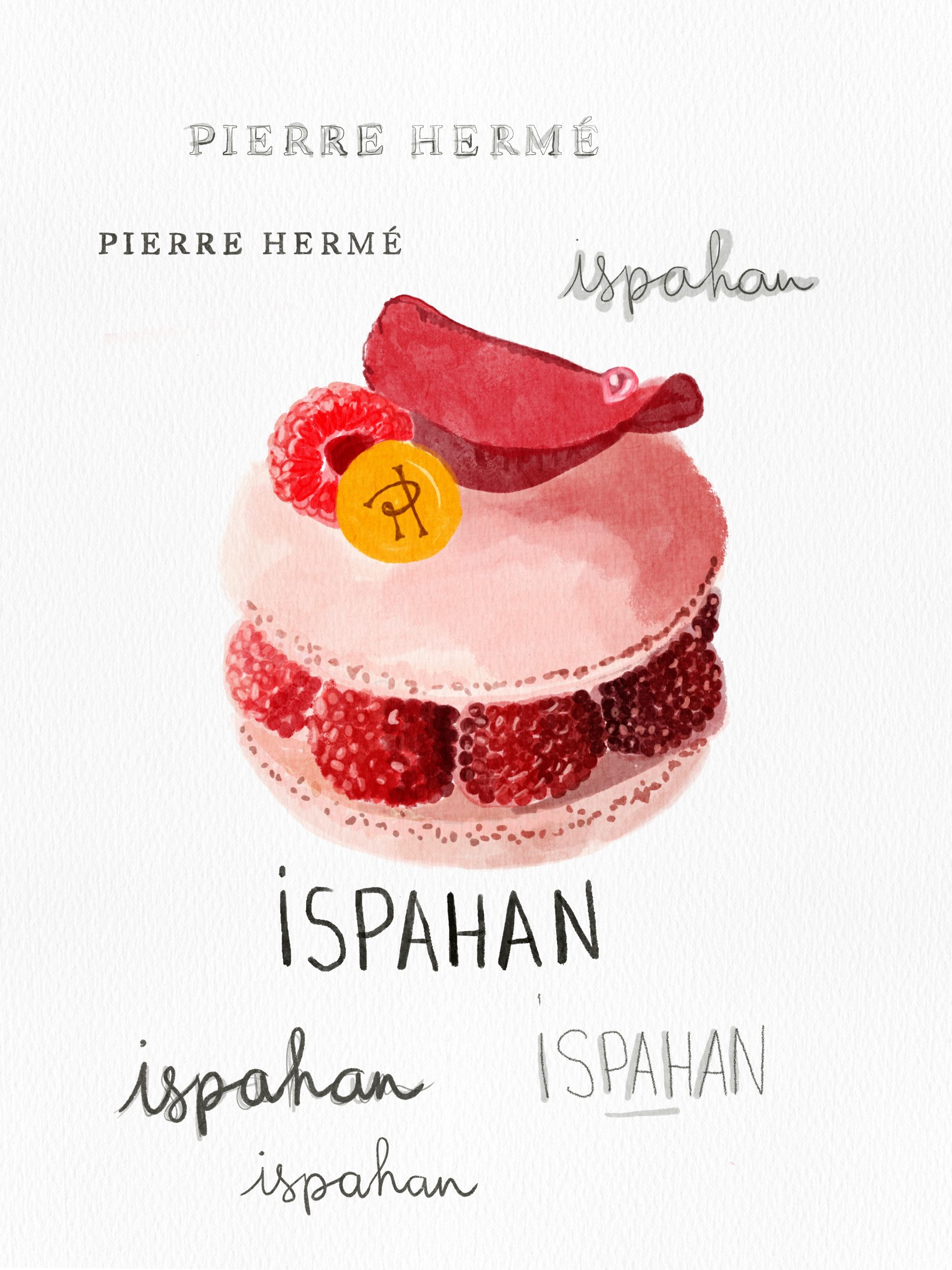
    07. Ispahan
    Rose and lychee ganache with raspberry gellant. I’m not the biggest fan of rose and lychee together, but the sharpness of the raspberry gellant makes this macaron sing.

    08. Mosaic
    Pistachio and cinnamon ganache with two griotte halves. Looks beautiful, tastes even better. The cinnamon warms the pistachio, while the griottes add a sharp contrast.

    09. Olive oil et vanille
    An olive oil and vanilla ganache, with two tiny green olives hidden inside. If you think olive oil in dessert is strange, this will change your mind. The slight bitterness of the oil against the sweetness of the vanilla is unexpectedly perfect.

    10. Rose
    Macaron with rose crème au beurre.
    Tasting notes: Yummy in pink. This macaron is really fragrant and delicate.

    Next week: back to the morning team.

    (First written in July 2007, edited February 2025.)

  • My first week as a stagiaire at Pierre Hermé, rue de Vaugirard

    My first week as a stagiaire at Pierre Hermé, rue de Vaugirard

    Paris, one week in.

    Barely settled from New Zealand, and already I’m on a train to Paris – off to start my long-awaited internship at Pierre Hermé.

    The alarm goes off at 4:30. In the dark, I make my way to the shop in the 15th arrondissement, stepping inside as quietly as I can. It’s empty. Where is everyone? A moment later, I find Sébastien, the head of the morning team, who hands me a set of locker keys. Now, at least, I can head downstairs and change.

    The pâtissier outfit – something I once imagined with so much anticipation – turns out to be more practical than elegant. A loose jacket, high-waisted pied-de-poule trousers, a Pierre Hermé baseball cap. The only redeeming piece: my shoes, white sabots, built for long hours on my feet. Some people manage to make it look good. I am not one of them. If I had any doubt, it vanished when one of the guys saw me in my regular clothes and exclaimed, “Oh mais Fanny, vous êtes beaucoup plus belle comme ça, vraiment.”

    With that settled, I stop looking in the mirror and go upstairs to meet the chefs. Apron firsttwo, actually: one cotton, one plastic. Things will get messy.

    I step into the laboratoire, wash my hands, shake hands with everyone. So many new faces, so many names. I pride myself on being good with names, but this is another level. I smile, nod, listen. The use of vous is enough to remind me that no matter how quickly I learn, I am still the new one here.

    Pastry kitchen survival 101

    Rule one: vous, always.
    Rule two: say chaud – not necessarily because what you’re carrying is hot, but because it’s heavy, in motion, and you don’t want to hear dégage instead. After a while, shouting chaud every few minutes becomes second nature. And useful – I can’t imagine anyone wanting to be doused in 118°C sugar syrup.

    By now, it’s just after six, and I am wide awake. Not just awake – sharp. Watching hands move, pastry bags squeeze, trays slide in and out of ovens, buttercream smoothed into perfect ripples. This is the morning team. They’re here to produce cakes, entremets, yeasted pastries – every motion precise, every detail considered.

    First week, first lessons

    My role? To move from one station to another, stepping in where needed, absorbing everything I can. In my first week, I’ve done everything from sorting almonds to making candied lemon peel. I start with something simple – measuring ingredients for crème onctueuse au chocolat. Straightforward, a good way to ease in. Then, the unexpected: the manager tells me to help Simon decorate the Ispahan entremets.

    Ispahan. One of the it-pastries at Pierre Hermé. My excitement rises as I stand before the delicate pink creations, ready to arrange raspberries over rose-scented buttercream, tuck fragrant lychees between them, pipe a tiny drop of glucose onto a rose petal before pressing it gently onto the macaron shell.

    Then, the Emotions. Pierre Hermé’s signature glass dessertslayered, spoonable. I make both Mosaic (griotte jelly, pistachio jelly, mascarpone cream) and Celeste (rhubarb compote, strawberries, passion fruit mousse, passion fruit marshmallows). The passion fruit marshmallows – light as air, with just enough chew. Separating hundreds of them, rolling them in icing sugar, takes patience, but the result is worth it.

    At some point, they let me make an entire batch of Sensation Céleste. A glass layered with jellies, topped with a macaron. First, rhubarb compote – gelatine, purée, lemon, sugar. A measured pour into each glass. Time to set, then another layer, another. I pipe tiny rounds of banana and strawberry jelly for Désiré, a dessert that’s just as delicious as it sounds.

    But I can’t just stay at my station – I find myself watching Anna, who handles everything that goes into the oven. Brioche, croissants, canelés, millefeuilles. The canelés are the best I’ve ever hadsoft inside, deeply caramelised outside. The Mosaic millefeuille is a dream, pistachio cream playing against the tart griottes.

    Next week: c’est la folie des macarons.

    (First written in July 2007, edited February 2025.)