Tag: holidays

  • Confiture de figues

    Confiture de figues

    [Fig jam]

    We stepped off the plane only to be wrapped by the intense heat. With miles of sea ahead of us and the mountain in our backs, it dawned on me: this is home. A home away from home perhaps, but I could feel it, one deep breath of warm air after another; sea mist, tarmac, and gasoline.

    It had been over two years since our last trip to the south of France. Before we knew it, we’d fallen asleep to the sound of crickets through the shutters we’d left open, and woke up the next day to roosters crowing on the hill across our house.

    Just like a good holiday morning should start, we had breakfast under the pergola at the back of the house. Coffee and spelt milk. Baguette with butter and a generous spoon of vibrant melon des Charentes [cantaloupe melon] jam that my grand-mère made (in 2013, according to the label).

    Yes, of course, I couldn’t leave without a jar.

    If you’re interested, you should know it’s perfectly safe to pack a little over ten jars of jams and pickled mushrooms into your suitcase. Here is how: wrap them with more layers of clingfilm than deemed acceptable, then place them into a zipped plastic bag, and roll them into the thickly knit sweaters you didn’t wear once on your holidays. Cross your fingers and open your suitcase as soon as you get home.

    A few hours later.
    We drove the car down narrow roads until we almost reached the bottom of the valley. And there stood a terraced field, dry from the sun, with at its top the fullest figuier [fig tree] I had ever seen.
    As we walked towards it, the perfume from its leaves left little to wonder about how delectable the fruits would be.

    A little over twenty minutes later.
    Our skin itched from the sap. And our basket was heavy with plump small figs. Naturally we’d eaten a few as we picked them, and oh my!


    Confiture de figues

    There is always something magical about making jam, but fig jam has to be one of my favourites. I don’t know if it’s the slight crunch from the seeds, or the deep red colour. Perhaps, it’s just because I can’t eat fig jam without thinking about our childhood, when towards the end of the summer, we’d ride our bicycle to the nearest tree and pick as many figs as we could eat.

    The recipe here is for 1kg of figs but don’t hesitate to multiply it according to how much fruit you have around. After we’d eaten a good two kilograms of figs and left another in a ceramic bowl by the sink, we had around 3kg left, which we turned into jam, making around 12 odd sized jars.

    For the record, if making big batches, I tend to go for 4-5kg of fruits at a time as I’ve found that if using more, the jam, which will take longer to cook, won’t have such a vibrant colour and flavours due to some of the sugar caramelising.

    As with every of my jam recipes, the sugar – granulated, as it contains less impurities, and thus creates less foam to skim – and water get cooked to 110°C before the fruits are added.
    This step, which I see as fundamental, has one major impact on the jam cooking time, which makes it not only convenient, but also reduces the time during which the fruits are cooked, maintaining a fresh flavour.

    A note on the citric acid: I like to use citric acid powder and not lemon juice, as I’ve found that it keep the fruits’ flavour more intact, however I used lemon juice this time around and was satisfied with the results, although I’ll keep on sticking to my citric acid for the future as it awakens the jam in a way lemon juice doesn’t.
    No matter which one you go for, always add it at the end of the cooking process – off the heat.

    Confiture de figues

    Makes 4 to 6 jars

    1 kg granulated sugar
    300 g water
    1 kg black figs
    , quartered
    40 g lemon juice or 20 g citric acid diluted in 2 tbsp of cold water (read note above)

    Sterilise jars by plunging them, along with their lids, in a pan of boiling water for approximately one minute. Then take them out and invert them onto a clean cloth. Allow to cool down, while you get on with the jam.

    Place the sugar and water into a large pan. Bring to the boil and cook to 110°C. Add the figs and simmer over medium heat for approximately 10 minutes, stirring every now and then until the jam reaches 104°C.
    Take off the heat and skim off any scum using a small laddle. Mix in the lemon juice, then using an immersion blender set on the lowest speed, blitz the jam to break off some of the figs.

    Immediately pour into the prepared jars. Screw the lid on and allow the jars to cool down completely, upside-down. Store in a cool dry place.

  • The macramé coconut bird feeder

    The macramé coconut bird feeder

    We’re in Åsen for the week. With a very limited internet connection, but this kind of thing doesn’t matter when you have for only alarm, the soft light of the sun through a forest of birches, and the mésanges‘ songs .
    There are the woodpeckers too, not unlike a ticking clock.

    Yes, we’ve seen many birds perched in the trees that line the forest, but mostly blåmeser [blue tits] and talgoxer [great tits].
    And I wanted to find a simple way to feed them as I know for the fact that they’ll be heading north soon.

    So this morning, I made a quick coconut bird feeder. Kalle was still asleep. And a loaf of sourdough bread was getting brown in the oven, later to be sliced while still warm (a guilty pleasure of mine) for breakfast.
    I took the coconut that Kalle sawed last night, and some string we had in the kitchen; and really, I liked the first one I made so much, that I took some pictures to show you.

    Notes

    Fresh coconut flesh is ok for birds to eat, but please don’t feed them any desiccated coconut as it can be harmful.

    After I took the pictures, I asked Kalle to drill a hole at the bottom of the eye-less shell, pictured here, to make sure water would drain in case of rainy weather.

    You could make it way fancier, adding more strings and braiding them; but I just wanted to make something easy, fast and durable. However, I’m pretty sure, I might make more macramé holders soon, perhaps for plants.

    Macramé coconut bird feeder

    Material:
    – a coconut – sawed in half and with holes drilled at the bottom of each half for draining purposes
    – kitchen string
    – hooks (optional, to attach the coconut bird feeders more easily to branches)


    1. Cut 4 strings, each measuring around 60cm.


    2.Group the string by 2 and make them meet in their centre.

    coconut nest-3

    3. Knot them together tightly.

    coconut nest-4

    4. Separate in four strands again and tie simple knots, around 3-4cm from the centre.

    coconut nest-5

    5. Place on top of one coconut half. And group two strands from different thread together, as shown above. Tie another simple knot, 3-4cm further. And repeat with the remaining strands.

    coconut nest-6

    coconut nest-7

    coconut nest-8

    coconut nest-9

    coconut nest-10

    6. Repeat this process one last time (or more of you have a large coconut) to that the final “line” of knots reaches the rim of the coconut half.

    coconut nest-11

    coconut nest-12

    coconut nest-13

    coconut nest-14

    7. Place your macramé coconut bird feeder upright and pull the strings, trying to centre them. Make a knot. Add a hook.

    coconut nest-15

    coconut nest-16

    coconut nest-17

    8. When the birds will have eaten the coconut flesh, refill the feeder with seeds and grains of your choice.

    macrame coconut bird feeder

    Which birds do you have in your garden these days? Lots of love, X Fanny.

  • A life-changing way to scan watercolours

    A life-changing way to scan watercolours

    This afternoon, I started gathering things I want to bring with us to Åsen (two more days!!). A film camera, and many rolls of my favourite film – Kodak Ektar in case you’re wondering, two bags of stone-ground flour, a glazed ceramic tray, watercolours and brushes.

    And in the center of the block of cold-pressed paper, I found these illustrations I made two summers or so ago. Sat on the patio of our cabin in Åsen, to the sound of raining trees.


    And I thought I’d tell you about the life-changing way to scan watercolours. A simple trick that I read about on Elizabeth’s blog.

    The process, which allows to control the rendered texture of the cold-pressed paper that makes editing a watercolour in Photoshop a pain, has become a favourite. And K. may have had to hear me ramble about it for a week or so, happy-dance included.

    Step one: scan the watercolour

    But scan it twice, rotating the image to 180° on the scanner bed for the second scan.

    Step two: open in Photoshop

    Layer both images, align the content, and set the top layer to 50% ( more or less, it’s up to you how much “texture” you want to show).

    Step three: edit as you usually would

    Which for me means: extracting the illustration using the channel panel, possibly correcting the white balance/saturation/contrast, and exporting.

    For a more detailed instructions, please head over Elizabeth’s for a beautifully illustrated tutorial.

  • My ultimate kanelbullar

    My ultimate kanelbullar

    Tomorrow is the 4th of October. A date that doesn’t go unnoticed in Sweden. Yes, tomorrow is kanelbullens dag [cinnamon roll day].
    I must have felt that this post – which I promised to share with you long before I even knew kanelbullar had their own day – was waiting in my drafts for a reason.

    This is a recipe I first made in Åsen, the summer before last. I kneaded the dough in the evening, as we came back from a day by the lake. And by the time breakfast was ready the next morning, the buns had proofed and were ready to go in the oven for a mid-morning fika.

    Later that day, I realised we’d forgotten my camera charger in Kusmark so I ended up taking some pictures using the film camera Kalle gave me.

    We rushed on the road to Mora – through the forests and the bridge that goes over the lake, through the little stress I’ve come to cherish and the rails by which we always get to see a train pass by – to bring the roll to the only lab we knew of.

    And because it was not fully exposed, I quickly took a few pictures of what was around me. In fact, the one below – of Kalle – is, to this day, one of my favourites.
    Yes, it’s not without a certain sense of both love and reserve that I’m proud to tell you that my 79th roll of film has pictures of bullar, one of K., one of the sky, and one of flowers. The dream roll?

    But let go back to that morning. When I rolled the dough and topped it with a thick layer of cinnamon butter. I don’t always say this, but salted butter really does wonder here.
    Yes, that morning, is to be forever remembered. The table covered in a thick layer of white paint. And the blue chairs around it. The spitting sound of the fire in the wood stove. This is where I learnt how to roll kanelbullar.

    A year has passed since then – days made of snow and walk through leafless trees, a spring that only lasted a second and a summer that is now starting to turn into autumn. Many more bullar have been rolled. At home. At the café.

    And while my rolling techniques have definitely improved, the recipe has received only a few tweaks. That’s how much I’m in love with it. And I hope you will be too.

    Kanelbullar, un peu comme des brioches

    I love my bullar to be soft and fluffy, so instead of using a traditional recipe (which I always find slightly dry), I go for a cross between a doughnut and a brioche dough.

    Although I’ve shared a recipe for kanelbullar in the past, these ones are different. They are my favourites. The ones I make at home and freeze into small plastic containers, ready to be thrown into a lunchbox or popped in the microwave for an almost-instant fika. The ones I make everyday at the café too (when I’m not off – and for the first time in a long time, I shall say: YES to the weekends).

    The old ones were of the spur-of-the-moment kind. Made late, during our last night in Sweden the first time we visited. Eaten by Byske river, just a few hours before our flight back to London. They had whole wheat flour and I remember how long it took to develop the gluten by hand.
    I also remember how wonderful it was to unwrap the not-so-neatly folded foil and dip them into a forever-hot cup of kokkaffe.

    Making a sticky dough by hand is always a challenge; it takes time, a good scraper and hands being cleaned every so often. But trust me, I’ve done it many times and it doesn’t only produce beautiful results, it’s also wonderfully relaxing.

    EDIT 5 October

    After a few of you reported butter leakage, I’ve noticed I had missed a modification, which I made a few months ago: I now use a reduced amount of butter in the dough – 130g instead of 200g; a leaner dough absorbs the butter better, but I couldn’t remember why I had reduced it as I love the texture of the buns made with 200g of butter so much!
    Thank you for your feedback! Also, make sure the bullar are proofed until doubled in size before baking them. It takes around 2 hours at 24°C but can take 3-4 hours if the room temperature is colder. Lots of love and sorry for the caramelised cinnamon butter 🙁

    EDIT 6 October

    I’ve tried both batches today, with 130g and 200g butter. While I love the texture of the buns with 200g of butter, they do leak during baking; a quick fix, if you’re after melt-in-your-mouth bullar, is to bake them in muffin paper-cases so you won’t end up with a puddle.
    As for the batch with 130g of butter, they’re a bit lighter and almost no butter leak 🙂 Sending you all my cinnamon-love X

    EDIT 8 December 2016

    After having made this recipe daily for well over a year, I think an update is in order.
    I have modified it slightly, mostly because I make it using 3.2 kg of flour, and that the flour here has a slightly higher absorption power.

    Here is my updated recipe:

    Kanelbullar 2.0

    Kanelbullar, un peu comme des brioches
    Every year, on the 4th of October, Sweden celebrates Kanelbullens dag: Cinnamon Bun Day. It feels like the perfect excuse to revisit one of my favourite recipes. These buns have been with me for over a decade now. The first version I baked in the summer of 2014 was a little more rustic.
    Since then, I’ve spent countless hours calculating baker’s percentages, testing variations and tweaking until I found what felt just right.
    What follows is my current go-to recipe (let’s call it version 2.0), followed by the 1.0 recipe for those who want to see where it all began.
    Author: Fanny Zanotti
    Prep Time1 hour 30 minutes
    Cook Time15 minutes
    Total Time1 day 1 hour 45 minutes
    Makes 14 buns

    Ingredients

    For the dough

    • 600 g flour
    • 75 g caster sugar
    • 18 g fresh yeast
    • 7.5 g sea salt
    • 4 g hand-ground cardamom
    • 225 g whole milk
    • 150 g eggs
    • 190 g unsalted butter

    For the filling

    • 190 g salted butter at room temperature
    • 150 g caster sugar
    • 3 tbsp ground cinnamon

    To top

    • 2 eggs beaten
    • pearl sugar

    For the syrup

    • 75 g caster sugar
    • 75 g water

    Instructions

    • In a large bowl, combine flour, sugar, yeast, salt, and cardamom. Add the eggs and milk. Mix until a dough forms.
    • Knead by hand for around 20 minutes, or in a stand mixer fitted with a dough-hook for about 10 minutes, until smooth, elastic, and just tacky. The dough should stretch into a thin membrane without tearing.
    • Add the butter gradually. By hand, work it in 3–4 additions, smearing and kneading until fully incorporated. In a mixer, add small pieces one by one. The dough will look split at first – keep going until smooth again.
    • Place in a large bowl, cover, and chill. Either proof 1 hour at room temperature, then refrigerate for 2 hours, or refrigerate straight away for at least 8 hours (and up to 24 hours).
    • The next day, line two trays with baking paper. Mix the filling ingredients until smooth.
    • On a lightly floured bench, roll the dough to a 30 × 60 cm rectangle, about 5–6 mm thick. Spread with cinnamon butter. Fold the dough into thirds (like a letter), giving you a rectangle about 30 × 20 cm.
    • Cut into 2 cm strips. Twist and tie each into a knot. Place on trays. Cover loosely and proof until doubled – around 2 hours.
    • Preheat oven to 200°C / fan 180°C. Brush the buns with egg wash, sprinkle with pearl sugar, and bake 12–16 minutes, until golden.
    • For extra shine, brush with hot syrup as soon as they come out of the oven. Cool slightly on a wire rack.

    Glad kanelbullens dag!

    The 1.0 recipe from my 2014 summer:
    For the dough
    530 g strong flour
    70 g caster sugar
    16 g fresh yeast
    10 g sea salt
    1 tsp ground cinnamon
    3 eggs
    (150 g)
    190 g whole milk
    130 g to 200 g (read note/edit above) unsalted butter
    , at room temperature

    For the cinnamon butter
    250 g salted butter, at room temperature
    170 g caster sugar
    3 tbsp ground cinnamon
    1 tsp ground cardamom

    For the topping
    1 egg, beaten, to glaze
    a handful of pearl sugar

    For the syrup
    75 g caster sugar
    75 g water

  • Biscuits croustillants à la cannelle

    Biscuits croustillants à la cannelle

    [Crisp cinnamon biscuits]

    I don’t want fig leaf or oak bark infusion. I don’t want gimmicks and royal icing where it’s not needed. I want to explore flour, sugar, butter and eggs.

    Give me cinnamon. And whole wheat flour. Oats. And dark brown sugar.

    I want to look underneath a biscuit. And see a golden colour. And little ridges. And above all, I want to build a collection of solid recipes for the years to come. For traditions that don’t exist yet, but will. And for those that are already there.

    Yes, at times, I love to experience with crazy flavours. The next big thing. Or more. But as I’ve told you yesterday, for me, Christmas is all about rituals and beautiful habits. I hope you feel the same way.

    Biscuits croustillants à la cannelle
    Adapted from Trine Hahnemann.

    When it comes to a biscuit texture you can get: crisp, crunchy, sandy/short, caky or chewy. These ones are full-on crisp. A beautiful texture which makes them – perhaps – the best biscuits I’ve ever eaten.
    So much, in fact, that this year, I’ve decided to forgo my usual vanilla shortbreads and use this recipe as a base instead. Maybe try different shapes, perhaps even thumbprint cookies and see how that goes.

    I think their insane texture comes from the initial sanding technique, when the butter gets rubbed into the flour and sugar, which created beautiful layers within the biscuit. So I might experiment with this instead of the usual creaming that most of my biscuit recipes use.
    They also make me want to try more of Trine’s recipes. Have you ever? If not, then please, make a batch of these.

    As I usually do, I rolled the dough between two sheets of baking paper (but as I mentioned yesterday, it makes me miss the feuilles guitare I use at the restaurant, SO. MUCH. BETTER.) as soon as it gets made, and then go on with the chilling. I’ve found that resting the dough before rolling doesn’t improve the texture, and really, makes it so hard to roll that you have to 1) bash it with a rolling pin to make it somewhat workable or 2) let it outside to warm up a bit (hence, erasing all the benefits of keeping the dough cold at all times: making the water content of the butter less available for gluten to bind).

    Two or three important things though when it comes to rolling the dough.
    – always roll in different directions.
    – every now and then, lift the baking paper and smooth any wrinkles out. They tend to make the dough fragile and the biscuits less pretty.
    – before you cut out your biscuits, remove the top layer of baking paper, then place it back (it won’t stick as much), before filliping around and removing the second layer of baking paper. This way, as you cut out, the shapes will stay in your cutter, instead of sticking to the paper (hope that makes a semblance of sense at all?!).

    Also, re-rolling the trimming? I would usually say it’s a big no. But f*ck it, it’s home baking after all.

    Biscuits croustillants à la cannelle

    makes around 30-40 biscuits

    For the dough
    375g plain flour
    125g light soft brown sugar
    1 tsp baking powder
    1 tsp ground cinnamon
    1/2 tsp sea salt
    250g cold butter
    , cubed
    one egg

    For the sugar topping
    one egg, beaten
    100 g demerara sugar
    4 tsp ground cinnamon
    gold shimmer powder
    , optional

    Mix the sugar, cinnamon, and gold shimmer (if using) to combine.

    Place the flour, sugar, baking powder, cinnamon and salt in a large bowl, and mix to combine. Add the butter, and rub it in the flour mix until it resembles coarse oats. Add the egg and work the dough until just smooth.
    Roll the dough between two sheets of baking paper until it’s around 4-5mm thick.
    Place on a baking tray that fits in your fridge, if the dough is too large, you can cut through the paper to make two or more rectangles. Chill the dough overnight.

    The next day, cut out your biscuits using either a round 5cm cutter or different shapes, and place on a large sheet of baking paper. Brush with the beaten egg and sprinkle generously with the cinnamon sugar. Shake off the excess and place on a baking tray lined with paper. At this point you can either freeze the biscuits for a month or so, or bake them straight away.

    Preheat the oven to 170°C. Bake the biscuits for 14-18 minutes, depending on their size. They’re ready when evenly brown. Allow to cool down completely and keep in an airtight container. Trine says they’ll keep for a month. If so, my dreams of the perfect biscuit have come true.

  • Éclairs au chocolat

    Éclairs au chocolat

    [Chocolate eclairs]

    When trees are shaped like hearts; and breakfast means just-brewed coffee slash bike ride slash jonchée eaten as soon as I’ve taken my gum boots off.

    And we run barefoot in fields of frost. And the grass glows to the moonlight in a way only gems can. With la grande ourse [the great bear] and a feral cat as our only companions for this aimless journey.

    We breathe the cold air and feel alive. We kiss and feel warmer. It’s the very instant that matters.

    Yes, at times, it’s ok to loose track. Of time, of purpose…
    Days are long. And nights too.

    Crossing off to-dos like there is no tomorrow, because, after all, holidays are made of no-tomorrows.

    Today, we made éclairs, à la Fauchon. It was fun, and messy. The kitchen ended up looking à la Fauchon too. Stripped with white and black fondants.

    It’s fine, really. It is.

    We licked our fingers. And ate an éclair, of the à la minute kind. Then scrubbed the counter until it no longer felt sticky. Just our mouths did. And that is a good sign, by all accounts.

    Éclairs au chocolat
    Inspired by Fauchon.

    If you can make choux paste and crème pâtissière, then it really all gets down to glazing an éclair with fondant, then piping straight lines of a coloured fondant. This can be made with either a piping bag or a paper cornet (the latter being my favourite, some things will never change, trust me).

    The only trick to know is to make sure both fondant have the same temperature and texture.
    For the chocolate fondant, I simply added a bit of cacao powder until it looked dark enough. Then mixed in 30°B syrup until the texture seemed just right.

    I guess it’s a bit of a trial and error at first. But it’s ok. We love sticky fingers around here.

    And since I’m at it, fondant is a kind of crystallised sugar that can be found in fancy shops. In case it’s nowhere to be found, try mixing icing sugar and a tiny bit of water…

    Both the choux paste and crème pâtissière can be made in advance. Since the paste is frozen, you can make it up to a week before. And the cream can stay in the fridge for a couple of days.
    However, once the éclairs are filled, they’re best eaten in the day.

    Éclairs au chocolat

    makes 12 éclairs
    for the choux paste
    one recipe of choux paste
    one egg
    , for eggwash
    butter, to grease the baking tray

    Make the choux paste according to the recipe.
    Pipe it onto a baking tray lined with baking paper into logs using a 15mm nozzle; then freeze. Cut into 13cm-long éclairs and arrange on a buttered tray. And bake until golden brown (tips on how to bake choux paste here).

    For the crème pâtissière

    250g milk
    100g cream
    2 egg yolks
    30g caster sugar
    15g cornflour
    100g dark chocolate

    Bring the milk and cream to the boil. In a bowl, mix the egg yolks with the sugar and cornflour. Pour the boiling liquids over the yolks, whisking as you go. Then place back into the pan and cook – whisking at all times – until boiling.
    Transfer to a bowl and add the chocolate. Handblend and clingfilm to the touch. Chill.

    Using a small nozzle, fill the eclairs. And set aside.

    For the glaze
    fondant
    cacao powder
    30°B syrup
    (100g caster sugar + 100g water, brought to the boil, then chilled)

    Melt the fondant over a bain-marie or in the microwave. Divide into two heatproof bowls. Add cacao powder to colour one of the batches into a dark brown fondant.

    Reheat both fondant over a bain-marie or in the microwave, until it reaches 30-35°C. Adding a little syrup to make it runny enough. Then using a small spatula or your finger, glaze the top of the éclair.
    Immediately pipe straight lines of dark fondant, making sure the tip of your bag or cornet is cut small enough (perhaps 2mm, the fondant will spread). Then run your finger along the éclair to clean up it sides and twirl the end of the piped lines.

    Repeat with the remaining éclairs. They will keep in the fridge overnight, although they’re best eaten on the same day.

  • Le fondant au chocolat

    Le fondant au chocolat

    [The ultimate chocolate fondant]

    In London, we’ve had winter in July. Air damp with rain. Kitchens warm with soup on the stove. Oven smelling like chocolate cake.

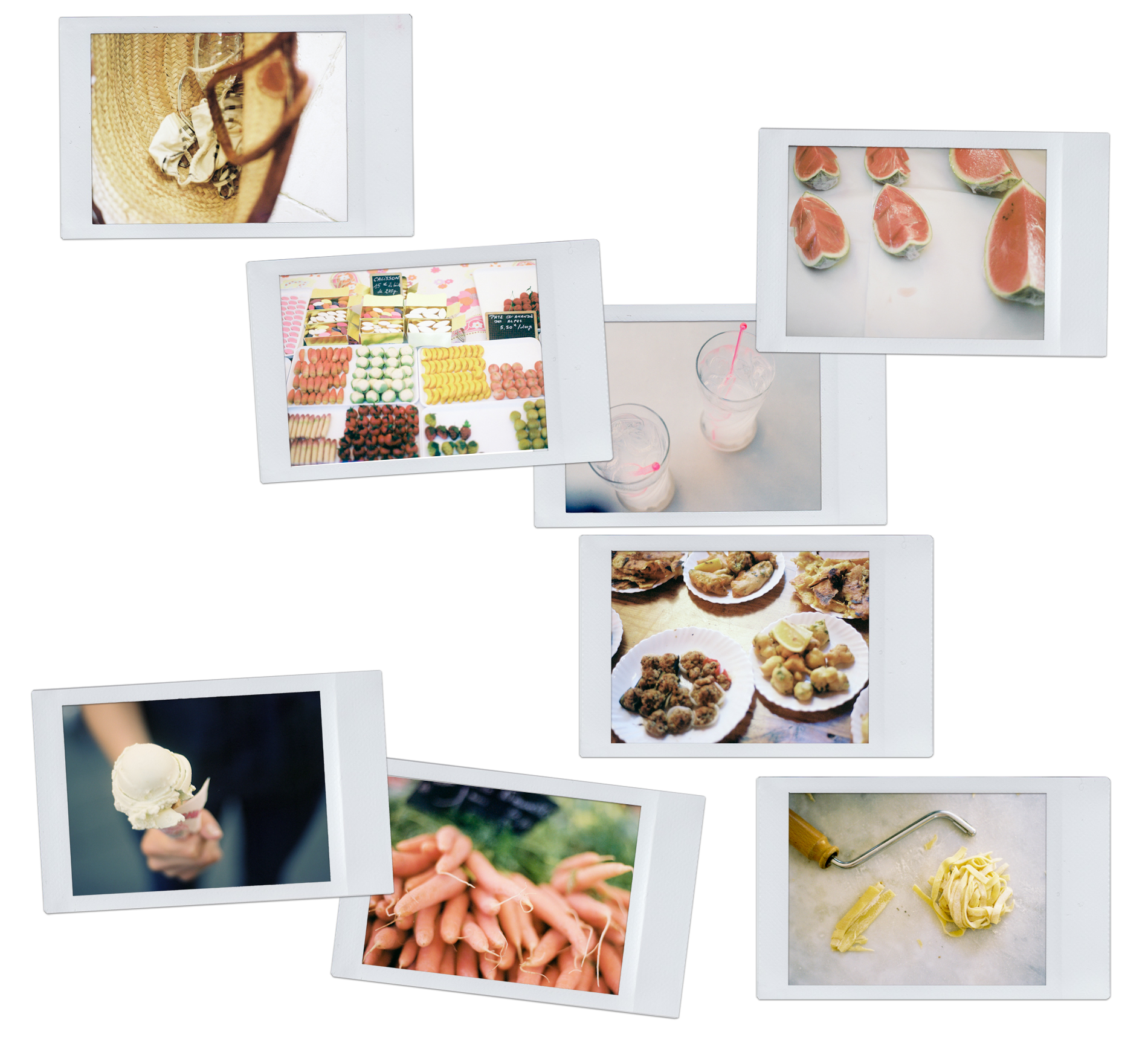
    And now, in the south of France, we’re having summer in September. Walks through the markets. Sirops d’orgeat at the terrace of the village café. Afternoons at the beach. Ice-cream, in a cone, please. Flip-flops at the feet. Deep-fried is a must, especially when it involves fleurs de courgettes. Watermelon; full-stop.

    It seems that whenever I come down here it’s summer. A summer of the out-of-season kind.

    It also seems that whenever I’m down here, I always return to the same cake. A cake of the homecoming kind.

    It certainly is my go-to. Because, let’s be honest, we all need one.

    One we make on Mondays. One we slice when still warm and slightly runny for a late afternoon indulgence. One we have for breakfast – the day after – cold from the fridge and dipped into the latte we overlooked as we were flipping through the pages of the newspaper. One we finish on Wednesdays after a dinner made of crusty baguette with a side of sliced tomatoes in their juices; perhaps with a scoop of yoghurt ice-cream.

    This cake is dark and dense. The very definition of a fondant.

    And since we’re at it, I shall let you know that what we – French – call fondant is somehow different to the fondants I’ve been known to bake à la minute for the restaurant.
    In fact, if you’re thinking about small little cakes with a melted chocolate centre, we call them coulants in good old France.

    So please, mind your French, will you 😉

    Fondant au chocolat

    Fondant au chocolat
    Adapted from Pascal Lac.

    I’ve told you about this cake before. It is, as I’ve mentioned above, a keeper. If you’re after a moist chocolate cake, then this is the one.

    Plus, it’s damn easy to make. Just chocolate, butter, eggs, sugar, and flour.
    Oh yes, ok, eight eggs and four hundred grams of sugar. Just forget about this and bake it in a 28cm pan for thinner wedges.

    It is worth it!

    When it comes to the chocolate, I like to use a slightly bitter, most possibly 70%. And I have to admit Valrhona Guanaja is especially great for cakes of all kinds.

    The only tricky – and when I say tricky, I mean very merely – step is to bring the eggs and sugar mixture to room temperature-ish over the heat.
    You can either do it straight over the gas, making sure to mix at all time while turning the bowl to ensure heat distribution. Or do it over a water-bath (which should not stop you from mixing and turning the bowl!).

    This step is done, as we say in French, to casser le froid [break the coldness]. And it will incorporate a little air in the eggs.

    Fondant au chocolat

    Makes one 24 to 28cm cake.

    200g dark chocolate
    240g butter
    8 eggs

    400g sugar
    130g flour

    Preheat the oven to 170°C, and generously butter a 24 to 28 cm springform pan.

    In a bowl, melt the chocolate and butter.

    In a heatproof bowl, mix the eggs and sugar – using a whisk – and place over medium heat (or as said above, on a water bath). Keep on mixing until not cold anymore. It shouldn’t be hot either.
    Pour the chocolate over the egg mixture, and mix to homogenise. Sprinkle the flour over and using a rubber spatula, gently incorporate it until just smooth.

    Pour the batter into the prepared tin and bake for 30 to 40 minutes (if you’re using a smaller tin) until just set.