A morning spent outside, the snow crisp and sparkling – minus 16 degrees in the air. Standing quiet behind a tree, watching talgoxar [great tits] and nötväckor [nuthatches] dart between the branches.
The sky these days, or just a dream? No but seriously have you ever seen pärlemormoln [pearlescent clouds], as we call them in Swedish?
A pale canvas, slowly awakening after months of nights, brushed with mother-of-pearl – soft greens, pinks, and blues, shimmering quietly in the cold.
They form high in the stratosphere where it’s cold enough for ice crystals to scatter light into these fleeting colors. Rare and delicate, they appear just before sunrise or linger after sunset, catching the sun’s rays long before they reach the ground.
We stood in the yard, Sienna with her sled and Stor Nalle in tow. “Do you think we’ll see them again?” she asked, her face turned toward the sky, cheeks red from the wind. “Maybe,” I said. “Maybe not. That’s what makes them special.”
We went for a walk today. And for once, I remembered to take my camera along. Our official purpose was to pick rönnbär [rowan berries], but really, I just wanted to wrap myself in a golden hour that comes everyday a bit sooner.
We walked by the river. And crossed the dam that seems more of a waterfall at the moment, as water gets released before the snow comes.
Every step we took over the bridge left traces in the frost. The first that lasts until the afternoon; only in the shadow of course, but still enough to warm my heart for a winter that I’ve longed after for weeks now.
Yes, winter, you may come now.
When we came home, coffee was promptly made and we picked through our small harvest. I have rönnbärsgele [rowan berry jelly] and syltade rönnbär [confit rowan berries] in mind, so hopefully I’ll share these with you soon.
The days are now long again. With the sun setting at ten thirty pm and rising just a short hours later at two thirty am.
And when I told Svante last Sunday “Det känns som sommar idag.”, he was quick to answer “Det är sommar.”, something that went in unison with his rhubarb plants, which have dramatically grown over the span of a few weeks.
So I guess summer has started; on a Sunday afternoon.
With the ice gone from the rivers of north Sweden for what feels a couple of days, K. turned into an almost full-time fly-fisherman. And as the last traces of snow disappeared (although I’ve now seen a little patch, by Bonnstan, which is still covered in a mountain of dirty snow), we packed our car, just so we’d have the essentials ready. All day. Everyday.
A blanket on the back-seat, in case we drop by Kusmark to pick up K.’s brother’s dog Kaiser. Waders, wading boots (for him) and hiking boots (for me), neatly arranged in a banana cardboard box in the trunk. A couple of rods and reels. Many fly boxes and manier flies.
Some days, I happily join him, along with our kaffepanna [Swedish coffee pot], two white plastic mugs, and our favourite kokkaffe; a chunky piece of falukorv [Falun sausage], and perhaps a baguette or a few slices of sourdough bread; a knife; a box of matches; and a few energy balls in a little plastic bag.
Raw vegan carrot cake balls I love to make a large batch of these and keep them in the freezer for days when we go on a little fishing/hiking trip. And really, they have now replaced the chocolate wrapped in foil that we used to bring along, at times with bits of roasted hazelnuts, other times with salty nuggets of lakrits [liquorish].
The last batch I made was this one: carrot cake-ish, of some kind. But the variations are endless.
You could substitute the carrot for raspberries (a favourite of mine) or bananas. Add a fat tablespoon of raw cocoa powder. Replace the oats for sprouted buckwheat or rye. Add seeds from a vanilla pod, or a grated tonka bean, or a few chopped nuts. And when the stone fruits will be in season, I urge you to try to make these with fresh peach and dried apricots (to replace the dates); and maybe add a pinch of saffron and a small handful of pistachio nuts. Another wonderful option is to use half passion fruit pulp, half grated apples, and roll the balls in matcha powder.
Raw vegan carrot cake balls
Makes 8-12 energy balls
120 g rolled oats
50 g shredded coconut
1 tsp ground cinnamon
1/4 tsp ground ginger
1/4 tsp ground cardamom
pinch of salt
130 g grated carrots (approx. 1)
90 g pitted medjool dates (approx. 6)
2 tbsp coconut oil (approx. 30 g)
1 tbsp agave/maple syrup
Place the dry ingredients in a food processor and blitz for a minute until coarsely ground. Add the carrots, dates, coconut oil and syrup, and blitz until it forms a dough.
Transfer to a clean work surface and roll into a log. Cut into 8, 10 or 12 depending on the size you wish your energy bites to be.
Roll each segment into a ball and coat in shredded coconut.
Place in an airtight container and refrigerate for at least 1 hour before eating. The raw vegan carrot cake balls will keep in the fridge for around 4-5 days. You could also make a double batch and freeze them for up to 3 months.
We’re in Åsen for the week. With a very limited internet connection, but this kind of thing doesn’t matter when you have for only alarm, the soft light of the sun through a forest of birches, and the mésanges‘ songs .
There are the woodpeckers too, not unlike a ticking clock.
Yes, we’ve seen many birds perched in the trees that line the forest, but mostly blåmeser [blue tits] and talgoxer [great tits].
And I wanted to find a simple way to feed them as I know for the fact that they’ll be heading north soon.
So this morning, I made a quick coconut bird feeder. Kalle was still asleep. And a loaf of sourdough bread was getting brown in the oven, later to be sliced while still warm (a guilty pleasure of mine) for breakfast.
I took the coconut that Kalle sawed last night, and some string we had in the kitchen; and really, I liked the first one I made so much, that I took some pictures to show you.
Notes
Fresh coconut flesh is ok for birds to eat, but please don’t feed them any desiccated coconut as it can be harmful.
After I took the pictures, I asked Kalle to drill a hole at the bottom of the eye-less shell, pictured here, to make sure water would drain in case of rainy weather.
You could make it way fancier, adding more strings and braiding them; but I just wanted to make something easy, fast and durable. However, I’m pretty sure, I might make more macramé holders soon, perhaps for plants.
Macramé coconut bird feeder
Material:
– a coconut – sawed in half and with holes drilled at the bottom of each half for draining purposes
– kitchen string
– hooks (optional, to attach the coconut bird feeders more easily to branches)
1. Cut 4 strings, each measuring around 60cm.
2.Group the string by 2 and make them meet in their centre.
3. Knot them together tightly.
4. Separate in four strands again and tie simple knots, around 3-4cm from the centre.
5. Place on top of one coconut half. And group two strands from different thread together, as shown above. Tie another simple knot, 3-4cm further. And repeat with the remaining strands.
6. Repeat this process one last time (or more of you have a large coconut) to that the final “line” of knots reaches the rim of the coconut half.
7. Place your macramé coconut bird feeder upright and pull the strings, trying to centre them. Make a knot. Add a hook.
8. When the birds will have eaten the coconut flesh, refill the feeder with seeds and grains of your choice.
Which birds do you have in your garden these days? Lots of love, X Fanny.
It’s still very much winter here in Skellefteå. In fact, we’ve had a blizzard over the weekend; snow, at times twirling around with the winds; and at other times, falling almost horizontally. A western under the snow. Not unlike the Dyonisos album that lullabied my teenage years.
Oh love me, Oh kiss me,
I’m lying on western under the snow
You’re the sky of my heart
So come to me and take off your clouds
But there’s been something different in the air. It might have started on a Monday, almost a month ago.
There are the birds. And a sun warmer and brighter than it’s been for months. There are the morning walks by the river. And the temperatures that have risen from -26°C to -10°C.
Today, we opened our windows as the sun rose – the crisp air filled our flat while we were safely nested under the duvet. A make-believe spring of some kind. Something only we know; or perhaps, something only we make up.
Not much has happened in our kitchen. Dinners made of glass noodle salad with barely-warm roasted salmon. A few nights made of crispy rice and red wine. And Kalle’s wonderful breakfasts; the latest edition involving tomato sauce with plenty of onion and garlic, golden-brown bacon, eggs – with a yolk runny as it should be, perhaps some beans too. But most importantly, the råg or vete-kakor [soft polar bread] that he cuts into four and fry in the rendered bacon fat until almost burnt.
You’d also find a glass-jarful of biscuits on the counter. Sometimes, drömmar or syltkakor; but mostly our favourite cinnamon shortbreads.
And just like we were in love with a crispy cinnamon biscuit recipe last year (which you should try too as they’re on the opposite spectrum of the shortbreads I’m showing you today), 2016 has been about kanelkakor.
Our favourite cinnamon shortbreads
Adapted from Leila Lindholm’s A Piece of Cake.
In Swedish, these shortbreads are called spröda kanelkakor; literally brittle cinnamon biscuits. And they are just that. Crisp and golden. With cinnamon just so. And when bitten, they’ll crumble into tiny morsels.
I like to bake them until golden-brown, which would be considered an offense by any Swedish mormor [grand-mother]. Yes, here, most biscuits are likely to be baked into the palest shade of gold; when the base just starts to brown around the edge.
But no matter how far north I now live, you can’t take the French in me away from deep-caramel tones.
The original recipe calls for a tablespoon of water, which I of course replaced with vanilla extract. Yes, vanilla never is a bad idea. And yes, you can forever-quote me on that.
The dough itself comes together in a minute or so. And perhaps, that’s why we’ve baked these shortbreads more than any other over the winter.
And although the recipe rightfully suggests to leave the dough wrapped in clingfilm in the fridge for at least an hour before baking, I haven’t found it necessary when I used cold butter. However, if your kitchen temperature exceeds 18°C, I’d recommend going ahead with this step to make sure your shortbreads won’t spread too much.
Our favourite cinnamon shortbreads
Makes 12 larges biscuits or 16 smaller ones.
For the dough 225 g plain flour
75 g icing sugar
60 g potato starch
1 tsp sea salt
1 tbsp vanilla extract
225 g cold butter, cut into 0.5cm cubes
For the eggwash one egg, beaten
For the cinnamon sugar
Combine: 100 g granulated sugar
1 tbsp ground cinnamon
Line two baking trays with baking paper and preheat the oven to 175°C (165°C for a fan-assisted oven).
Place all the ingredients in the bowl of a stand-mixer fitted with the paddle attachment, and mix on low speed until it forms a dough.
Roll the dough into a log and cut it into either 12 or 16 even slices, depending on the size you want your shortbreads to be.
Roll each slice into a ball, then flatten it onto the prepared baking tray. Repeat with the remaining slices.
Press a fork into each shortbread, then brush with the beaten egg and sprinkle with the cinnamon sugar.
Bake in the pre-heated oven for 20 to 24 minutes, or until golden-brown. Allow to cool down completely before placing them into an airtight box. These will keep for at least a week; although they’ve never lasted this long in our home.
[Caramelised white chocolate and hazelnut macarons]
I’d like to tell you I’ve made macarons today. I had planned to. Really. Last week, we bought mandelmjöl [ground almonds] and florsocker [icing sugar]; mjölkchoklad [milk chocolate] and vispgrädde [whipping cream].
But you see, we’ve been for walks everyday. At times, in the forest. Or by the river. And, always, in the snow.
Christmas trees everywhere around us
the old cabin
my two loves
little berries
Karl’s beautiful sandwiches
kaiser
kaiser
birch beauty
And the chocolate bars we wrapped in foil – along with kokkaffe and the old kaffekanna [coffee pot], perhaps a square or two of Tatin tart salted caramels too, and a few baconost [bacon cheese] sandwiches that K. loves to make with lingonbröd [lingonberry bread, which I’ve seen an amazing recipe for here, and I can’t wait to go pick lingonberries to make it] – well, they’re gone.
Yes, I wanted to make moka macarons, but we’ve eaten all the chocolate before it even got the chance to be turned into a whipped ganache, just so.
Instead, we made the most of last night snowfall. For K. and Kaiser, the not-so-puppy-anymore you’ve perhaps seen onmy pictures, it most likely involved effortless runs over the ice. For me, it means that the one patch of slippery mud will land me somewhere I didn’t decide to. Repeatedly 🙂
Macarons au chocolat blanc caramélisé et aux noisettes
When I realised I had never posted a recipe for macarons, I couldn’t believe it. It’s not like I haven’t spent the last seven years of my life making some almost daily. Pistachio and vanilla were ranking high amongst all. But I’ve also made some with elderflower and champagne, fermented mango, coconut and lime, salted caramel, avocado and chilli, pumpkin and cinnamon, rhubarb and cream. Even beetroot and orange ones. The list could go on for – almost – ever, really.
And that’s what I love about macarons, how versatile they are.
These ones are made with caramelised white chocolate – a love of mine, and roasted hazelnuts.
At times, I like to fill my macarons with a crémeux instead of a ganache to lower the sweetness slightly. However, macarons made with crémeux will only keep for a couple of days in the fridge before getting a bit too moist. They will keep beautifully frozen though, and judging by how many times I’ve seen our container in the freezer getting emptier and emptier, I’m sure some chefs – whose names will remain undisclosed – can vouch for it.
The recipe for the shells is adapted from Andrew Gravett’s beautiful macarons. He’s an amazing pastry chef and person, and I couldn’t be anymore grateful to have followed him in one way or another during my six years in London.
It’s super-foolproof. And trust me, this is something you want your macarons to be.
The stages are quite simple really: start by making a smooth tant-pour-tant, for this I like to use extra fine ground almonds as they give a more flawless finish.
Then make an Italian meringue, which you fold into the almond mixture and the extra egg whites.
After all is incorporated, you’ll deflate the batter slightly. This step, called macaronage, can be done with either a maryse or a plastic scraper. I like to use a plastic scraper and push the batter against the sides of the bowl until I have the correct texture. Now, it’s quite hard to describe the texture of the finished macaron batter: it should almost form a ruban and when the batter drops, it should smooth out into the rest, leaving only the tiniest bump.
If you’d like I could write a little post about macaron troubles and what they mean. Perhaps we’d call it the macaron doctor?
In the meantime, here are a few notes on macarons:
– flat and odd shaped macarons with bubbles mean your batter was over-mixed.
– gritty macarons with a pointy top means your batter was under-mixed.
– cracked shells can mean two things: too much humidity in your kitchen/oven or your oven temperature is too high.
– shells that stick to the silicon mat: try to bake them a minute or two longer.
Macarons au chocolat blanc caramélisé et aux noisettes
makes around 40 macarons
for the caramelised white chocolate 100 g white chocolate
Preheat the oven to 180°C/fan 160°C. Place the chopped chocolate onto a baking tray lined with a silpat. Bake for 8 minutes, or until the chocolate is golden-brown. Take out from the oven, and using an off-set palette knife, work the chocolate to even out the colour and smooth it out. Allow to cool down while you get on with the rest.
for the hazelnut paste 300 g blanched hazelnuts
Preheat the oven to 165°C/fan 145°C and roast the halzelnuts for 20-25 minutes, or until golden-brown. Save 100g to chop for decorating shells. And blitz the remaining 200g in a mixer until you have a smooth paste, around 8 minutes.
This will make more than you need, but you can keep it in a container in the fridge for later use.
For the caramelised white chocolate and hazelnut crémeux 1 g gelatine 200 bloom
50 g hazelnut paste
60 g caramelised white chocolate
50 g milk
50 g 35% cream
a fat pinch of salt
1 egg yolk
Soak the gelatine in ice-cold water. Place the caramelised white chocolate and hazelnut paste in a bowl.
Bring the milk and cream to the boil. Pour onto the egg yolk, whisking as you do so. And return to the pan. Cook over low heat to 80°C, stirring at all times with a silicon spatula. Off the heat, add the squeezed gelatine. Then pour onto the white chocolate in three times, emulsifying well to create a glossy core. Handblend for 3 minutes to emulsify further.
Transfer to a container and clingfilm to the touch. Chill for at least 4 hours or up to 3 days.
For the macarons 150 g icing sugar
150 g ground almonds
55 g egg whites
150 g caster sugar
50 g water
55 g egg whites
15 g caster sugar 100 g roasted hazelnuts, chopped and cooled down
In a small blender, blitz the icing sugar and ground almonds for a couple of minutes, pulsing so it doesn’t overheat the nuts. Tip into a large bowl and add the egg whites. Mix to a smooth paste and cover with a damp cloth.
Place the sugar and water in a small pan and cook over medium het to 118°C.
When the syrup reaches 110°C, start whisking the egg whites on low speed. When soft peaks form, add the caster sugar, a little at a time, keep on whisking until stiff peaks form.
Wait for the syrup to stop bubbling – around 30 seconds or so – and pour over your meringue, whisking as you do so, along the sides of the bowl to avoid splashes. Once all the syrup as been incorporated, increase the speed to medium and keep on whisking until the meringue is around 50°C.
Add the meringue to the almond mixture and fold in using a maryse. Then deflate slightly until you get a ribbon.
Pipe the macarons using a 9mm nozzle onto a baking tray lined with a silpat. Around 3cm wide. Immediately sprinkle with chopped hazelnuts.
Leave the trays at room temperature for around 30 minutes, or until a skin forms and the macarons no longer feel tacky.
Bake at 160°C/fan 140°C for 12 minutes.
Allow to cool down completely, then turn the macaron and fill them with the crémeux using a 11mm nozzle.
Freeze on a baking tray, then put away in an air-tight container.
I wish you were here with me. Sat on the patio. There is a wooden table which I’ve slowly taken over: notes, drawings of mushrooms, a mug holding watercolour brushes, a mismatch of cameras, and a cup of coffee hotter than what I would normally fancy.
From where I sit, I can see the logs Karl brought from the little shelter down in the garden on the same wheelbarrow we used to collect the hay that his father – Svante – cut on the day we arrived. They’re neatly piled and possibly enough to keep the fire going for a good week.
There is two pairs of rain boots – my new favourite, as they will take me anywhere.
And then, there is the forest. All around us.
This morning, we saw the same hare I fell in love with yesterday. Hopefully, he’ll stick around here a little longer. Svante told me he probably had his eyes on the apple tree that stands right in the middle of the garden.
But secretly, I think we’ve become some sort of wild friends.
Yes, right now, I wish you were here with me. Listening to the sound of the forest after a rainstorm.
It’s, perhaps, the most beautiful thing I’ve ever heard. The lightest raindrops hitting the moss. The cracking branches. The birds’ songs, and the happy merry-go-round of bumblebees. The wind going through soaked leaves.
The house is quiet. Aside from an old timer ticking seconds like others tick boxes.
You see, I have a gluten-free chocolate cake in the oven – hopefully cold enough by the time the boys will come back from their fishing expedition. The kind where coffee gets boiled over a bonfire and knee-high neoprene boots make you belong to the river. The kind where, when Karl will be here, he’ll smell of burning wood and will have too many stories to share.
And just like the house smelled wonderful yesterday as I was baking kanelbullar. It now smells of chocolate. And rain.
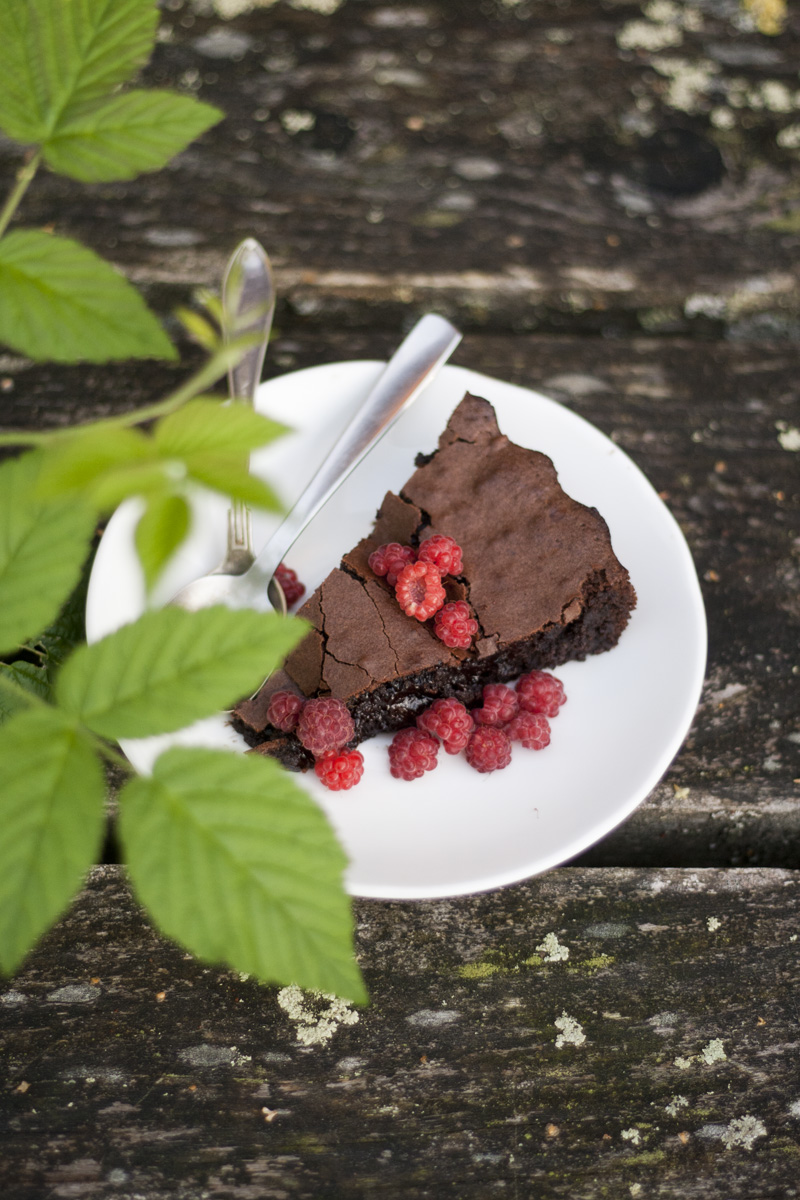
Now a few hours later, I went to pick – tiny – hallon [raspberries] by the pond. And all the times Karl told me to check for worms inside the berries finally made sense.
I cut myself a thick slice of the still-warm cake, fudgy around the rim and slighty gooey in the centre. And with a handful of my rather small bounty and a tall glass of filmjölk, it was just as delicious as I had hoped for.
Gluten-free chocolate fondant cake
You could make this cake with ground almonds only, but I couldn’t resist to try the gluten-free oat flour I found at the supermarket a few days ago.
The process is very simple. Not unlike a classic fondant cake.
The eggs and sugar get whisked together for a few minutes, until the sugar has almost dissolved. Then the melted chocolate and butter get folded in. And finally the flours. A quick trip in the oven; and voilà!
Gluten-free chocolate fondant cake
200 g 70% dark chocolate
250 g unsalted butter
5 eggs
250 g caster sugar
50 g ground almonds
40 g GF self-raising oat flour
8 g sea salt
Preheat the oven to 180°C, and generously butter a 26cm cake tin.
In a heatproof bowl, melt the chocolate and butter; either in a microwave or over a pan of simmering water. In a large bowl, whisk the eggs and sugar for around 4 minutes, or until fluffy and almost doubled in size. You don’t want to overdo it, it’s just a matter of dissolving the sugar.
Fold in the chocolate mixture, mixing well. And finally add the ground almonds, oat flour and salt. Pour into the prepared tin and bake for 24-28 minutes, until barely jiggling in the very centre of the cake.
Allow to cool down completely before slicing. Or scoop while warm, like I did.