Tag: recipes

  • Galette des rois

    Galette des rois

    [Almond king’s cake]

    Galette des rois

    The galette des rois is traditionally eaten throughout January to celebrate the Epiphany. Although, the its origin can be traced back to pagan celebrations of the winter solstice. In these celebrations, a cake was baked with a hidden bean inside, and whoever found the bean was crowned king of the feast.
    These days, galette des rois is composed of two disks of puff pastry encasing frangipane – a cream made by mixing both crème d’amandes and crème pâtissière, with a ceramic fève [trinket] baked into it.
    A southern version, called brioche des rois is a rich orange blossom brioche adorned with gorgeous candied fruits.
    When making galette, I like to freeze the shaped pastry for an hour or so, and then ALWAYS turn it upside-down on my baking mat/baking paper lined baking tray to provide a nice flat surface for scoring.
    Author: Fanny Zanotti
    Prep Time45 minutes
    Cook Time45 minutes
    Total Time1 hour 30 minutes
    Makes 1 large galette, enough for 8-10.

    Ingredients

    For the crème pâtissière

    • 185 g whole milk
    • seeds from 1 vanilla pod
    • 60 g egg yolks
    • 35 g demerara sugar
    • 20 g cornflour
    • a pinch of salt

    For the crème d’amandes

    • 125 g butter at room temperature
    • 150 g icing sugar
    • 1 tbsp vanilla sugar
    • 200 g ground almonds
    • 2 eggs
    • 20 g cornflour
    • a generous pinch of salt

    To assemble

    • 600 g puff pastry
    • one egg yolk beaten, to glaze

    For the glazing syrupe

    • 50 g demerara sugar
    • 50 g water
    • a pinch of salt

    Instructions

    • Make the crème pâtissière. Bring the milk and seeds from a vanilla pod to the boil.
    • in a bowl, combine the egg yolks, sugar, cornflour and salt using a whisk.
    • Temper the egg yolk mixture with the just-boiled milk and return to the sauce pan. Bring to the boil over low heat, whisking constantly.
    • Pour the crème pat into a heatproof container and cover with clingfilm to the touch.
    • Refrigerate until cold.
    • When the crème pat is cold, get on with the crème d’amandes.
    • Cream the butter, icing sugar and vanilla sugar in the bowl of a stand-mixer fitted with the paddle attachement until light and fluffy.
    • Add the eggs one at a time, mixing well after each addition.
    • Add the ground almonds, cornflour and salt and mix to combine.
    • Then add the crème pâtissière, in three times, mixing well and scraping the sides of the bowl as you do so.
    • The frangipane is ready to be used.
    • To make a galette des rois, you will need around 600 g puff pastry. Roll into into two large discs, around 4-5mm thick. Pipe the frangipane in the center leaving a 2cm edge. If you wish, place a ceramic fève in the frangipane – the one who gets it in its slice will be crowned king/queen. Brush the edge with water and top with the second disc of puff pastry, pressing the edges together well.
    • For a perfect finish, cut around the galette – through both layers of puff pastry to create a neat edge. Use a large plate with the right diameter and a small sharp knife.
    • If you want, you can then freeze the galette as is for 1 hour, you just want the puff pastry to harden so that it creates a nice flat surface for scoring later.
    • Then pre-heat the oven to 190°C /fan 180°C. And prepare a baking tray lined with a silicon mat or baking paper.
    • Place the galette upside-down onto the prepared tray. Brush with a beaten egg yolk and allow to dry 10-15 minutes. Score using the tip of a small knife.
    • Poke a few holes as well to let the steam escape.
    • Bake for 40-45 minutes until golden brown.
    • In the meantime, make the glazing syrup: bring the water and sugar to the boil, with perhaps a pinch of salt. When the galette is ready, brush immediately with the syrup.
    • Leave to cool slightly and serve in wedges.
  • Cake week-end au citron, confit de clémentines à la vanille

    Cake week-end au citron, confit de clémentines à la vanille

    [Lemon weekend cake, clementine confit]

    Originally published on January 29, 2010

    This is a cake I’ve made so many times over the years that I could make it with my eyes closed.

    I remember the first time I posted about it. It was early 2010, and a thin mantle of snow had fallen overnight, just enough to cover the ground.

    I had just started working as a commis pastry chef at the Capital, a small boutique hotel that would become the road map of my seven years in London. Yes, many of the chefs I consider my mentors and friends have – at one point or another – worked in the kitchen where I did my very first service.

    This reminds me that I’ll have to tell you, one day, about the time where I traveled across town – from Islington to Mayfair – on a vegetable delivery van to meet Chavot for an interview, leaving loaves of sourdough proofing in the kitchen above John Salt, and came back just in time to bake them before dinner service.

    But… this cake. A gâteau de voyage [a travel cake]. It doesn’t translate well, but the name alone suffices to evoke the soft lull of a holiday; the carefully wrapped slice, eaten on the night train; the afternoons at the beach; perhaps even, the long drive through the Massif Central.
    All gâteaux de voyage have the particularity to keep well at room temperature over a week or so. And this weekend cake is no exception, with both butter and crème fraiche to keep it moist, I find that it tastes even better the next day.

    It starts by whisking the eggs and sugar, with just a pinch of salt. The flours gets folded in. Then a third of the batter is mixed with the fats, then delicately folded back into the remaining batter.
    Although, I now often make it by adding the fats to the eggs, then folding in the flour.

    For the sake of staying true to my original recipe, I will leave the former method – as written in 2010, but know that both work fine, the latter leading to a slightly denser crumb, which I like when having cakes with tea or more accurately – and dare I say it – I love when dipping a slice in piping hot tea.
    Please, tell me you also give in to this ritual or am I the only one?

    And although, I can never resist it unadorned, I am rather fond of serving it with a generous spoonful of clementine confit and a dollop of crème fraiche.
    There is something about the suave softness of the compote against the gentle bite of the cake.
    Sometimes I even make it with tea – finely milled to a powder – folded into the batter. Other times, I leave it plain, perhaps with a touch of vanilla or orange blossom water, and we eat it with softly whipped cream and warmed raspberries.

    Yes, more than a recipe this really is blueprint and should be used as such.

    Just a quick note on baking temperatures: while I often bake this loaf cake at 175°C for approximately 45 minutes, I can only remind you of my favourite method for baking loaf cakes.
    5 minutes at 200°C/fan 180°C, 10 minutes at 180°C/fan 170°C, and around 25 minutes at 170°C/fan 160°C.

    Cake weekend au citron, confit de clémentines à la vanille

    Makes one loaf cake.

    For the clementines confit

    350 g clementines, around 3 to 4
    200 g caster sugar
    half a vanilla pod
    100 g water
    20 g cornflour diluted in 40 g cold water

    For the lemon weekend cake

    4 eggs
    250 g caster sugar
    zest from 2 organic lemons
    200 g plain flour
    one tsp baking powder
    150 g creme fraiche
    50 g butter, melted

    softened butter, extra for piping

    To serve

    a generous dollop of crème fraiche for each serving

    Make the clementine confit: bring a large pan of water to the boil. Plunge the clementines in it and simmer for 3 minutes. Sieve, placing the fruits in an ice-cold water bath as you do so. Repeat one more time. Then chill the clementines until cold enough to handle.
    Slice finely, and place in a pan along with the sugar, vanilla pod and seeds, and water.
    Simmer for 30 minutes or until reduced and almost candied. Then vigorously fold in the cornflour mixture. Allow to boil for a couple of minutes, and transfer to a bowl.
    The confit will keep in the fridge for up to 5 days or in the freezer for up to 3 months.

    Make the cake batter: preheat the oven to 175°C/fan 155°C; butter and flour a loaf tin.
    Place the eggs, sugar, lemon zest, and salt in a bowl, and whisk until thick and doubled in size.
    In an another bowl, mix the flour and baking powder, and fold into the egg mixture.
    Pour a third of the batter onto the cream and melted butter, mix well, and transfer back to the main batter mix, gently folding in as you do so.
    Pour into the prepared tin. If you want an even crack in the center of your loaf cake, pipe a thin line of softened butter across the batter; and bake for 45 minutes, or until a knife inserted in the cake comes out clean.
    Allow to cool down 20-30 minutes before unmoulding.
    If not eating right away, place into an airtight container and keep at room temperature.

    Place a slice of cake cut in half lengthwise in a plate. Top with both a spoonful of confit and a dollop of crème fraiche.

  • Saffransmazariner

    Saffransmazariner

    [Saffron mazariner]

    Twelve weeks ago, almost to the second, Sienna was put on my chest; pink as a candy, eyes wide open. Twelve weeks that went quickly, and also, twelves weeks when winter came and went more times that I can count.

    There was the night we rushed to the maternity; the air suddenly so sharp we’d forgotten how it felt against our cheeks. There was the first snow, as early as the third of October, which was gone a few days later; and as it did, the longing for a winter as I had known it only became more intense with every morning that passed by without a snowflake. And then, one day, winter was here, not that it didn’t come without a warning.
    The afternoons by the river, frost on every branch. That Sunday when snowflakes were big as cotton balls. And the clear evening skies we had last week when the temperatures dropped to -20°C.

    In our kitchen, there is a bread made of rye and filmjölk [sour milk] on the counter. And every time we open the pantry, the earthy smell of saffron fills the room. We have blueberry cakelets in the fridge, and lussekatter in a jar above it. A mjukpepparkaka [gingerbread cake] on our table, and a baking tray filled with brown butter and cardamom salted caramel, waiting to be cut.

    Yes, there is so much I want to tell you about, but Christmas is only a few days away, and some things cannot wait, like these saffransmazariner.

    Saffransmazariner

    A mazarin is a tartlet traditionally composed of three elements:
    – a crisp pâte sablée case
    – an almond cream filling, not unlike the French crème d’amande
    – a simple icing sugar glaze

    Sometimes, a thin layer of jam covers the bottom of the tart shell, or the filling can be topped with fresh berries before baking, in which case, the mazarin isn’t glazed.

    Its origin – although I haven’t quite had the time to research – seems rather uncertain, possibly linked to an Italian cardinal who moved to Paris and first assisted Richelieu, only to succeed him in the mid seventeenth century.
    Through his regency, Cardinal Mazarin has been thought to popularise pasta and perhaps, other Italian delicacies in France and Sweden (which were rather new allies then). And although there is no evidence of it in literature, mazariner do strongly remind me of the traditional crostata di mandorle, a very similar tart from Italy.

    My saffron mazariner are the festive version of the Swedish favourite. You see, I have the bad habit to buy mazarinformar [mazarin moulds] at every garage sale; so really, I’m always looking for an excuse to bake them under one form or another.
    You can use any tartlet moulds, ideally around 5-6cm in diameter, but in a pinch, I suspect a muffin tin will do fine too. A large mazarin, sliced in thin wedges would also look fantastic on a cake stand!

    The dough – my usual pâte sablée, with a touch of baking powder for an extra brittle shell – will make more than you need, but you can:
    – do as I usually do and line additional moulds (around 40), and keep them in the freezer for up to two months
    – freeze the extra dough, which you can later use to line a 24cm tart tin
    I tend to make it in the food-processor, but a stand-mixer works too. As always, I can only recommend rolling it before letting it to rest in the fridge; however this dough is quite forgiving, and when I don’t want to use up a lot of baking paper or if I’m feeling lazy, I will wrap the dough in clingfilm, and chill it for 20-30 minutes, then roll it onto a lightly floured bench. For more tips on how to handle tart dough, please refer to these posts here.

    Mazariner freeze beautifully. On the day you want to eat them, simply take them out for a few hours, and glaze them with a simple icing sugar glaze.

    Saffransmazariner

    Makes 28

    For the pâte sablée

    360 g plain flour
    90 g icing sugar
    1/2 tsp sea salt
    1/4 tsp baking powder
    200 g unsalted butter
    100 g eggs (2 medium)

    butter, melted to grease the moulds

    For the saffron filling

    150 g unsalted butter
    1 g ground saffron
    300 g good quality marzipan (minimum 50% almonds), coarsely grated
    100 g eggs (2 medium)
    1/2 tsp sea salt
    10 g plain flour (approx. 1 tbsp)

    For the glaze

    250 g icing sugar
    water from the kettle

    Make the dough. In the bowl of a food-processor, place the flour, sugar, salt, baking powder and butter, and mix until the mixture ressembles wet sand. Add the eggs and pulse until it just starts to form a dough.
    Divide the dough in two and roll each piece to 3-4mm thick between two sheets of baking paper. Place onto a tray and chill in the fridge for 20-30 minutes.

    In the meantime, preheat the oven to 175°C/fan 160°C, and brush 28 (or more, read note above) tartlet moulds with melted butter; setting them aside until needed.

    Make the filling. Melt the butter in a small pan and add the saffron. Mix well and allow to infuse for a few minutes.
    Place the marzipan, eggs, salt and flour in the bowl of a food-processor and mix to a smooth paste. Slowly add the butter, mixing as you do so.
    Transfer the filling to a piping bag.

    Take the dough out of the fridge and loosen the top sheet of baking paper. Flip over and remove the other sheet, this way, the dough still is on baking paper, yet doesn’t stick to it (I hope that makes sense).
    Cut out the dough into small ovals or circles, depending on the shape of your tins, and line each with dough, trimming the excess using your thumb or a small paring knife.

    Place the lined moulds onto a baking tray, and fill them with your saffran almond cream, around 3/4 full.

    Bake for 20-25 minutes or until golden brown. Allow to cool down for 10-15 minutes, then unmould.

    Mix the icing sugar with a drop of hot water, just enough to form a thick paste, and spoon on top of the mazariner. Allow to set for an hour or two, then store in an airtight container for up to five days. You can also freeze the unglazed mazariner for up to 3 months (see note above).

  • Apple pie shortbreads

    Apple pie shortbreads

    On snow.

    The first snow didn’t settle onto the ground. That night, the clouds broke into minute snowflakes as we stepped out from the house. And just like I did last year and the year before that, I stopped and stared into this black and white kaleidoscope for what could have been a nightlong, a lifelong really.

    It’s been snowing every day ever since. Flakes fluffy as cotton balls. At times for seconds, other times for hours. And although it still hasn’t turned our streets white, I have a feeling it won’t be long before it does.

    On nesting.

    There are the lamps on every windowsill, turned on as the sun sets, slightly earlier with every day that passes; for now, around half past four.

    There are the candles we burn, and the evenings spent threading rönnbär [rowan berry] into garlands.

    There is the soup plate that stands on our kitchen counter, by the right of the sink. In it, pinecones I collected during a walk in the forest, perhaps the last one before winter sets in. I turn them around every morning as I wait for my coffee to brew, and they open into an almost fractal pattern as they dry.

    There are the biscuits we bake. An early batch of pepparkakor [gingerbreads] – adapted from this recipe, more to come later -, crisp chocolate drömmar [dreams], made with hjorthornssalt [ammonium carbonate], and of course, cinnamon shortbreads. We keep a small tuperwareful of each in the last draw of our freezer, safely nested among the neverending bags of berries we picked under a summer that never really happened.

    But that’s another story for another day. In the meantime, here is to winter!

    Apple pie shortbreads

    These shortbreads were inspired by K., who suggested on one of our weekly trips to the store that we make biscuits filled with apple compote.

    We put a kilogram of small Swedish apples in our basket, along with a bag of caster sugar, and a block or two of butter.
    By the time we came home, we’d formed a pretty clear idea of these biscuits, even going as far as naming them apple pie shortbreads; because it is, essentially, what they are.

    The dough, made short with a lot of butter and a generous amount of starch is the updated version of this recipe by Leila Lindholm. Depending on what’s in my cupboards, I’ll make it with either potato starch or cornflour, and so should you.
    It’s a dough I use for many biscuits: from cinnamon shortbreads to hallon [raspberry] thumbprint cookies. A firm favourite in our house.

    The compote is cooked quickly over medium heat until the apples have released their juices, and begin to soften.
    You can use any apples that hold their shape well during baking. The list is long, but I’d suggest braeburn, royal gala, fuji, golden or granny smith, just to name a few really.

    You could pass on the glaze, although I think it is a wonderful addition, both in terms of sweetness and texture. As mentioned in the recipe below, I would however leave it out if keeping these in the fridge or the freezer, then glazing them right before they’re ready to be served.

    And as always, I bake my biscuits quite darker than the Swedes usually do; perhaps a French trait I can’t seem to rid of, I truly find that it makes for a better texture and a slight caramel flavour.

    Apple pie shortbreads

    Makes 24.

    For the dough
    300 g plain flour
    80 g potato starch or cornflour
    1 tsp sea salt
    320 g unsalted butter
    , diced
    130 g icing sugar
    1 tbsp vanilla sugar

    For the apple compote
    2 generous tbsp unsalted butter
    200 g peeled, cored and diced apples
    , around 2-3 medium
    30 g caster sugar
    1 tsp ground cinnamon
    a pinch of salt

    For the glaze
    icing sugar
    boiling water

    Line two baking trays with baking paper and preheat the oven to 180°C/fan 160°C.

    Whisk the flour and potato starch to combine, then set aside.
    Cream the butter, icing sugar and salt in a stand-mixer fitted with the paddle attachment. Add the flour mixture and mix on low speed until a dough forms.

    Roll the dough into a log and cut it into 24 even slices.

    Roll each slice into a ball, then flatten it onto the prepared baking tray. Gently dent each shortbread using your thumb or the bottom of a small glass. Repeat with the remaining slices, and chill in the fridge while you get on with the apple compote.

    In a frying-pan set over high heat, melt the butter until it just starts to foam. Add the diced apples and stir to coat. Add the sugar, cinnamon, and salt, and reduce the heat. Cook until the apples start to soften, around 8-10 minutes.
    Immediately transfer to a small plate and set aside to cool down slightly.

    Fill each indent with a fat teaspoon of apple compote.

    Bake in the pre-heated oven for 20 to 24 minutes, or until golden-brown. Allow to cool down completely.

    Make the glaze by mixing icing sugar and just-boiled water until it has a firm pouring consistency. Drizzle the glaze over the cookies and allow to set for 10-15 minutes.

    Stored into an airtight box, these will keep for a week at room temperature.
    Without the glaze you can keep the shortbreads for a little over a week in the fridge and up to three months in the freezer.

  • Glad Lucia, a lussekatter history (and recipe)

    Glad Lucia, a lussekatter history (and recipe)

    Traditionally eaten for Santa Lucia on the thirteenth of December, lussekatter – also called lussebullar – have a nebulous history. One that’s laced with Christianity and paganism, German and viking heritage.

    In fact, even the origin of the Lucia celebrations is quite elusive.

    Lussi, an evil figure roamed the land along with her lussiferda, a horde of trolls and goblins.

    Lussinatta once coincided with the Winter solstice back in the 1300s when Europe still used the Julian calendar. During that night, the longest of the year, it was said that animals could talk and supernatural events could occur; Lussi, an evil figure (that holds many similarities with the german Perchta or the italian Befana) roamed the land along with her lussiferda, a horde of trolls and goblins, punishing naughty children and casting dark magic. People, forced to remain secluded, would eat and drink in an attempt to fight the darkness.

    And as the years went by in the pre-Christian Norden, farmers started to celebrate the return of the light and the tradition of a goddess of lights took roots in the pagan folklore.
    It was also the start of festivities of some kind – not to say Christmas, although it is believed that both Christian and heathen traditions started to blend from the 1100s . In fact the very origins of the word jul [Christmas] are blurry, with one occurrence dating back to Harald Hårfager who might have said: “Dricka jul!” [drink Christmas!].
    During these celebrations, pig would get slaughtered, both for the gods and for the feast.

    The tradition of a feast and offerings is documented in Erland Hofsten’s unpublished manuscript Beskrifning öfwer Wermeland, dating from the early 1700s. And although no further narrative is given, Hofsten believed in a pagan provenance.

    The first printed description comes a few decades later in 1773 through Erik Fernows’ Beskrifning öfwer Wärmeland: “Man skall den dagen wara uppe at äta bittida om ottan, hos somlige tör ock et litet rus slinka med på köpet. Sedan lägger man sig at sofwa, och därpå ätes ny frukost. Hos Bönderne kallas detta ‘äta Lussebete’, men hos de förnämare ‘fira Luciäottan’.” And now if you please excuse my poor translation/paraphrase (Swedish is hard enough without having to deal with old Swedish): On that day, we should be up early (otta is an old Swedish word akin to night, but really means the time of the day when the night becomes the morning, around 4-5am) to eat, and for some, a shot of snaps would go down. Then we’d lay on the sofa and would later eat another breakfast. Amongst the farmers this would be known as to “eat Lussi’s bait”, but for the more affluents it was called a “Lucia morning celebration”.

    One that spread from Värmland to Västergotland where C. Fr. Nyman encountered the custom for the first time, as described in his unpublished 1764 manuscript: “Rätt som jag låg i min bästa sömn, hördes en Vocalmusique utan för min dörr, hvaraf jag väcktes. Strax derpå inträdde först ett hvit-klädt fruntimmer med gördel om lifvet, liksom en vinge på hvardera axeln, stora itända ljus i hwar sin stora silfversljusstake, som sattes på bordet, och strax derpå kom en annan med ett litet dukadt bord, försedt med allehanda kräseliga, äteliga och våtvaror, som nedsattes mitt för sängarna… det är Lussebete .” That morning he was awaken by songs coming from outside his door. He then proceeded to meet a white-clad lady wearing wings and holding a large silver candlestick, which she placed on the table. And soon after another lady came in carrying a small table lined with cloth and full of food and drinks, which she laid in between the beds. In his story, C. Fr. Nyman, calls it Lussi’s bait, reinforcing not only the heathen terms of the celebration, but also hinting about the origin of the lussekatter.

    It is noted in Nordisk familjebok 1912 that it was common to bake a peculiar bread shaped as a L and called “dövelskatt” [the devil’s tax] in south-western Sweden: “I sydvästra Sverige bakas till L. ett särskildt kultbröd, kalladt ‘dövelskatt’”.
    And with different spellings like the Dutch duyvelskat, or the more common Lussebette, it’s hard not to think how the word we all thought meant Lucia’s cats was actually intended to be an offering to Lussi in exchange for her mercy. Or as it’s described in this interview of Anna Freij that the buns were tinted bright yellow with saffron to scare the devil away.

    With the introduction of the Gregorian calendar in the 16th century, Lucia no longer coincided with the winter solstice, but the customs of December 13th being the longest night of the year remained strong in the farming community throughout the centuries and up to the 1700s.
    And it’s suspected that as Christianity grew in the north, the church tried to associate the pagan tradition with Santa Lucia, mostly based on phonetics and etymology (latin lux: light).

    And just like that, the customs of eating saffron bread, something that was once reserved to the higher classes of southern Sweden, started to spread amongst rural Sweden, where wheat buns would be brushed with a saffron-infused syrup; with each province having their own distinctive shaped bun.

    I hope that what was intended to be “just a recipe” five or so hours ago, brought some insight into this wonderful tradition, which like many others is a complex maze of cultural and historical layers tangled into each-other like morning hair.

    Here are the sources I’ve used to this little research:
    http://runeberg.org/svetym/0512.html
    https://en.wikipedia.org/wiki/Harald_Fairhair
    http://www.firajul.nu/julenstraditioner/ordet-jul
    http://www.bageri.se/aktuellt/nyheter/varfor-ater-vi-saffransbrod-till-jul/
    http://malinryke.blogspot.se/2014/12/lussekattens-historia.html

    Lussekatter

    Come early November, every supermarket launches their annual production of lussekatter, which I suspect are loved by many.
    As soon as you step in, the sweet scent of saffron gives away the trolleyful of golden buns waiting to be wrapped in small plastic bags. I have never tasted one from the shop, but from what I'm told they tend to be on the dry side.
    My lussekatter, although certainly not authentic as their supermarket counterpart, are a dream to work with, to eat warm from the oven, or toasted the next day, to soak in an egg whisked with a dash of cream, milk, and sugar, and then pan-fried until golden, not unlike a French Swedish-toast.
    The recipe itself is a simple enriched dough that some would be tempted to call a pain au lait [milk bread]. As with any rich dough, I recommend using a stand-mixer, althought it's definitely possible to make them by hand, simply follow the instructions given on that post.

    Notes

    A note on the saffron:
    If you don’t have any ground saffron, simply bring the milk to the boil and soak/infuse the saffron threads in it for at least 30 minutes. You will have to wait for the milk to be completely cooled down before using in the recipe.
    Edit 13/12/2018: Nowadays, I always tend to dissolve the saffron in a tablespoon or so of rum. I find it brings out the flavour even more!
    Author: Fanny Zanotti
    Prep Time1 hour
    Cook Time12 minutes
    Makes 20 buns

    Ingredients

    For the raisins

    • a handful of raisins
    • boiling water

    For the dough

    • 250 g unsalted butter
    • 600 g strong flour
    • 75 g caster sugar
    • 18 g fresh yeast
    • 0.5 g one envelope ground saffron (read note above)
    • 7.5 g sea salt
    • 375 g whole milk

    Instructions

    • Soak the raisins in boiling water and set aside to cool down. This can be done up to three days ahead, in which case, keep the soaked raisins in the fridge.
    • Slice the butter into thin 2-3mm thick slices. Set aside until needed.
    • In the bowl of a stand-mixer fitted with the dough-hook, place the flour, sugar, yeast, saffron and salt. Add the milk and mix on medium speed for around 10 minutes or until the dough detaches from the sides of the bowl and feels smooth, elastic and barely tacky. If you take a small piece of dough, you should be able to stretch it into a very thin membrane.
    • Add the butter, one small piece at a time continuously until all the butter is in – and knead it in for a further 10 minutes.
    • Place the dough in a large bowl, and clingfilm to the touch. Refrigerate for at least 3 hours or up to 12.
    • Line three baking trays with paper and set aside.
    • Scrape the dough onto a lightly floured surface and divide in 50-55g pieces and cover loosely with clingfilm.
    • Take one piece and roll into a thin snake, approximately 30cm long, then form an S shape, curling both ends into a spiral. Place onto the prepared baking trays, making sure to give the buns plenty of space. And repeat with the remaining dough.
    • Cover with clingfilm and leave to proof until doubled in size, around 2-3 hours.
    • Preheat the oven to 200°C/fan 180°C.
    • Brush the top of the buns with the egg wash and press two raisins into each bun.
    • Bake for 10-12 minutes until golden-brown. Allow to cool down slightly.
  • Kladdkaka du dimanche

    Kladdkaka du dimanche

    [Swedish chocolate cake, of the Sunday kind]

    Everytime I come around here, a whole season has gone by.

    There was summer and its endless hours in the kitchen that I now call home. But before we knew it, the time for semester [holidays] came. And went.

    Two weeks in our stuga [cabin] in the middle of the woods; and I still stand by my words when I say Åsen is my dream place. A dream that – this time – we shared with my family who traveled the three-thousand kilometres between us.

    We picked blåbär [blueberries] and lingon; and my father – who’d never been this up north ever before – spent a day teaching me where to find mushrooms in the Swedish forests, reminiscing the mornings we’d busied up in the lower Alps more than twenty years ago now. We picked mostly giroles, but also ceps and chanterelles, although it was still a little early in the season for the latter.

    We visited the small factory where the dalahäst we cherish so much are made, a short twenty minute drive from the stuga, in the heart of Dalarna. My mother bought more horses that she could – literally – handle; and the picture I took on my phone will always be a favourite memory of mine.

    We baked traditional Swedish snittar and drömmar [biscuits] that now also have a strong following in a little house of the south of France.

    Then came the golden days – that I must admit, I almost wrote as “goldays”, perhaps I am onto something – of autumn.

    Long walks by the river to the sound of the wind through birch branches so tall it makes you dizzy. And no matter what, I will always be in love with the peculiar colour of a sun setting through these trees that are now a part of my universe.

    There is the smell of rain. And dead leaves too. And of pumpkin roasting in the oven, just so. There is the first frost, which I had predicted to the day. Yes, to the day! And the rönnbär [Rowan berries] we picked and candied; a jar that will probably be forgotten at the back of the fridge for another few weeks before it makes an appearance on our table.

    And rather unexpectedly, there was winter too.

    The day after we’d moved to our new flat. The view of Skellefteå rooftops from our bed; one minute black as coal, the next covered in a thick mantle of snow. A snow that lasted for a week, even though back then, we did not know that just yet.
    The following Sunday, we pulled the suspenders of our warm overalls up and wrapped ourselves in wool. A morning in the snow, and an afternoon by the kitchen stove. And somewhere in the middle, kladdkaka and wine were involved.

    My Swedish kladdkaka recipe
    This is not a recipe I had planned to share with you, although it’s one that followed us through the seasons.

    Served with barely whipped cream and freshly picked berries in the summer; roasted pears and vanilla ice-cream in the autumn, and now made in a cardboard box kitchen as we were unpacking the things we love enough to have taken along on the ride that took us here to the north of Sweden.

    Yes, this kladdkaka recipe is just that. An everyday wonder; whipped up in less then ten minutes, it can be as fancy or as casual as you want it to be.

    And today, I thought I’d test the halogen builders site light Kalle bought last year for me to be able to take pictures through our long winter. And that perhaps, you’d appreciate to have your Sunday fika sorted out for the weekend ahead.

    In case you still have your doubts, you should know Sam’s – 3 year-old – stance on the subject: “De är jättekladdiga!” [They are very sticky*].
    * A good thing since kladdkaka literally means “sticky cake”, although I have a feeling chewy would be more of an appropriate translation.

    My Swedish kladdkaka recipe

    Makes one 22cm cake, serving 8-10.

    125 g unsalted butter
    250 g caster sugar
    1 tbsp vanilla sugar
    2 eggs
    90 g plain flour
    40 g cocoa powder
    5 g sea salt

    Preheat the oven to 175°C. Butter and line a 22cm tin with baking paper.

    Melt the butter in a pan set over medium heat.

    Off the heat, add the sugars and allow the mixture to cool down slightly for 2-3 minutes. Whisk in the eggs, one at a time, mixing well after each addition.

    Add the flour, cocoa powder, and salt, and mix until just smooth.

    Pour the batter in the prepared tin, and bake for 25 minutes, or until domed and cracked on top. Allow to cool down completely before serving.

  • Our favourite cinnamon shortbreads

    Our favourite cinnamon shortbreads

    winter walk-3

    It’s still very much winter here in Skellefteå. In fact, we’ve had a blizzard over the weekend; snow, at times twirling around with the winds; and at other times, falling almost horizontally. A western under the snow. Not unlike the Dyonisos album that lullabied my teenage years.

    Oh love me, Oh kiss me,
    I’m lying on western under the snow
    You’re the sky of my heart
    So come to me and take off your clouds

    But there’s been something different in the air. It might have started on a Monday, almost a month ago.

    There are the birds. And a sun warmer and brighter than it’s been for months. There are the morning walks by the river. And the temperatures that have risen from -26°C to -10°C.

    Today, we opened our windows as the sun rose – the crisp air filled our flat while we were safely nested under the duvet. A make-believe spring of some kind. Something only we know; or perhaps, something only we make up.

    Not much has happened in our kitchen. Dinners made of glass noodle salad with barely-warm roasted salmon. A few nights made of crispy rice and red wine. And Kalle’s wonderful breakfasts; the latest edition involving tomato sauce with plenty of onion and garlic, golden-brown bacon, eggs – with a yolk runny as it should be, perhaps some beans too. But most importantly, the råg or vete-kakor [soft polar bread] that he cuts into four and fry in the rendered bacon fat until almost burnt.
    You’d also find a glass-jarful of biscuits on the counter. Sometimes, drömmar or syltkakor; but mostly our favourite cinnamon shortbreads.

    And just like we were in love with a crispy cinnamon biscuit recipe last year (which you should try too as they’re on the opposite spectrum of the shortbreads I’m showing you today), 2016 has been about kanelkakor.

    Our favourite cinnamon shortbreads
    Adapted from Leila Lindholm’s A Piece of Cake.

    In Swedish, these shortbreads are called spröda kanelkakor; literally brittle cinnamon biscuits. And they are just that. Crisp and golden. With cinnamon just so. And when bitten, they’ll crumble into tiny morsels.

    I like to bake them until golden-brown, which would be considered an offense by any Swedish mormor [grand-mother]. Yes, here, most biscuits are likely to be baked into the palest shade of gold; when the base just starts to brown around the edge.
    But no matter how far north I now live, you can’t take the French in me away from deep-caramel tones.

    The original recipe calls for a tablespoon of water, which I of course replaced with vanilla extract. Yes, vanilla never is a bad idea. And yes, you can forever-quote me on that.

    The dough itself comes together in a minute or so. And perhaps, that’s why we’ve baked these shortbreads more than any other over the winter.
    And although the recipe rightfully suggests to leave the dough wrapped in clingfilm in the fridge for at least an hour before baking, I haven’t found it necessary when I used cold butter. However, if your kitchen temperature exceeds 18°C, I’d recommend going ahead with this step to make sure your shortbreads won’t spread too much.

    Our favourite cinnamon shortbreads

    Makes 12 larges biscuits or 16 smaller ones.

    For the dough
    225 g plain flour
    75 g icing sugar
    60 g potato starch
    1 tsp sea salt
    1 tbsp vanilla extract
    225 g cold butter
    , cut into 0.5cm cubes

    For the eggwash
    one egg, beaten

    For the cinnamon sugar
    Combine:
    100 g granulated sugar
    1 tbsp ground cinnamon

    Line two baking trays with baking paper and preheat the oven to 175°C (165°C for a fan-assisted oven).

    Place all the ingredients in the bowl of a stand-mixer fitted with the paddle attachment, and mix on low speed until it forms a dough.

    Roll the dough into a log and cut it into either 12 or 16 even slices, depending on the size you want your shortbreads to be.

    Roll each slice into a ball, then flatten it onto the prepared baking tray. Repeat with the remaining slices.
    Press a fork into each shortbread, then brush with the beaten egg and sprinkle with the cinnamon sugar.

    Bake in the pre-heated oven for 20 to 24 minutes, or until golden-brown. Allow to cool down completely before placing them into an airtight box. These will keep for at least a week; although they’ve never lasted this long in our home.

  • Saffransbullar med mandelmassa

    Saffransbullar med mandelmassa

    [Swedish saffron and almond buns]

    Sunrise: 9:33 AM
    Sunset: 1:28 PM
    Temperature: -11.8°C

    The Swedish saffron and almond buns you see here were made on the twenty-fourth of November. Perhaps, it was a Tuesday. Or a Monday. But I remember how we made the dough the night before. And topped it with marzipan butter in the morning, just as a trumpet in the distance started playing Christmas melodies. I might have let them overproof as I went for a walk in the snow.

    Yes, I might have.

    Since then, I’ve made them countless times at the café and twice more at home. For a Christmas fika.

    Today, I have a different kind of saffron buns proofing on my kitchen counter: lussekatter. A simple saffron dough, rolled and twirled into shape.
    And I’m pretty certain that every house in Sweden also smells like warm saffron. And perhaps, if they’re as lucky as we are, of forest and cinnamon too.
    Because it’s St Lucia today. And the third Sunday of advent.

    But I’ll have to wait to show you the lussekatter, as the sun set hours ago and it’s now too dark to take pictures.
    However, I’m sure that these bullar will make a perfect in-the-meantime treat. And possibly make you wish for a forever in-the-meantime moment.

    Saffransbullar med mandelmassa

    For these buns, I adapted my usual kanelbullar recipe by adding saffron to the dough. Here in Sweden, saffron is easy to come across and fairly inexpensive – compared to France or the UK. One of the things I find particularly pleasant, is that the saffron comes already ground so you don’t have to infuse it in warm liquid like I’ve been used to with the threads.

    Edit 13/12/2018: Nowadays, I always tend to dissolve the saffron in a tablespoon or so of rum. I find it brings out the flavour even more!

    If you don’t have any ground saffron, simply bring the milk to the boil and soak/infuse the saffron threads in it for at least 30 minutes. You will have to wait for the milk to be completely cooled down before using in the recipe.

    The filling recipe comes from my friend Suss, my one and only reference when it comes to all things related to Swedish baking. She’s an amazing baker and these buns alone prove it!
    It’s really straight-forward: butter, marzipan, and the zest of an orange; and yet, it makes for the best saffron buns you’ll ever find.

    Saffransbullar med mandelmassa

    makes around 14-16

    For the saffron dough

    530 g strong flour
    70 g caster sugar
    16 g fresh yeast
    10 g sea salt
    0.5 g ground saffron
    (see note above)
    3 eggs (150 g)
    190 g whole milk
    150 g unsalted butter
    , at room temperature

    For the almond butter

    160 g salted butter, at room temperature
    160 g marzipan
    zest from 2 oranges

    For the topping

    1 egg, beaten, to glaze
    a handful of pearl sugar

    For the syrup

    75 g caster sugar
    75 g water

    In a large bowl, combine the flour, caster sugar, yeast, salt and saffron. Add the eggs and milk, and mix with a wooden spoon until a dough forms. Transfer to a clean work surface and knead by hand for around 20 minutes – if you’re making the dough in a stand-mixer, fit it with the hook attachment and knead on medium speed for around 10 minutes, until the dough detaches from the sides of the bowl and feels: – smooth, elastic and barely tacky. If you take a small piece of dough, you should be able to stretch it into a very thin membrane.

    Add the butter in three or four times – if making by hand; if you’re using a stand mixer, add the butter, one small piece at a time continuously until all the butter is in – and knead it in for around 10 minutes. The dough will “split” as you do so and butter will smear over your work surface, but keep on adding butter until it’s all used. Then knead the dough until smooth again. Place in a large bowl, and clingfilm to the touch.

    You could proof the dough for 1 hour at room temperature and then place it in the fridge for at least another hour before using it, or refrigerate straight away for at least 8 hours and up to 24 hours.

    The next day, get two baking trays ready by lining then with baking paper. Make the almond butter by mixing all the ingredients until smooth and spreadable.

    Slightly flour your work bench and tip the dough over. Roll into a 30 x 60 cm rectangle, around 5-6mm thick, with the short end facing you. Spread the almond butter evenly over the lower 2/3 of the dough. Then fold the dough into three, first the top part over the centre, then the bottom (and closest to you) over the rest. You should be left with a 30 x 20 cm-ish rectangle.

    Cut 2cm wide strips and roll each into a knot, and place it on the prepared baking tray. Keep on going until all the strips are rolled.

    Cover loosely with clingfilm and allow to proof for a couple of hours or until doubled in size.

    Preheat the oven to 185°C.
    Brush the top of the buns with the egg wash and sprinkle with pearl sugar.

    Bake for 12-16 minutes or until golden brown.
    Transfer to a wire-rack using a palette knife and allow to cool down slightly.

    For extra shiny buns, brush the top of your just-baked bullar with a simple syrup made of equal quantity of sugar and water brought to the boil.

    Let me know if you try to make them 🙂 Lots of love, and a wonderful week!

    pS. If you want to follow my Swedish Christmas adventures, use #fannysjul on instagram. X

  • Macarons au chocolat blanc caramélisé et aux noisettes

    Macarons au chocolat blanc caramélisé et aux noisettes

    [Caramelised white chocolate and hazelnut macarons]

    I’d like to tell you I’ve made macarons today. I had planned to. Really. Last week, we bought mandelmjöl [ground almonds] and florsocker [icing sugar]; mjölkchoklad [milk chocolate] and vispgrädde [whipping cream].

    But you see, we’ve been for walks everyday. At times, in the forest. Or by the river. And, always, in the snow.

    And the chocolate bars we wrapped in foil – along with kokkaffe and the old kaffekanna [coffee pot], perhaps a square or two of Tatin tart salted caramels too, and a few baconost [bacon cheese] sandwiches that K. loves to make with lingonbröd [lingonberry bread, which I’ve seen an amazing recipe for here, and I can’t wait to go pick lingonberries to make it] – well, they’re gone.


    Yes, I wanted to make moka macarons, but we’ve eaten all the chocolate before it even got the chance to be turned into a whipped ganache, just so.

    Instead, we made the most of last night snowfall. For K. and Kaiser, the not-so-puppy-anymore you’ve perhaps seen on my pictures, it most likely involved effortless runs over the ice. For me, it means that the one patch of slippery mud will land me somewhere I didn’t decide to. Repeatedly 🙂

    Macarons au chocolat blanc caramélisé et aux noisettes

    When I realised I had never posted a recipe for macarons, I couldn’t believe it. It’s not like I haven’t spent the last seven years of my life making some almost daily. Pistachio and vanilla were ranking high amongst all. But I’ve also made some with elderflower and champagne, fermented mango, coconut and lime, salted caramel, avocado and chilli, pumpkin and cinnamon, rhubarb and cream. Even beetroot and orange ones. The list could go on for – almost – ever, really.
    And that’s what I love about macarons, how versatile they are.

    These ones are made with caramelised white chocolate – a love of mine, and roasted hazelnuts.
    At times, I like to fill my macarons with a crémeux instead of a ganache to lower the sweetness slightly. However, macarons made with crémeux will only keep for a couple of days in the fridge before getting a bit too moist. They will keep beautifully frozen though, and judging by how many times I’ve seen our container in the freezer getting emptier and emptier, I’m sure some chefs – whose names will remain undisclosed – can vouch for it.

    The recipe for the shells is adapted from Andrew Gravett’s beautiful macarons. He’s an amazing pastry chef and person, and I couldn’t be anymore grateful to have followed him in one way or another during my six years in London.
    It’s super-foolproof. And trust me, this is something you want your macarons to be.

    The stages are quite simple really: start by making a smooth tant-pour-tant, for this I like to use extra fine ground almonds as they give a more flawless finish.
    Then make an Italian meringue, which you fold into the almond mixture and the extra egg whites.
    After all is incorporated, you’ll deflate the batter slightly. This step, called macaronage, can be done with either a maryse or a plastic scraper. I like to use a plastic scraper and push the batter against the sides of the bowl until I have the correct texture. Now, it’s quite hard to describe the texture of the finished macaron batter: it should almost form a ruban and when the batter drops, it should smooth out into the rest, leaving only the tiniest bump.

    If you’d like I could write a little post about macaron troubles and what they mean. Perhaps we’d call it the macaron doctor?
    In the meantime, here are a few notes on macarons:
    – flat and odd shaped macarons with bubbles mean your batter was over-mixed.
    – gritty macarons with a pointy top means your batter was under-mixed.
    – cracked shells can mean two things: too much humidity in your kitchen/oven or your oven temperature is too high.
    – shells that stick to the silicon mat: try to bake them a minute or two longer.

    Macarons au chocolat blanc caramélisé et aux noisettes

    makes around 40 macarons

    for the caramelised white chocolate
    100 g white chocolate

    Preheat the oven to 180°C/fan 160°C. Place the chopped chocolate onto a baking tray lined with a silpat. Bake for 8 minutes, or until the chocolate is golden-brown. Take out from the oven, and using an off-set palette knife, work the chocolate to even out the colour and smooth it out. Allow to cool down while you get on with the rest.

    for the hazelnut paste
    300 g blanched hazelnuts

    Preheat the oven to 165°C/fan 145°C and roast the halzelnuts for 20-25 minutes, or until golden-brown. Save 100g to chop for decorating shells. And blitz the remaining 200g in a mixer until you have a smooth paste, around 8 minutes.
    This will make more than you need, but you can keep it in a container in the fridge for later use.

    For the caramelised white chocolate and hazelnut crémeux
    1 g gelatine 200 bloom
    50 g hazelnut paste
    60 g caramelised white chocolate
    50 g milk
    50 g 35% cream
    a fat pinch of salt
    1 egg yolk

    Soak the gelatine in ice-cold water. Place the caramelised white chocolate and hazelnut paste in a bowl.
    Bring the milk and cream to the boil. Pour onto the egg yolk, whisking as you do so. And return to the pan. Cook over low heat to 80°C, stirring at all times with a silicon spatula. Off the heat, add the squeezed gelatine. Then pour onto the white chocolate in three times, emulsifying well to create a glossy core. Handblend for 3 minutes to emulsify further.
    Transfer to a container and clingfilm to the touch. Chill for at least 4 hours or up to 3 days.

    For the macarons
    150 g icing sugar
    150 g ground almonds
    55 g egg whites
    150 g caster sugar
    50 g water
    55 g egg whites
    15 g caster sugar

    100 g roasted hazelnuts, chopped and cooled down

    In a small blender, blitz the icing sugar and ground almonds for a couple of minutes, pulsing so it doesn’t overheat the nuts. Tip into a large bowl and add the egg whites. Mix to a smooth paste and cover with a damp cloth.

    Place the sugar and water in a small pan and cook over medium het to 118°C.
    When the syrup reaches 110°C, start whisking the egg whites on low speed. When soft peaks form, add the caster sugar, a little at a time, keep on whisking until stiff peaks form.
    Wait for the syrup to stop bubbling – around 30 seconds or so – and pour over your meringue, whisking as you do so, along the sides of the bowl to avoid splashes. Once all the syrup as been incorporated, increase the speed to medium and keep on whisking until the meringue is around 50°C.

    Add the meringue to the almond mixture and fold in using a maryse. Then deflate slightly until you get a ribbon.

    Pipe the macarons using a 9mm nozzle onto a baking tray lined with a silpat. Around 3cm wide. Immediately sprinkle with chopped hazelnuts.
    Leave the trays at room temperature for around 30 minutes, or until a skin forms and the macarons no longer feel tacky.

    Bake at 160°C/fan 140°C for 12 minutes.

    Allow to cool down completely, then turn the macaron and fill them with the crémeux using a 11mm nozzle.
    Freeze on a baking tray, then put away in an air-tight container.

  • Cake à la banane rôtie

    Cake à la banane rôtie

    [Roasted banana cake]

    I once read that the universe didn’t need another banana cake. In that case, the universe and I might have to disagree.

    We don’t disagree often though.
    In fact, most of the time, we’re in a symbiotic agreement that all is in its place.

    Let me tell you about a few nights ago.
    It might have been Monday or Tuesday, I don’t know for sure, although I’d think it was Tuesday.

    K. and I took a walk at dusk. With very diffuse clouds above our heads. And right after K. told me they might – perhaps – be northern lights not clouds, the sky turned into a beautiful firework of magnetic fields. Greens and purples. Right above. Reflecting in the snow around us.

    And just like last week, when I saw norrsken for the very first time, I stayed there. Looking up until they melted back into the sky, leaving place to constellations and satellites.

    On our way back, we could still see them in the distance. And as a truck drove past – carrying wood that would become something else – it smelled of walks in the forest. Those of the kind I cherish so much now that the snow is slowly melting, uncovering – everyday a bit more – grass and bushes. Yes, I never want to forget the snow.

    I don’t want to forget this morning either. When I sat in the sun, with a cup of coffee and a slice of banana cake. I was wearing leggings and a thick sweater, oh, and the scarf my mum gave me right before we left France.
    Because, you see, I had bananas on the kitchen counter – the one made of the somewhat retro plywood – ripe and spotted. And we all know it can only mean one thing: banana cake.

    Yes, perhaps the universe doesn’t need another banana cake. But I did.

    Cake à la banane rôtie
    This cake will keep for days, well wrapped in clingfilm. In fact, I think it’s even better a day or two after. In fact, it keeps so well, that I almost always make a double batch to have cake all week long.

    Some of you might want to skip the roasted banana purée if you’re in a hurry, and although I love the combination of roasted and fresh bananas, it will work almost as well if you choose to use only mashed fresh bananas. In this case, simply use three large ones, around 300-320g.
    You could also make a rum glaze or a mascarpone frosting, but I think banana cake is one of the many things that are better eaten naked.

    A few notes on method, the honey, piped butter, and baking temperature:
    I do not let the butter come at room temperature whenever I cream it, as it will soften as you work it. And especially, in this recipe, because we add the warm banana purée which makes the whole softening process much faster.

    The honey in this recipe, because it is an invert sugar, is used to bind with the water contained in the bananas, and make sure the cake will keep moist but not soggy for almost ever.
    The flavour of honey is fairly subtle and complements the banana well.

    As you now know, I’m very fond of this technique to get a neat crack on top of loaf cakes. I always pipe a thin line of soft butter on top of my unbaked loaf, using either a piping bag or even easier a paper cornet (remind me to show you how to fold one).
    When the batter starts to rise, the butter will sink in, creating a neat crack.

    When it comes to loaf cakes, I always like to bake them at high temperature and then reduce to finish the baking. I usually do 5 minutes at 180°C, 10 minutes at 170°C, and 25-30 minutes at 160°C.
    For this banana cake, given how much moisture there is, I’ve found I get better results with 20 minutes at 180°C and then around 30 minutes at 160°C.

    Cake à la banane rôtie

    makes one large loaf cake

    For the roasted banana purée
    2 large bananas, with skin on
    50 g caster sugar

    For the caramelised roasted bananas
    160 g plain flour
    1 1/2 tsp baking powder
    1 tsp sea salt

    180 g butter
    130 g light brown sugar
    50 g creamy honey
    200 g roasted banana purée
    1 banana
    , (approximately 100 g) mashed with a fork
    3 eggs, at room temperature

    10 g butter, at room temperature, to pipe on top of the cake

    Start by making the roasted banana purée.
    Preheat the oven to 180°C and place the bananas – skin-on – on a baking tray lined with baking paper. Prick a few holes into the fruits using a small paring knife and roast for 15 minutes, or until black with juices coming out. Allow to cold down until cold enough to handle.
    In a small pan, cook the sugar over low heat to make a light caramel. While the sugar is cooking, peel the bananas, being careful not to burn your fingers.
    When the caramel is just light brown. Take off the heat and add the bananas. Return to the stove, and cook slowly – stirring frequently to dissolve any bits of caramel that might have seized – until you can see the bottom of the pan as you stir, not unlike jam. Transfer to a bowl and allow to cool down for 15-20 minutes.

    In the meantime, butter and line a 1L loaf tin.
    In a bowl, combine the flour, baking powder and salt. Set aside.
    Place the cubed butter, sugar and honey in a large bowl, and cream for around 3 minutes. Add the banana purée and the mashed banana, and mix for a further minute.
    Add the eggs, one at a time, mixing for a minute after each addition.
    Add the flour and mix until just smooth. Scrape the batter into the prepared loaf tin, pipe a line of soft butter on top of the cake.
    Bake in the preheated oven for 20 minutes, then reduce the temperature to 160°C and bake for another 30 minutes or until a knife inserted in the centre of the cake comes out clean.
    Unmould immediately, placing the cake on its side. Cool down completely.

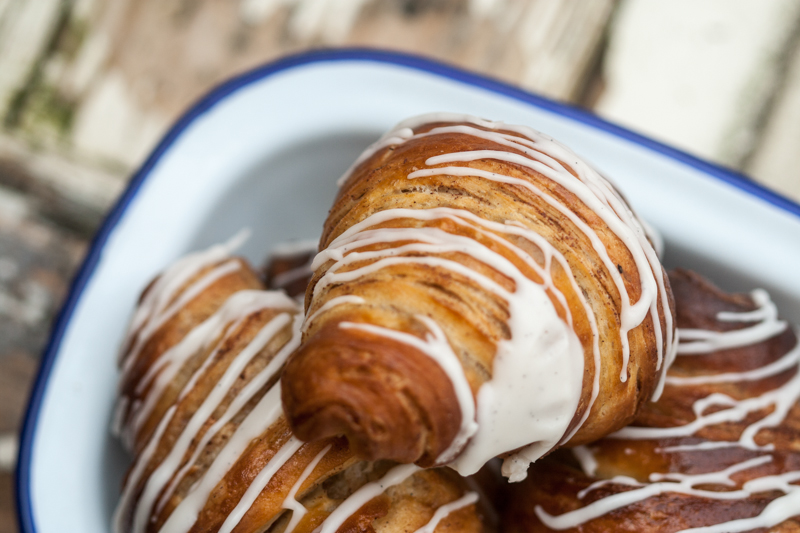
  • Kanelbullar croissants

    Kanelbullar croissants

    There was that weekend, many-many months ago. I had told you about the days when blogs were not so editorially perfect and how I miss them; about the two crumpets with raspberry jam that I had had for an early afternoon breakfast; and about how we’d moved the kitchen table by the window and took way too many pictures.

    Because, you see, my book was coming out the day after. And I guess that – as pretty much the entire universe – when I’m about to step in the unknown I like to delve a bit deeper in my comfort zone.
    It might be just a breath. Or as it happened, it might be croissants.

    There is this one thing I know for sure though. It’s that there are many rainy weekends ahead of us. And really, I thought I’d take you with me.
    A time machine of some sorts.

    Making the détrempe under the grey light of a drenched morning.
    Rolling turns later that day during the blue hour.
    And waking up to gold through our windows to finish shaping the croissants.

    By twelve, we had hot coffee – much hotter than I’d usually care for, and freshly baked croissants. And perhaps, you’ll have some too.

    This recipe doesn’t make traditional croissants. But more of a beautiful cross between a kanelbulle and a croissant. Soft and slightly flaky, as I only gave the dough two simple turns, as opposed to my usual croissant routine: three simple turns. In fact, a look at the insides will give it away: the membranes are thicker, and cinnamon speckles dot them throughout.

    Perhaps, if you want to, I could make some regular flaky croissants, just like the ones I grew up on, and show you too. Yes, croissants are nothing new. But I guess, in the constant chaos that surround us all, there is still some wisdom left.

    The ingredients.

    For the détrempe
    300 g strong flour
    200 g plain flour
    80 g caster sugar
    12 g instant yeast
    10 g milk powder
    10 g sea salt
    250 g cold water
    45 g butter
    , melted and cooled down

    For the butter
    300 g unsalted butter, at room temperature
    2 tbsp ground cinnamon

    For the glaze
    200 g icing sugar
    boiling water
    seeds from one vanilla pod


    twelve pm.
    Mix the flours, sugar, yeast, milk powder and salt in a large bowl. Add the cold water and butter; and mix until a dough starts to form.


    ten minutes past twelve pm.
    Transfer the dough to a clean work surface and knead for around ten minutes or until the dough feels elastic and smooth.


    twenty minutes past twelve pm.
    Place the dough back in the bowl and clingfilm tightly. Leave in a warmish place for an hour or so, or until doubled in size.


    twenty-five minutes past twelve.
    While the yeast is working in magic, work yours with the butter. In a bowl, mix the soft butter (you could flash it in the microwave for ten seconds at a time until soft but not melted) with the ground cinnamon. Perhaps a pinch of cardamom too.


    half past twelve.
    Scrape the butter onto a piece of piece of baking paper and top with another one. Roll it until you get a rough 40x30cm rectangle. Transfer to a baking tray and chill in the fridge.
    Have a cup of coffee. And kisses. And maybe, even tickles down your neck. I highly recommend the latter. That’s what dream-Sundays are made of.

    half past one.
    The détrempe is proved when it’s almost doubled in size. When you take it, it will be very smooth and elastic.

    half past one.
    Place the détrempe onto a lightly floured work surface and roll into a rough rectangle. Wrap in clingfilm and freeze for twenty-five minutes to stop the yeast. Then transfer to the fridge and let it be for a few hours.

    five o’clock.
    Tea time for some. And feuilletage for others. I can’t help but feel a little sad for the former who’ll never know the calmness only rolling dough can bring.
    Take out the butter sheet on your bench to soften it ever so slightly. Place the détrempe onto a lightly floured work surface and roll to a 40x60cm rectangle. Flour more as needed but always make sure to brush off the excess afterwards.

    ten past five.
    Place the rectangle of butter on the lower half of the détrempe – patching it as you do so to cover any naked corner – then fold the upper half over.

    fitfteen minutes past five.
    Flatten the dough with your hands to get rid of any air bubbles, and rotate counter-clockwise so that you have a “book” its spine on your left hand-side.


    twenty minutes past five.
    Roll the dough before the first turn.

    For that, I like to press my rolling pin into the dough to create some indents. This step – if done gently yet with sufficient pressure – allows to distribute the butter evenly.
    I then start rolling the dough in long movements, from the centre up and then from the centre down. Those two techniques can be applied to any laminated dough.
    If the dough starts to stick, don’t hesitate to flour your work bench and reposition the dough.

    twenty-five minutes past five.
    Once the dough has been rolled to – ideally – around seven millimetres, brush off any excess flour, and fold in three, like you would do with a letter.
    This is a tour simple [simple turn].

    Wrap the dough tightly in clingfilm and chill in the fridge for at least an hour.

    twenty-five minutes past five (of the am kind).
    I went for another simple turn as I’ve told you before. Because fluffy meant something special to me that day, or so it seems.
    Of course Karl wouldn’t wake up, so pictures didn’t happen, but here is what I did: I rolled the dough to around seven millimetres thick, then folded it in three, exactly like shown above.
    After that, I placed the dough back in the fridge – again, wrapped in clingfilm.
    If you wanted a flakier texture, I would advise to go for another tour simple [simple turn] now.

    half past six (of the am kind).
    Get two baking trays lined with baking paper.
    Roll the dough on a lightly floured surface to a rough thirty-centimetre-wide rectangle. Cut the dough in half width-wise (if that’s even a thing) and place one half onto one of the prepared baking trays. Chill while you get on with the other half.
    This will make the dough easier to handle and roll thinner, while the other part stays cool.

    Keep on rolling the dough, maintaining a width of around thirty centimetres, until it’s about four or five millimetre-thick.
    Cut triangles using a sharp knife, making sure their base is eight to ten centimetre wide.
    As you cut the triangles, place them onto the prepared baking tray; and keep in the fridge until needed.

    Repeat the rolling and cutting process with the other half of dough.

    seven am.
    Get two baking trays lined with baking paper.

    Take out a couple of dough triangle out at a time. Gently stretch them, then roll without putting any pressure on the layers. And place them with the “point” underneath on the prepared baking tray, generously spaced out.

    twenty minutes past seven.
    Layer two large pieces of clingfilm, chasing any air bubbles and lightly brush with vegetable oil.

    twenty-five minutes past seven.
    Place the layered clingfilm – oiled side down – on top of your croissants, to cover them loosely. Allow to prove at room temperature for around two hours or until wobbly and doubled in size.
    If butter starts leaking, then you might want to find a slightly cooler place to prove your croissants. If I’m at the restaurant, then 26°C is the temperature I go for (with 65% humidity for the ones of you who are lucky enough to have a prover).

    Once the croissants have proved, brush gently with a beaten egg, making sure not to put any egg-wash on the cut edges, which would prevent the rise of the feuilletage.

    Bake at 200°C for seventeen to twenty minutes. Allow to cool down slightly, then transfer to a wire rack.

    ten thirty.
    Make the sugar and vanilla glaze: mix the icing sugar with enough water to form a pourable icing; stir in the vanilla seeds, and drizzle over the croissants.

    THE END. Of life as you knew it.

  • Zimtstern à la cannelle

    Zimtstern à la cannelle


    We found a tree, just a few nights before Christmas. A bit of a happy coincidence. Not that we hadn’t looked everywhere before. Sold out or cheap plastic.

    And there it was, still wrapped in some sort of net. We named it Charlie; forgot about the pizza we’d set off to eat, and proceeded to carry it home on K’s shoulder across London. We stopped at the shop, the one around the corner, and got a pizza there. Twenty minutes later, we sliced into it, and later that night, we let the multi-coloured lights (with a green chord and cone-like bulbs; that remind me so so much of the ones my grand-mother brought back with her and her children when they moved back from Tahiti to France) lullaby us to sleep.

    And at that exact moment. With the twinkling lights and the smell of forest filling our room. That was Christmas. My Christmas.

    But really, I’m not sure why I’m telling you that.

    You see, I had amazing plans for this year. I wanted to share with you my favourite – old and new – recipes for biscuits to bake during those nights made of wool socks and candles and mulled wine and peeks through the window wishing for snow.
    But before I even knew it, Christmas had well gone. Not that we still have Charlie in our bedroom. Perhaps, we’ll go to the park at the end of our street one night, and dig through the earth to make him a new home.

    So we’ll have to make it an extended Christmas this year. Recipes from another time for the one to come maybe; if you don’t mind.

    After all, I went to every possible shop to find the perfect star cookie cutter. Buying anything star-shaped that came my way. And I no have many. Possibly six too many.
    One thing I know for sure though, you won’t have too many zimtsterns. Ever.

    Zimtstern à la cannelle
    Adapted from Mingou’s beautiful zimstern (via Pauline, the must-visit source for anything Christmas biscuit related)

    Just like we’re not in Kansas anymore, Christmas is far gone. However, as I write this, a couple of weeks after it all happened (for us, it was a delicious lunch at the pub with a little too much wine and a lot too-much laughs), I’m snuggled in bed with Ash in my ears and the comforting thought of many biscuits – cut and arranged in plastic containers – ready to be baked at any time. In fact, as long as we have Charlie on and a wreath on our door, I’m not planning on giving up on the holidays.


    Zimtstern(s?) are new to me. And really, when I first saw them, I knew they were going to be something special. Beautiful chewy, with a subtle cinnamon flavour. A bit like a macaron and yet not quite.
    Mingou’s recipe isn’t traditional as it calls for flour. I guess it makes them a little bit cakier (in a good way) and way easier to work with.

    I made the soft dough and rolled in – still in between two sheets of baking paper – then cut it and baked it for barely ten minutes. As Mingou says, it’s definitely better not to overbake them as they’ll turn quite hard. The edges will just start to brown slightly when they’re ready.

    As they cool down, make the glaze, a simple royal icing; I wanted to add vanilla, but then I forgot, although it would make a lovely finishing touch. Next time, tomorrow perhaps?

    When it comes to dipping the biscuits in, place them in the icing, then go up and down to get rid of the excess. Finally you can tap the biscuit slightly on your table to smooth the glaze.

    Zimtstern à la cannelle

    Makes around 50 small biscuits.

    200 g ground almonds
    100 g icing sugar
    60 g caster sugar
    3 tsp ground cinnamon
    1 tsp maldon sea salt
    160 g plain flour
    2 egg whites

    Preheat the oven to 150°C and line two baking trays with baking paper.

    In a bowl, combine the dry ingredients. Add the egg whites and mix until it forms a dough. Roll in between two sheets of baking paper to around 8mm thick. Cut out using your favourite cutter, from what I’ve seen, the must is a six-point star, something that seemed to be absolutely unfindable in my corner of the world.
    Arrange the biscuits onto the prepared baking trays and bake for around 10 minutes, or until slightly puffed up and the edges just begin to brown (ever so slightly).
    Transfer to a wire rack and allow to cool down completely.

    For the royal icing

    2 egg whites
    380 g icing sugar
    seeds from one vanilla pod

    Prepare the icing by mixing the egg whites with the icing sugar until smooth. It should be soft to touch, but not too runny. Gently dip the top of one biscuit into it, then remove, allowing the icing to drip for a couple of seconds. Place back onto the baking sheet, iced-side up. Repeat with the remaining biscuits and allow them to set at room temperature for a couple of hours.

    The zimtsterns will keep in an airtight container for a couple of weeks.