Tag: viennoiseries

  • La tarte tropézienne

    La tarte tropézienne

    There is the sound of the icebergs bumping into each other with every wave, not unlike a distant thunderstorm. There is the forest that I’ve walked through so many times before, now covered in a thick blanket of snow. There are lakrits [liquorice] cookies in the oven. And lights by every window we see.

    Yes, this is it. Sweden.

    And really, it’s just as wonderful in the vinter [winter] as it’s ever been in the sommar [summer].

    What’s up with the Swedish words? Well, I need to learn. And if I was ever able to speak English by writing about food back-back-back in the days. I’m hoping the same will – almost magically – happen with Swedish.
    But I’ve found some amazing companions. Just yesterday, I saw Donal on television. Perfect accent and all. And today, I went to buy Linda’s beautiful baking books, which I’m utterly in love with.

    In fact, I’ve been keeping an eye on every blueberry bush – how wonderful it is to walk surrounded by blåbär och lingon [blueberries and lingonberries] – waiting, very impatiently, for summer to make blåbärssylt [blueberry jam], blueberry crumble tartlets and Linda’s blåbärsrutor [literally, blueberry squares/boxes].

    The tartes tropéziennes here have barely anything to do with it all. Perhaps that’s why it took me so long to tell you about them.
    But when Karl ate one, he said they reminded him of semla. So there is that. And I might have to make some semla inspired tarte tropézienne very soon.

    La tarte tropézienne
    Adapted from Paris Pastry Club.

    Back when I was a child, you could only buy a tarte tropézienne in St Tropez. We would drive through les Maures, a natural reserve not unlike the savanna. The road meandered between cork oaks and arbousiers [strawberry trees].

    It was the late 80s and St Tropez still had a fishing village vibe to it. Nothing compared to what it once was, yet nothing compared to what it’s now become.

    We would walk along the port, and through the market. Sometimes, we’d go up to the fort, the best view over the gulf.
    And, before we’d leave, we’d always stop at the boulangerie to get a tropézienne. A brioche filled with crème madame – pastry cream with butter and whipped cream; delicately flavoured with orange blossom.

    When I wrote Paris Pastry Club, more than gimmicky or trendy recipes, I wanted to share my absolute favourite basics. Ones you can tweak endlessly, creating an amazing répertoire of recipes to call your own.
    And when I see all your beautiful creations on instagram or on your blogs, I’m blown away. And so so so proud to inspire you – at least a little, with my words.


    These tartes tropéziennes are just this.
    A tweak on two recipes from my book. The brioche, also known as the last brioche recipe you’ll ever need, and the crème mousseline, turned crème madame for the occasion, from the fraisier (and please, as soon as the strawberries will actually taste like they should, please, make one on a Saturday, and have it for Sunday lunch, trust me on that).


    A few notes on the brioche:
    – I made half a batch in my stand mixer without problems, but it did take a little longer than the usual double batch. If I were you, I’d make a double batch, use half for tropézienne buns and shape the other half into a loaf, which you can then bake, slice and freeze for instant morning happiness.
    – Here I’ve used T55 flour, but you could also use plain flour, although make sure the protein content of your flour is around 10-12g per 100g of flour.
    The higher the protein content, the stronger the flour is, which means it has more gluten. I’ve found that for brioche, I like to use flours with eleven percents of proteins.
    – When you knead the dough, I recommend doing the windowpane test after around ten minutes. It’s kneaded enough wuen you can stretch a walnut-sized piece into a very thin membrane without it tearing apart. This stage is called full gluten development, and for my brioche recipe, it’s usually reached after 10-12 minutes of kneading in the stand mixer on medium speed. If the dough tears when you try to stretch it, simply knead for a couple more minutes before testing it again.


    – Balling the dough isn’t only done to shape it. It’s an essential step to even the distribution of gluten strands, creating a tension layer, and making sure that no large air bubbles are formed.
    To ball the dough correctly, start by portioning your brioche in even piece (I like to weigh them out so that they will proof/bake evenly). Once you have divided your dough, dip the top side in flour and dust off any excess. Place the unfloured side down on a clean work surface and roll gently with the palm of your hand in a circular motion so that the outer layer of the dough stretches into a smooth ball.

    A few notes on the crème madame:
    – Crème madame is a crème pâtissière to which butter and whipped cream have been added. It should be firm and glossy, and will set into a rich cream.
    Really, crème madame = crème mousseline + whipped cream = (crème pâtissière + butter) + whipped cream.
    – I’ve been writing a post about basic pâtisserie creams which should be published very soon.
    – For a detailed step-by-step how to make crème pâtissière, please check this article.
    – When making crème mousseline, start by creaming the butter using the paddle attachment of your stand-mixer until light and fluffy. Then add the cold crème pâtissière in batches, beating well after each addition. If the butter has seized a little, simply place the bowl on top of a pan of simmering water for a few seconds before beating for a minute or two; or use a blowtorch to heat the sides of your bowl. Repeat until all the butter has disappeared and you’re left with a gorgeously thick crème mousseline.
    If you overheat the mousseline, it will become somewhat runny. Place in the fridge for a couple of hours, then beat for five minutes using the whisk attachment of your stand-mixer.

    La tarte tropézienne

    makes 8 individual tropéziennes
    For the brioche
    275 g T55 flour
    30 g vanilla sugar
    one tsp sea salt
    1/2 tsp instant yeast
    3 eggs
    30 g whole milk
    one tbsp orange blossom water
    160 g butter
    , thinly sliced

    one egg, beaten, for egg wash
    200 g pearl sugar, to sprinkle

    For the crème pâtissière
    500 g whole milk
    3 vanilla pods
    4 egg yolks
    150 g caster sugar
    50 g cornflour
    1 tsp orange blossom water

    For the crème madame
    600 g crème pâtissière (above)
    150 g butter, at room temperature
    100 g 35% cream, whipped to stiff peaks

    For the syrup
    100 g water
    70 g caster sugar
    one tbsp orange blossom water

    If you have a stand-mixer, fit the dough hook and mix the flour, salt and vanilla sugar together on slow speed. Add the instant yeast. Then pour in the milk, the eggs and the orange blossom water.
    Switch to medium speed and knead for 10 minutes, or until the dough can be stretched without breaking. Scrape the sides of the bowl every now and then to ensure everything is amalgamated.
    Alternatively, mix the ingredients by hand then turn out onto a floured work surface and knead until the dough can be stretched without breaking.
    Now, add the butter, one piece at a time, and when almost all of it is in, increase the speed and knead until smooth (or knead by hand). The dough should stop sticking to the side of the bowl (or work surface) and should be silky and very smooth, although somewhat tacky.

    Transfer the dough into a plastic container, clingfilm to the touch, and chill in the fridge overnight.

    Make the crème pâtissière.
    Bring the milk and vanilla pods and seeds to a rolling boil in a medium pan set over moderate heat.
    In a separate bowl, whisk the egg yolks and sugar to prevent the egg yolks from clumping. Add the cornflour and mix well until combined. When the milk has boiled, remove from the heat and pour a third of it over the egg mixture, whisking as you do so. This step is key when making crème pâtissière as it loosens the egg yolks but also tempers them, avoiding any lumps .
    Pour all of the egg mixture back into the pan, return to the heat and cook slowly, whisking at all times until it starts to thicken and boil.
    Once it has bubbled for a few minutes, transfer to a plastic container and clingfilm to the touch to avoid the formation of a skin. Chill in the fridge for overnight.

    Make the orange blossom syrup. Bring the sugar and water to the boil. Allow to cool down slightly, then add the orange blossom water. Reserve at room temperature overnight.

    The next day, scrape the dough from the container onto a clean and lightly floured work surface, gently press to degaz, and divide in eight 75g squares.
    Ball each square, then roll into a 1cm-high disk, roughly 8cmm wide.

    Arrange the disks of brioche onto a baking tray lined with baking paper. Cover loosely with a lightly oiled double layer of clingfilm; and proof until doubled in size.

    Preheat the oven to 200°C.
    Brush the brioche with the beaten egg, then generously sprinkle with the pearl sugar. Bake for 15-17 minutes, or until golden brown.
    Allow to cool down completely.

    In the meantime, make the crème madame.
    Cream the butter until light and fluffy. Add the crème pâtissière, one third at a time, beating well after each addition. Once all of the crème pâtissière has been added, beat for 5 minutes. The mousseline should be firm and glossy.
    If the butter has seized a little, simply place the bowl on top of a pan of simmering water for a few seconds before beating for a minute or two; or use a blowtorch to heat the sides of your bowl. Repeat until all the butter has disappeared and you’re left with a gorgeously thick crème mousseline.
    Finally, gently fold in the whipped cream.
    Place this crème madame in the fridge to firm up slightly for an hour or so.

    Once the brioches have cooled down, slice them in half with a large bread knife and generously brush the cut-side with syrup.

    Transfer the crème madame into a piping bag fitted with a 10mm nozzle and pipe the cream around the rim of the bottom brioches, then pipe a large ball in the centre.
    Top each brioches with their matching “hats”.

    Keep in the fridge, loosely covered with clingfilm for at least 4 hours or overnight.
  • Kanelbullar croissants

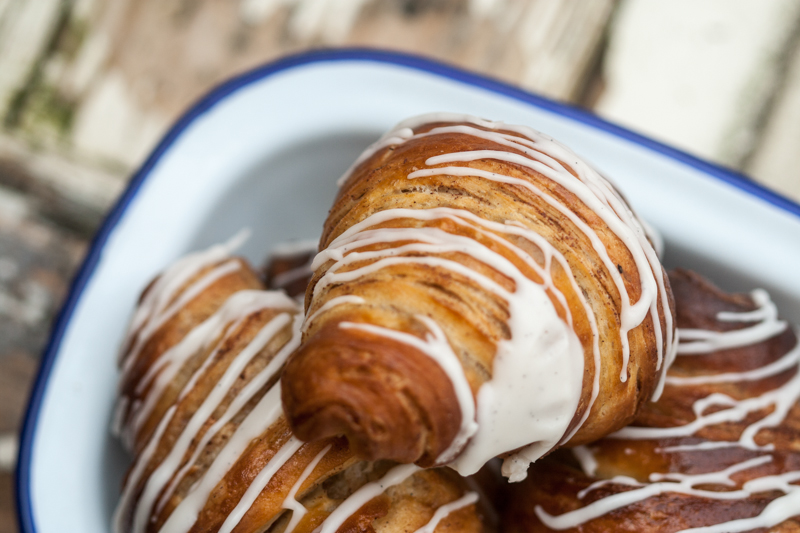
    Kanelbullar croissants

    There was that weekend, many-many months ago. I had told you about the days when blogs were not so editorially perfect and how I miss them; about the two crumpets with raspberry jam that I had had for an early afternoon breakfast; and about how we’d moved the kitchen table by the window and took way too many pictures.

    Because, you see, my book was coming out the day after. And I guess that – as pretty much the entire universe – when I’m about to step in the unknown I like to delve a bit deeper in my comfort zone.
    It might be just a breath. Or as it happened, it might be croissants.

    There is this one thing I know for sure though. It’s that there are many rainy weekends ahead of us. And really, I thought I’d take you with me.
    A time machine of some sorts.

    Making the détrempe under the grey light of a drenched morning.
    Rolling turns later that day during the blue hour.
    And waking up to gold through our windows to finish shaping the croissants.

    By twelve, we had hot coffee – much hotter than I’d usually care for, and freshly baked croissants. And perhaps, you’ll have some too.

    This recipe doesn’t make traditional croissants. But more of a beautiful cross between a kanelbulle and a croissant. Soft and slightly flaky, as I only gave the dough two simple turns, as opposed to my usual croissant routine: three simple turns. In fact, a look at the insides will give it away: the membranes are thicker, and cinnamon speckles dot them throughout.

    Perhaps, if you want to, I could make some regular flaky croissants, just like the ones I grew up on, and show you too. Yes, croissants are nothing new. But I guess, in the constant chaos that surround us all, there is still some wisdom left.

    The ingredients.

    For the détrempe
    300 g strong flour
    200 g plain flour
    80 g caster sugar
    12 g instant yeast
    10 g milk powder
    10 g sea salt
    250 g cold water
    45 g butter
    , melted and cooled down

    For the butter
    300 g unsalted butter, at room temperature
    2 tbsp ground cinnamon

    For the glaze
    200 g icing sugar
    boiling water
    seeds from one vanilla pod


    twelve pm.
    Mix the flours, sugar, yeast, milk powder and salt in a large bowl. Add the cold water and butter; and mix until a dough starts to form.


    ten minutes past twelve pm.
    Transfer the dough to a clean work surface and knead for around ten minutes or until the dough feels elastic and smooth.


    twenty minutes past twelve pm.
    Place the dough back in the bowl and clingfilm tightly. Leave in a warmish place for an hour or so, or until doubled in size.


    twenty-five minutes past twelve.
    While the yeast is working in magic, work yours with the butter. In a bowl, mix the soft butter (you could flash it in the microwave for ten seconds at a time until soft but not melted) with the ground cinnamon. Perhaps a pinch of cardamom too.


    half past twelve.
    Scrape the butter onto a piece of piece of baking paper and top with another one. Roll it until you get a rough 40x30cm rectangle. Transfer to a baking tray and chill in the fridge.
    Have a cup of coffee. And kisses. And maybe, even tickles down your neck. I highly recommend the latter. That’s what dream-Sundays are made of.

    half past one.
    The détrempe is proved when it’s almost doubled in size. When you take it, it will be very smooth and elastic.

    half past one.
    Place the détrempe onto a lightly floured work surface and roll into a rough rectangle. Wrap in clingfilm and freeze for twenty-five minutes to stop the yeast. Then transfer to the fridge and let it be for a few hours.

    five o’clock.
    Tea time for some. And feuilletage for others. I can’t help but feel a little sad for the former who’ll never know the calmness only rolling dough can bring.
    Take out the butter sheet on your bench to soften it ever so slightly. Place the détrempe onto a lightly floured work surface and roll to a 40x60cm rectangle. Flour more as needed but always make sure to brush off the excess afterwards.

    ten past five.
    Place the rectangle of butter on the lower half of the détrempe – patching it as you do so to cover any naked corner – then fold the upper half over.

    fitfteen minutes past five.
    Flatten the dough with your hands to get rid of any air bubbles, and rotate counter-clockwise so that you have a “book” its spine on your left hand-side.


    twenty minutes past five.
    Roll the dough before the first turn.

    For that, I like to press my rolling pin into the dough to create some indents. This step – if done gently yet with sufficient pressure – allows to distribute the butter evenly.
    I then start rolling the dough in long movements, from the centre up and then from the centre down. Those two techniques can be applied to any laminated dough.
    If the dough starts to stick, don’t hesitate to flour your work bench and reposition the dough.

    twenty-five minutes past five.
    Once the dough has been rolled to – ideally – around seven millimetres, brush off any excess flour, and fold in three, like you would do with a letter.
    This is a tour simple [simple turn].

    Wrap the dough tightly in clingfilm and chill in the fridge for at least an hour.

    twenty-five minutes past five (of the am kind).
    I went for another simple turn as I’ve told you before. Because fluffy meant something special to me that day, or so it seems.
    Of course Karl wouldn’t wake up, so pictures didn’t happen, but here is what I did: I rolled the dough to around seven millimetres thick, then folded it in three, exactly like shown above.
    After that, I placed the dough back in the fridge – again, wrapped in clingfilm.
    If you wanted a flakier texture, I would advise to go for another tour simple [simple turn] now.

    half past six (of the am kind).
    Get two baking trays lined with baking paper.
    Roll the dough on a lightly floured surface to a rough thirty-centimetre-wide rectangle. Cut the dough in half width-wise (if that’s even a thing) and place one half onto one of the prepared baking trays. Chill while you get on with the other half.
    This will make the dough easier to handle and roll thinner, while the other part stays cool.

    Keep on rolling the dough, maintaining a width of around thirty centimetres, until it’s about four or five millimetre-thick.
    Cut triangles using a sharp knife, making sure their base is eight to ten centimetre wide.
    As you cut the triangles, place them onto the prepared baking tray; and keep in the fridge until needed.

    Repeat the rolling and cutting process with the other half of dough.

    seven am.
    Get two baking trays lined with baking paper.

    Take out a couple of dough triangle out at a time. Gently stretch them, then roll without putting any pressure on the layers. And place them with the “point” underneath on the prepared baking tray, generously spaced out.

    twenty minutes past seven.
    Layer two large pieces of clingfilm, chasing any air bubbles and lightly brush with vegetable oil.

    twenty-five minutes past seven.
    Place the layered clingfilm – oiled side down – on top of your croissants, to cover them loosely. Allow to prove at room temperature for around two hours or until wobbly and doubled in size.
    If butter starts leaking, then you might want to find a slightly cooler place to prove your croissants. If I’m at the restaurant, then 26°C is the temperature I go for (with 65% humidity for the ones of you who are lucky enough to have a prover).

    Once the croissants have proved, brush gently with a beaten egg, making sure not to put any egg-wash on the cut edges, which would prevent the rise of the feuilletage.

    Bake at 200°C for seventeen to twenty minutes. Allow to cool down slightly, then transfer to a wire rack.

    ten thirty.
    Make the sugar and vanilla glaze: mix the icing sugar with enough water to form a pourable icing; stir in the vanilla seeds, and drizzle over the croissants.

    THE END. Of life as you knew it.

  • I’ll be left with cinnamon croissants

    I’ll be left with cinnamon croissants

    I guess like all good things, Sundays have to come to an end too.

    Today was a good Sunday. We went to bed late enough to wake up mid-morning. Crumpets happened. I might have eaten two with homemade raspberry jam from last summer.

    And we braved the rain – the mostest perfect excuse for a lazy day in – for a trip to the corner shop. In our basket: milk and butter, lots of. Yeast too. And strong flour. We also got a bottle of our favourite white wine and some salmon we knew we’d have for dinner tomorrow.

    Croissants were to be made.

    Find the recipe here.


    We moved the kitchen table by the window and took mostly blurry pictures. And in all measures, that’s more than fine by me. Since when did blog have to be so editorially perfect? Maybe, I miss the early days when it was more misses than hits.

    So yes, I made dough for cinnamon bun croissants. Or is it cinnamon croissant buns? I wanted to do a step-by-step. With – of course – gifs as tokens of my love for the old-school.
    It might happen. It might not.

    In the meantime, cross your fingers for me tomorrow. I have a book coming out and I can’t quite believe it! And it case it was all just a dream, I’ll be left with cinnamon croissants. Life isn’t too bad at the moment.

  • PS. Une brioche avec un peu plus de beurre

    PS. Une brioche avec un peu plus de beurre

    [PS. A brioche with a tad more butter]

    London, sometime in April.
    I made a brioche. In five minutes; and five days. We woke up early to shape and proof the dough. Well, I did. A couple of hours later, we sat at the table, with our eyes still plein de sommeil [full of sleep].

    And we had a slice each. With plenty of strawberry jam. And a cup of coffee.

    I then proceeded to braid my hair. And for a walk we went. The trees were snowing and no matter how long I will live in London, my dreams will always float higher with the April snow.
    Another coffee was taken, at a café this time; perhaps in Fulham or Clapham. I can’t remember.

    But I recall a phone conversation with my mum. About the brioche. And how she should make it.

    France, sometime in May.
    I flew in wearing UGG boots and a wool scarf. But as we reached the car on the airport parking lot, I switched for those leather sandals I’m so fond of.

    We arrived home. And dropped the suitcases somewhere in the living room.

    Without judging unpacking necessary, we headed to the kitchen. An apron got wrapped around my waist, flour got weighed out, dough was put away in a bowl.

    And before we knew it, we made a brioche. In five minutes; and a five days. Oh and five hundred grams of butter. Perhaps with a couple of hidden chocolate squares. Yes, perhaps…
    It tasted just as good. If not better.


    And just so my mum doesn’t have an excuse not to make brioche, here is the recipe in French. Oui!
    Accents included and all. Mum if you knew how long it takes to add accents when you have an English keyboard, you’d already be making brioche as you read this.

    Dans un bol, fouetter le beurre fondu, l’eau, le sel, les oeufs et le miel. Ajouter la farine et la levure. Mélanger à la cuillère en bois jusqu’à obtention d’une pâte souple et homogène.

    Recouvrir le bol avec un torchon et laisser pousser à température ambiante pour un peu plus de 2h.

    Une fois la pâte ayant doublé de volume, mettre le bol – toujours recouvert d’un torchon – au frigo pendant au moins 24h.

    Le lendemain – ou n’importe quand dans les cinq jours qui suivent – beurrer un moule à cake génereusement. Prélever 450g de pâte du pâton. Puis la diviser en quatre. Fleurer (fariner) le plan de travail et bouler (former des boules) chacun des morceaux.

    Placer les boules dans le moule préalablement beurré et faire pousser pendant 1h30.

    Pendant ce temps, préchauffer le four a 190°C. Battre un oeuf pour la dorure. Dorer la brioche au pinceau. Et cuire pour 40 à 50 minutes. Démouler et laisser refroidir sur une grille.

  • Five-minute brioche

    Five-minute brioche


    When I mentioned the five-minute brioche, I forgot to say it’s more of a five-minute and five-day brioche.

    Five days where the blossoms turned into snow. Five days where I got less sleep than what a normal night means to you. Five days where everytime I came home, I opened the fridge to imagine that bubbly dough turn into brioche.

    And then on the night before the fifth day, I set my alarm to eight am; two hours later than a day on. Still dizzy from a sleep overdose, I walked to the kitchen. Fleurer le marbre [sprinkle the marble with flour]. Couper la pate [cut the dough]. Bouler [make balls]. Faire pointer [proof]. Et se recoucher [and go back to bed].

    This, my friends, is the recipe for happiness. Especially, if I then braid my hair and spend the day with someone I love.

    A couple of hours later, we slowly emerged from that broken night – or more accurately, morning nap; a concept that I should put to practice more often.

    The loaf went in the oven. And then got sliced, topped with the strawberry jam he made last week – with the somewhat bland berries I was a little too excited with at the market – and then eaten in bed, with the necessary dose of good tunes and the occasional sun peaking through the window.

    It felt like a Sunday. With all the trimmings, bar the messy kitchen. And, no matter how much I love to get my hands dirty by kneading the hell out of a sticky dough until it becomes smooth, it seemed appropriate to take a shortcut this time.

    Even more so that this brioche proved the die-hard French that I am wrong.

    First came Dan. And his focaccia. Almost no-knead. And almost more delicious than any bread I’ve ever tasted. Then came the no-knead bread that got everyone crazy. And now, Zoë.

    So as much as it hurts me to say it, it is possible to make brioche in a matter of seconds. In one bowl. With one wooden spoon.

    Brioche en cinq minutes
    Adapted from Zoë François and Jeff Hertzberg’s Five minute bread.

    I once read somewhere that in order to make a good brioche you need time. I think it was actually mentioned as part of the ingredient list, which I thought was clever as I remembered the hours spent kneading – by hand – a three-kg batch at school.

    And while I love the process, I must admit it does feel good to – every now and then – take the easy option. It says five minutes. But it really is less than that.
    Butter gets melted. And mixed with water, eggs, honey, and salt. No sugar. Just honey, which being inverted sugar – kind of natural trimoline – helps the brioche to stay moist after baking.
    Flour and yeast get incorporated. And the dough is left outside to proof. Only to be, later, chilled; for a day or two. Or in my case, five.

    As a side-note, I do think this recipe could take more butter. Possibly twice more. Possibly because I’m French. Possibly something I will try and report. Which will also allow me to show you how to bouler une pâte [shape the dough into a ball], because – let’s be honest – I’m not sure it translate into words.

    EDIT 24/07/2011: We made this again, but with 500g of butter instead of the 350g written below. It worked and was, as expected, delicious!

    Five-minute brioche

    makes four loaves

    350g-500g (read EDIT above) butter, melted and cooled down
    350g water
    20g salt
    8 eggs
    170g clear honey
    1kg strong flour
    15g instant yeast

    one egg, beaten, for the eggwash

    In a bowl, combine the melted butter, water, salt, eggs, and honey. Add the flour and yeast. And mix using a wooden spoon until smooth.

    Cover the bowl with a cloth and allow to rest at room temperature for a little over 2h (or feel bad-ass and stick it in a turned-off microwave – make sure you read the note above beforehand though).

    Transfer the cloth-covered bowl to the fridge and chilled for at least 24h or up to five days.

    On the day you’re ready to bake, generously butter a loaf tin and cut 450g off your dough. Then using a scraper – or a knife – divide into four bits. Have some flour handy and gently pat each piece into it. Putting the flour side up – and sticky side down – shape it into a ball using the palm of one of your hands.

    Place the four balls into the prepared tin and allow to proof for 1h30.

    Preheat the oven to 190°C. Brush the top of the dough with the eggwash and bake for 40 to 50min, or until golden brown. Unmould and allow to cool on a wire rack, or not.

  • Brioches marbrées au thé matcha

    Brioches marbrées au thé matcha

    [Marbled matcha brioches]

    With no rational reason except that those brioches looked terribly good, I decided to venture into the realm of feuilletage; once again. Although, this time, my kitchen did not come with a rolling pin.
    I could have bought one on my recent visit to Pages. I almost did in fact. But eventually got out from the shop carrying many cercles [rings], a couple of knives, a sugar thermometer, and some ramekins.

    Quite providentially, my kitchen did come with more empty wine bottles than I’m willing to admit ; let’s be honest, we had five of them sitting on the counter.
    In my defense, I must tell you they have been there for weeks.

    Armed with the one bottle that seemed fit for the occasion – read perfectly cylindrical, label removed – I went straight for the recipe. And then realised the folding instructions were in Japanese.

    Now, why did my kitchen not come with full wine bottles instead? At that point, I could have used a glass.
    Instead, I started doodling, only to realise my panic attack was pointless. A simple tour double.

    Just like for puff pastry.

    I made the dough. Left it to rise. Made the matcha filling. Chilled it. Then, I started rolling and folding, and rolling and folding.
    Somehow, my dreamlike vision of the use of wine bottles as rolling pins vanished when the filling started leaking and the dough stuck to the bottle.

    My counter ended up green, so did my fingers.
    But that’s okay.
    First, because I like green. And second, because I see no problem whatsoever in licking green fingers when they taste like matcha.

    One lesson I have learnt from this experience: get yourself a decent rolling pin girl.

    If unlike me – and probably not unlike every person around the world – you own a rolling pin, then I urge you to make these brioches. With green tea, or if you’re feeling a little more subversive, with cocoa powder.

    Brioches marbrées au thé matcha
    Adapted from Les carnets parisiens.

    Don’t be scared with all the rolling pin action here. These brioches are very easy to make, and a treat to eat.
    Soft and fragrant.
    When it comes to yeasted dough, my favourite kneading technique – which I learnt at school – is quite close from this one. I wish I could make a video to show you, but for now, the explanations of Richard Bertinet will have to do.

    I don’t do it the exact same way, but the throwing and folding are similar. Trust me, this kneading technique is a keeper.

    If you’re going to use cocoa powder instead of matcha, go for 20g of powder. And then proceed as follow.

    Brioches marbrées au thé matcha

    Makes 12 small brioches

    For the brioche dough
    300g strong flour
    60g cater sugar
    one tsp dehydrated yeast
    125g whole milk
    one egg
    50g butter, diced and at room temperature

    For the matcha filling
    80g milk
    one egg white
    50g caster sugar
    20g flour
    20g matcha green tea
    10g butter

    Make the dough. In a large bowl, combine all the ingredients except for the butter and mix until it forms a rough dough.
    On an unfloured surface, start kneading the dough incorporating the butter as you do so until it forms a smooth ball; around 8 minutes.
    Place the dough back into the bowl – covered with a cloth – and leave in a warm place for 2 hours or until double in size.

    make the filling. Bring the milk to the boil. While it’s heating, mix the white and sugar in a bowl until combined. Mix in the flour and matcha green tea, and beat until homogeneous.
    When the milk is boiling, pour it over the matcha mixture, whisking as you do so. Transfer back into the pan, and cook on medium heat until thick. Mix in the butter.
    Spread it on a baking tray lined with cling film, around 20x15cm. Chill.

    Remove any air from the brioche dough by gently patting it down, then roll it into a 30x20cm rectangle. Place the matcha filling in the middle, then fold the dough over it, sealing the extremities together. Roll into a longer rectangle, then make a tour double. Repeat the folding one more time, then roll the dough back into a 30x20cm.

    Roll the dough onto itself to form a log. Trim the ends, then using a sharp knife, slice into 3cm-thick segments.

    Butter 12 5.5cm-wide rings, and place the slices into them, cut side up.

    Cover loosely with cling film, and allow to rise for 30 to 45 minutes.

    Preheat the oven to 180°C, and bake for 15 to 20 minutes or until golden brown.