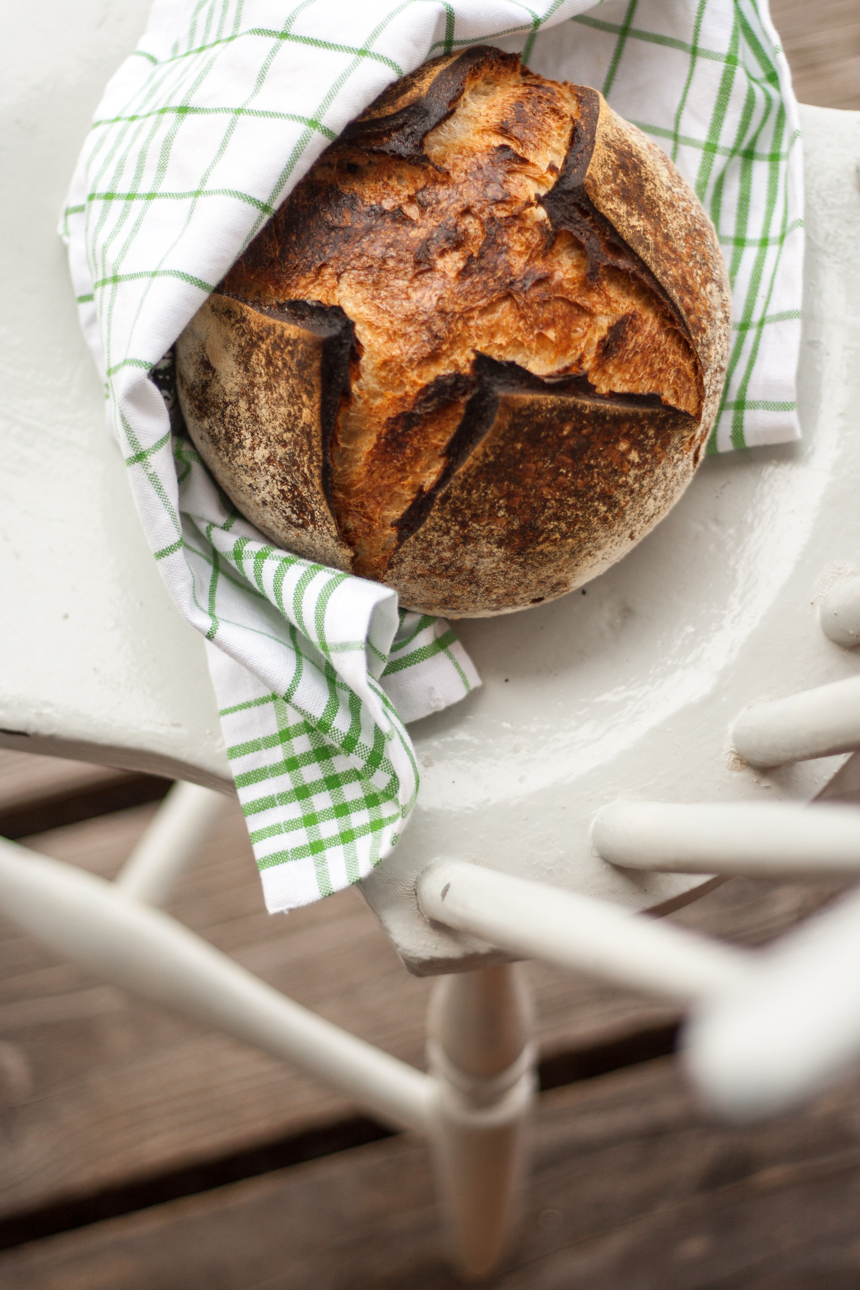
Category: Boulangerie

  • A brioche study, recipe: the “generic” brioche (control)

    A brioche study, recipe: the “generic” brioche (control)

    Analysing the impact of the egg-to-milk ratio in brioche formulas

    The formula

    The recipe shown below will make two 500g loaves. I chose, however, to make half a batch, yielding to a single loaf, which is something I’ll carry on doing over the next experiments, as the kneading time of a half-recipe takes longer when done in a stand-mixer; more on that to come in part two: the method (ingredient list, pastry chef tips and techniques on brioche).

    Brioche #1: Control formula

    quantityingredientBAKERS %
    500gflour100%
    70gcaster sugar14%
    15gyeast3%
    8gsalt2%
    180gmilk36%
    180gegg36%
    150gbutter30%
    1103gtotal weight

    Notes

    I haven’t finished writing about the method and techniques associated with rich doughs, so in the meantime, please refer to this article for detailed instructions on how to make brioche.

    I ended up making the control brioche twice: after I baked brioche 2, I was amazed by the differences in between the two batches. So much in fact, that I thought something had gone wrong with the control brioche (I mostly suspected slow yeast or underproofing). So I went ahead and made the control brioche again, only to find out the differences were the result of the formula substitutions; and in no way related to the other ingredients or the method.

    The difference in crumb colour on the pictures above is due to lighting (natural versus halogen) as I’ve just gotten an industrial halogen lamp so I would be able to take pictures at night – also known as 2pm here, hehe – and I’m still trying to figure it out.

    Results

    The oven-spring isn’t tremendous.

    The crust is very thin and soft. As the loaf cools down, it wrinkles.

    The crumb is light and soft, with a slight moistness to it. It’s has a beautiful texture and a lovely chew, almost reminiscent of a doughnut.

    This “generic” brioche turned out amazing. I fell in love with its crumb and soft crust. The loaf stayed beautifully soft on the second day too; as we topped it with a thick layer of hjortronsylt [cloudberry jam].
    I’ll definitely be making it again and again.

    READ MORE ABOUT THE BRIOCHE STUDY

    Part I: the approach

    Part II: the ingredients

    – Part III: the process – method, techniques and tips

    – Recipe: brioche #1, the control – this is where you are.

    – Recipe: brioche #2, the almost Chavot-brioche

    – Recipe: brioche #3, the pain au lait

    – Recipe: brioches #4 and #5

    – Part IV: impact of the egg-to-milk ratio in rich doughs

    – Ressources: Brioche in literature

    Explore the feature: A brioche study and follow our discoveries on instagram: #BRIOCHESTUDY.

    FROM THE 2016 ARCHIVES

  • A brioche study, part I: the approach

    A brioche study, part I: the approach

    Analysing the impact of the egg-to-milk ratio in brioche formulas

    In the first part of my forever-unfinished feature How to be a pastry chef? – the checklist, I asked you some questions about brioche with the aim to develop your curiosity and drive you to research important techniques. It went along the following lines:

    Do you know brioche dough is an emulsion? Do you treat it as such? Can you knead it by hand or in a mixer without over-heating it? And which temperature should the butter be?

    But although these points are fundamental in a technical approach, I’ve since had been absorbed by some other questions that belong to the food science realm.

    How do the milk and eggs respectively affect the texture of a brioche? Which kind of flour yield to the softest crumb? And how much butter is too much?

    As with any mixture experiment, we have to study each of these variables – liquids ratio, flour properties, butter quantity – separately in order to develop an understanding on how they each have an impact on the finished product.
    And for no other reason than it has obsessed me for years, I’ve chosen to start by examining the effect of the egg-to-milk ratio in rich doughs.

    Eggs or milk?

    If you ask Eric Chavot, a true brioche – or as he would say, une vraie brioche – is made using eggs as the only source of hydration.
    And while I’m certain many would agree, the subject of brioche – from its etymology to its formula – has always been a controversial one.

    In my kitchen, I tend to use a combination of both eggs and milk; with more or less of each depending on the texture I want to achieve. A knowledge that’s really more empirical than anything; and perhaps, relies a bit too much on wishful thinking.
    So today, we will stop counting shooting stars and start analysing percentages. It will take five different loaves. Over two kilograms of flour and perhaps a litre or two of milk. A box of eggs. Most likely two. And hopefully, a few worthy notes that will improve my understanding of rich doughs.

    The approach

    1. Develop a control formula that will act as a reference point during the experiment.
    2. Define the range into which the variables will fluctuate.
    3. Establish the method: ingredients (on both quantitative and qualitative – brand, temperature – points of view), process (order of incorporation, kneading time/speed, proofing time/temperature, shaping, baking time/temperature)
    4. Make successive batches of brioches, each with a different ratio of egg to milk. All other variables (see method above) remain unchanged.
    5. Record the organoleptic properties of each batch:
    – texture (our main focus point): thickness/hardness of the crust, crumb appearance and mouthfeel.
    – colour: darkness of the crust, tint of the crumb.
    – flavour and smell.
    I haven’t decided yet on whether or not to include objective qualities – such as: crust thickness in mm, loaf size, or even weight of the baked brioche – to measure the response. Yes, even though this is a matter of mixture design, I mostly want to document the results in a comprehensive yet accessible and home-practicable way.
    6. Analyse the results.

    Developing the control formula

    I could have used my favourite stand-alone brioche recipe, the one pictured above and which I told you about in Paris Pastry Club and the one I made tropéziennes with.
    But out of all my rich dough recipes, it stands out by its high hydration and high fat quantity.

    I thus wanted to create a generic rich dough recipe. To do this, I analysed my favourite recipes, ranging from brioche to burger buns, from challah to kanelbullar.
    On the table below, you can see the ones that I consider the more relevant, with BRIOCHE 2 being my usual, the one I just mentioned.

    Brioches: bakers percentage

    bullarbrioche 1brioche 2brioche 3burger bunsbrioche 4
    flour100%100%100%100%100%100%
    hydration64%58%65%60%64%60%
    eggs38%19%55%
    60%13%20%
    milk26%38%11%0%51%40%
    fat28%15%58%40%19%16%
    sugar13%19%11%12%6%20%

    Note: the hydration values, although inaccurate since milk and eggs don’t hydrate the dough fully (respectively at 88% and 76.15%), could have also been labelled “liquids”. I did however choose to go with “hydration” for ease of understanding and recipe development.

    I then went ahead and calculated an average formula as seen on the table below. And by multiplying the bakers percentages, I got the recipe for two brioche loaves.
    As you can notice, some of the measurements would be quite difficult to put into practice, so I used this “average recipe” as a guideline.

    Brioches: average

    BAKERS %for two 500g loaves
    flour100%500 g
    hydration62%
    fat29%147g
    sugar14%68g
    eggs34%171g
    milk28%138g

    Brioche #1: Control formula

    quantityingredientBAKERS %
    500gflour100%
    70gcaster sugar14%
    15gyeast3%
    8gsalt2%
    180gmilk36%
    180gegg36%
    150gbutter30%
    1103gtotal weight

    The percentages I chose to keep are as such:
    – flour 100%
    – caster sugar 14%
    – milk 36%
    – egg 36%
    – butter 30%

    As you can see, I’ve increased the total liquids (milk+eggs) as when I first baked the control brioche, I realised that with only 62% liquids the dough was way too dry so I had to add 60g of liquids (30g egg and 30g milk), bringing the total hydration to 72% instead.
    This can be due to 2 factors:
    – I calculated the average formula using recipes from my French/English recipe notebooks, and thus missed to take into account the Swedish flour’s high absorption capacity
    – when making such a small batch of dough (I halved the recipe) the kneading can take twice as long as when making a larger batch, and the dough has more surface to loose moisture from

    I then added 3% of yeast and 2% of salt, and our control formula was done.

    This control formula is a perfect starting point as its egg-to-milk ratio is 50%-50%, which will allow us to really analyse its impact on the dough and on the finished brioche.

    The mixture design

    I have in mind to make 5 different “brioche” recipes. Yes, “brioche” in quotes, as our experiment will range from actual brioche to pain au lait [literally, milk bread].

    1: controlbrioche 2brioche 3brioche 4brioche 5
    milk50%0%100%33%67%
    egg50%100%0%67%33%

    Here are the different formulas, each associated with a number, which is used as both a name and a rank. We will start with the control brioche 1, move onto brioche 2, and so on.
    As you can see above, we’re starting with the most extreme formulas as we might be able to stop our experiment after brioche 3, in the eventuality that the results will have given us enough information about the impact of the egg-to-milk ratio in the dough.
    I will, however, most likely still decide to conduct brioche 4 and 5, with my personal recipe collection in mind.

    Ressources

    – A clear explanation of mixture design.
    – A few notes on brioche.
    – A five-minute brioche?

    TO COME

    Part I: the approachthis is where you are.

    Part II: the ingredients

    – Part III: the process – method, techniques and tips

    Recipe: brioche #1, the control

    – Recipe: brioche #2, the almost Chavot-brioche

    – Recipe: brioche #3, the pain au lait

    – Recipe: brioches #4 and #5

    – Part IV: impact of the egg-to-milk ratio in rich doughs

    – Ressources: Brioche in literature

    I hope you’ll like this experiment as much as I do, even the most boring parts. Follow #briochestudy on Instagram for real-time science 🙂

    And, of course, I wish you all the happiest new year! To 2016 and brioches. X

  • Chasing rugbrød, part one

    Chasing rugbrød, part one

    We waked, in the two cabins in those happy days, just before the sun came up, when the birds were in their loudest clamor of morning joy. Wrapped each in a blanket, George and I stepped out from our doors, each trying to call the other, and often meeting on the grass between. We ran to the river and plunged in,—oh, how cold it was!—laughed and screamed like boys, rubbed ourselves aglow, and ran home to build Polly’s fire beneath the open chimney which stood beside my cabin. The bread had risen in the night. The water soon boiled above the logs. The children came laughing out upon the grass, barefoot, and fearless of the dew. Then Polly appeared with her gridiron and bear-steak, or with her griddle and eggs, and, in fewer minutes than this page has cost me, the breakfast was ready for Alice to carry, dish by dish, to the white-clad table on the piazza. Not Raphael and Adam more enjoyed their watermelons, fox-grapes, and late blueberries! And, in the long croon of the breakfast, we revenged ourselves for the haste with which it had been prepared.

    Edward Everett Hale (1869), The Brick Moon, and Other Stories

    If I came to you today with the perfect recipe for rugbrød – which I’ve come to know as danskt rågbröd, literally, Danish rye bread – then I think this story would have no point in being told.

    It might have started on our way to Lövnas. We stopped in the closest town, an hour or so away from the cabin, at the small supermarket facing the gas station. And although I was still dozy from our trip, I remember – with an unusual crispness – picking a small bag, much heavier than it looked, dark and packed with seeds, with five or six thin slices of danskt rågbröd.
    I didn’t think much about it then. Not that it would send me into a relentless search for my favourite homemade rugbrød or that it would be the start of many months (and possibly years, although it’s something I can’t say just yet) of breakfast tartines.

    I also remember Kalle putting two yoghurt cartons in our basket. Perhaps, because they read körsbär [cherry], but more plausibly, because they were called fjäll [mountain], a word I’d heard – and not quite understood – when Kalle spoke it. “Vi ska åka till fjällen”.

    The next morning, we had our first breakfast at the cabin. And while everyone else could only think about what they’d top their bread with, I was studying my deep-dark slice of rågbröd.

    Yes, nobody talks about the bread. The foundation of a tartine, really.
    That one had the colour of wood bark and the smell of roasted pumpkin and sunflower seeds. Whole rye berries barely held together with a sour rye dough. And linseeds dotted throughout.
    The very same that created the obsession I have for rågbröd.

    Danish rye bread #1
    Adapted from Baktips.

    As I’ve told you earlier, I’m not coming today with a perfect recipe. More of the first part of a long study. Eventually, I’d love to be able to make a danskt rågbröd that’s packed with more rye berries than dough, feels moist yet crunchy and has lovely dark-brown undertone.

    Today’s experiment was delicious. In fact, I could only take a picture a few days after I’d baked it and right before it had been devoured.
    I’m not quite happy with how light the crumb came but I made the very stupid decision to bake mine at 150°C (a wrong educated guess as I assumed the baking would be the same as for a filmjölksbröd – my favourite! but I digress) – so I think I’ll definitely have to try the same recipe again with a higher temperature and perhaps a longer baking time as since then, I’ve read tales of breads baked for as long as twelve hours.

    PS. Maman si tu lis cet article, je pense que tu aimerais ce pain!

    Danish rye bread #1

    Makes one loaf.

    For the soaker

    215 g cracked rye
    100 g sunflower seeds
    20 g linseeds
    200 g water
    50 g sourdough

    For the dough

    All of the soaker (above)
    100 g sourdough
    170 g water
    10 g fresh yeast
    130 g pumpkin seeds
    10 g salt
    160 g plain flour
    40 g rågsikt or rye flour

    On the night before the day you’re planning to bake your bread, combine all the ingredients for the soaker; cover losely with clingfilm and allow to rest overnight at room temperature.

    The next morning, butter and line a 1.5L loaf tin with baking paper.

    Add the remaining ingredients (making sure to dissolve the yeast into the water, as the dough doesn’t get kneaded) to the soaker and mix well until smooth. Depending on your flour you might need to add a little more water (or less). The dough will have the consistence of a runny batter, almost like a cake batter with oats inside.

    Scrape the dough into the prepared loaf tin and proof at room temperature for 2 hours.

    About an hour into the proofing, preheat your oven to 250°C/ fan 225°C (and now, it will differ from what I did – bake at fan 150°C, which was silly and really, don’t do it! – I’m leaving the original baking instructions even though I haven’t tried for myself).

    After 2 hours, brush the top of your loaf with water and bake at 250°C/ fan 225°C for 10 minutes. Reduce the oven temperature to 200°C/ fan 180°C and bake for a further 50 minutes or until dark-brown and a probe inserted into the centre of the loaf reads 98°C.

    As soon as the loaf comes out from the oven, place inside a plastic bag or wrap in clingfilm and let it cool down for at least 6 hours before cutting the loaf into thin slices. My topping of choice is butter, flaky sea salt and radis!

    The recipe.

    As this is a straightforward dough and all I want to highlight for personal reference is the ratio of ingredients, the percentages shown below are not bakers’ percentages, but composition percentages.
    I had to add an extra 70g of water (in reference to the recipe linked above) as the finished dough seemed on the drier side. And I also left out the raisins (might want them next time) and walnuts – as I didn’t have any at home then.

    Danish rye bread #1, overall formula

    WeightIngredientPercentages
    215gcracked rye18%
    100gsunflower seeds8%
    20glinseeds2%
    370gwater31%
    150gsourdough12%
    10gfresh yeast1%
    130gpumpkin seeds11%
    10gsalt1%
    160gplain flour13%
    40grågsikt3%
    Total
    1205g

    Just a few numbers for keepsake:
    – 22.8% flour (16.6% unfermented + 6.2% fermented flour)
    – 18% cracked rye
    – 12% sourdough
    – 19% seeds (without linseeds)
    – 2% linseeds

    The ingredients.

    The recipe calls for ingredients that might be slightly hard to come across outside of Scandinavia (really, I have no idea, let me know in the comments if you’ve ever seen it), like rågsikt [sifted rye flour], which is a flour blend made of 60% wheat flour and 40% finely milled and sifted rye flour.
    I used the ICA eco rågsikt and also ICA vetemjöl in place in plain flour.

    In case you don’t have any rågsikt available near you, I suggest using 100% rye flour – something I’m planning on trying next time I make this recipe.

    The timing.

    With the addition of yeast, this recipe is almost instant (if you don’t account for the soaker).

    Day minus 3: Two or three days before you want to bake, take out your sourdough from the fridge (if that’s where you keep it, in case you feed it/bake everyday, then jump to the next step!) and feed it twice a day at 12 hour-intervals.

    Day 1 (evening): Mix the ingredients for the soaker. Let to rest at room temperature overnight.

    Day 2 (morning):
    – Add the remaining ingredients and scrape the batter into a 1.5L loaf tin.
    – Fermentation = at room temperature, for around 2 hours.
    – Brush the top of the loaf with water.
    – Bake.

    Notes.

    – I need to find the “right” baking settings for this bread as I’d like its crumb to be darker and also perhaps slightly chewier. Maybe increase the amount of rye berries, add malt extract?
    – As mentioned above, I’d like to try this recipe again using rye flour instead of rågsikt. And raisins too!

    Ressources.

    – A video, which shows the texture of the finished dough and the process of making rugbrød in Denmark. I might try the recipe next time too – if you wanna join me in #chasingrugbrød!

    The table of Danish rye bread elements.

    – About rye (wikipedia).

  • Brioches feuilletées au sucre

    Brioches feuilletées au sucre

    [Flaky sugar brioches]

    Today, it hailed three times. Rained once. And snowed twice. With the sun being at its brightest in between. Yes, I think April showers take a whole new meaning here.

    Some other things do too.
    In fact, I started this post in my head – perhaps yesterday, or even the day before – by telling you how busy this week has been. But as I’m writing this now – dressed with wool from head to toes, and sitting at the little wooden table that stands by the stacked firewood; hot chocolate in one hand, computer in the other, pink sunset and all – I’m forced to re-evaluate my Swedish version of busy.

    Especially when, just a few months ago, busy meant an eighteen-hour day on a three-hour night. A few hundreds of covers and the mise-en-place to match.

    These days, busy has been more like taking walks and pictures. An occasional visit to the city we’ll call home from this Monday. Perhaps, a batch of croissants; twelve of them. Or some choux, with a vanilla cream just so. A few hours spent unpacking the boxes we brought from London. And packing the essentials again. A loaf of bread; a large one mind you, but still: one. Uploading all my recipes (well, as of now, I’m about one percent into the process) to – what I think is going to be – the best/easiest/cleanest recipe database ever.

    Brioches feuilletées au sucre

    Adapted from Philippe Contincini's Sensations.
    One day last week, after yet another croissant batch, I thought I give myself a break and make Philippe Conticini's brioches feuilletées. They'd been on my must-make list for ages, and I think they'll stay on my weekend-breakfast list for ever.
    Not only the dough – slightly drier than my go-to brioche – is a wonder to work with while laminating, but the brioches still taste amazing the day after; which makes them perfect for lazy Sundays.
    You could make the dough on Friday night, laminate and shape on Saturday. And either bake them in the afternoon or proof them overnight in your fridge (although the pearl sugar might melt from the humidity). The next morning, leave them well covered at room temperature for an hour or so, while you preheat your oven.
    While I won't cover lamination today, as you can see a step-by-step over here; there is a few important points for these brioches.

    Notes

    On adding the butter from the beginning
    Since the quantity of butter in the dough is so small, I add it along with the rest of the ingredients at the beginning of the mixing stage. It’s not something I’d ever do for my usual brioche as it has 10 times more butter which would slow down gluten development, even making it impossible to form in some parts of the dough, which would result in a patchy non-emulsified mess.
    On my process for brioche dough
    As with every brioche dough I make at home, I like to place my dough in a container and clingfilm it to the touch with several layers of clingfilm; and chilling it in the freezer for 30-45 minutes, before I leave it in the fridge overnight. This cools down the dough quickly – a necessity to avoid over-fermentation, which might happen since the dough gets fairly warm with the kneading friction (especially if like me, you’re kneading by hand).
    On pearl sugar
    The best pearl sugar for this recipe is Beghin Say Sucre Grain, which I always stock up whenever I’m in France! You can order some online here. 
    Make sure that once you’ve sprinkled the dough with pearl sugar, you run your rolling pin over it to make the sugar stick to the dough; and don’t forget to brush the edge of the dough with syrup; this makes sure your rolls stay tight as they bake.
    On using a muffin tin
    In fact, I think those would be amazing proofed and baked in a muffin tin – although I haven’t tried since I don’t have one here. I did try to bake the brioches in rings though, but I didn’t get the lovely domed shape as my rings were too small and compressed the dough slightly.
    Author: Fanny Zanotti
    Prep Time1 hour
    Cook Time30 minutes
    Total Time13 hours 30 minutes

    Ingredients

    • 510 g strong flour
    • 40 g caster sugar
    • 20 g fresh yeast
    • 7 g sea salt
    • 150 g whole milk
    • 150 g eggs
    • 50 g soft butter
    • 300 g butter for tourage

    For the simple syrup

    • 100 g caster sugar
    • 100 g water

    To fill

    • 150 g pearl sugar

    Instructions

    • Place all the ingredients aside from the tourage butter in a large bowl, and mix until it forms a dough. Transfer to a clean work surface and knead until smooth and elastic; around 15 minutes by hand (if you're using a stand-mixer fitted with the hook attachment, check the dough after 10 minutes as gluten will develop considerably faster). Wrap in clingfilm and chill in the freezer for 30 to 45 minutes, until hard but not frozen; then transfer to the fridge overnight.
    • Make the syrup: bring the sugar and water to the boil, and allow to cool down at room temperature.
    • The next morning, cut the butter into 5mm thick slices and arrange on a large piece of baking paper. Roll to a 20x30cm rectangle.
    • Lightly flour your work surface and roll the dough into a 20x60cm rectangle. Place butter on lower half, then give the dough three tours simples, with at least 30 minutes of rest in between each.
    • Chill the dough for an hour, then roll into a 35cm wide rectangle, around 5mm thick and 60cm long.
    • Sprinkle the dough with the pearl sugar leaving a 5cm margin on one edge. Roll lightly using your rolling pin for the sugar to stick to the dough; then brush the “naked” edge with syrup.
    • Roll tightly, then wrap in clingfilm and chill in the freezer for 30 minutes, seam-side down.
    • Trim and slice into 4.5cm logs; or divide the dough in 12.
    • Place into two muffin tins, 6 rolls in each so they have plenty of space.
    • Cover loosely with clingfilm and proof for around 2 hours (at 24°C for me).
    • Bake at 190°C / fan 170°C for 30-35 minutes, or until golden-brown. Brush with the remaining syrup when still warm.

    PS. The pictures above were taken when I made half a batch of brioche. So, in case you wondered, that’s why my finished log of dough is only around 30cm long and not 60 as yours would be if you decide to make a full batch.

  • Kusmark sourdough

    Kusmark sourdough

    I thought it would be nice to start my weekend boulangerie posts with a book quote. You know, being the weekend and all. Perhaps, you’ll want to do what I’ve doing and explore forgotten books.

    Yes, I’ve had time. To bake, to draw, to read.
    And yes, I’m extremely happy.

    On this subject, a few nights ago, we watched a documentary – in Swedish – about what used to be Frantzén/Lindeberg. It was unusually accurate and very interesting. I could relate a lot; with both Frantzén and Lindeberg, who were in two – very – different phases which caused them to separate. But really, I especially liked the part where Lindeberg – after leaving the restaurant – says (and I’m about to very badly paraphrase/translate him) that once you leave that intense bubble created by the constant need to reach perfection, you start to soak in the beauty of life that has been around you all these years without you even noticed.
    And while I don’t want to leave that bubble behind just yet, it’s certainly refreshing to be able to live without being consumed by a limitless passion that restlessly occupies every of your thoughts.

    “It was a pleasant May morning in 1775, and the air was filled with the fragrance of the freshly cut pine logs that had been poled down the river in big rafts to be cut into planks and boards at the big sawmills. The river, unusually full with the spring rains, dashed against its banks as if inviting the little girls to play a game with it. Usually Anna and Rebecca were quite ready to linger at the small coves which crept in so near to the footpath, and sail boats made of pieces of birch-bark, with alder twigs for masts and broad oak leaves for sails. They named these boats Polly and Unity, after the two fine sloops which carried lumber from Machias to Boston and returned with cargoes of provisions for the little settlement.
    But this morning the girls hurried along without a thought for such pleasant games. They were both anxious to get to the lumber yard as soon as possible, not only to fill their basket with chips, as their mother had bidden them, but to hear if there were not some news of the Polly, the return of which was anxiously awaited; for provisions were getting scarce in this remote village, and not until the Polly should come sailing into harbor could there be any sugar cakes, or even bread made of wheat flour.”
    Alice Turner Curtis (1920), A Little Maid of Old Maine

    Kusmark sourdough
    Adapted from Jeffrey Hamelman’s Bread: A Baker’s Book of Techniques and Recipes.

    You know those times when you know you’re doing something wrong, but you decide to go ahead and do it anyway. When, this was me, all over this bread. And yet, it turned out beautifully.
    A lovely chewy crumb, with a wonderful sourdough aroma – yet not too strong – and a dark crisp crust.
    I had a slice with a little butter and that Swedish flaky salt I’ve fallen in love with; the bread still slightly warm and the butter oozing on my fingers.

    The dough felt quite dry and gluten development was very fast. I guess I’ve gotten too used to my usual 75% hydration sourdough and this one being only 65%, it was surprisingly easy to work with.
    Yes, I do think it’s one of those magic breads that can absorb mistakes. Perhaps, a new go-to.

    I’ve named it Kusmark sourdough as it is apparently custom to name your bread according to the geographical location of your starter. And really, I thought it sounded great.

    The recipe.

    Makes one boule.

    The recipe is based on Jeffrey’s Vermont sourdough, which seems to be loved by many.

    75gT55 flour100%
    95gwater125%
    15gstarter20%
    for the dough
    375gbread flour90%
    50gwhole rye flour10%
    231gwater65%
    169glevain
    9.5gsalt1.9%

    The ingredients.

    Jeffrey recommends to go for a 12% protein flour for his levain breads. So I went ahead and used my Kungsörnen vetemjöl special and the Saltå Kvarn rågmjöl that I’ve also been using to feed Surdeg these past few weeks.

    The latter seems to absorb slightly more water than what rye has gotten me used to, so if you’re using the same flour, you might need to adjust the hydration slightly.

    Starter used: Surdeg (19/03/2015), 14 days old.

    The timing.

    Mixing the dough & autolyse = 1 hour-ish.
    Bulk proofing = 3 hours, with one or two folds.
    Pre-shaping, bench rest & shaping = 35 minutes.
    Fermentation = at room temperature, for around 2-3 hours or 1 hours at 20°C then retarded overnight (for up to 16 hours according to Jeffrey) at 5°C.
    Baking = 45-60 minutes, depending on the size of your loaf.

    The process.

    While I’m a bit of a perfectionist when working, I must say that I’m way more laid-back when it comes to home baking. In my mind – perhaps because I’ve spent so much time being insanely precise – I really like the nonchalance of baking at home. Yes, the oven isn’t perfect. Yes, the dough temperature might be too high or low. Yes, you will fail. But I’ve learnt to appreciate all of these. Maybe that will change, but for now, I’m pretty happy to take it for what it is: trying to make the best things possible in a home kitchen environment.

    That means, I’m not going to lie, that:
    – I didn’t measure dough temperature, even though I know they’re important. I adjusted the water temperature slightly to have a dough slightly warmer than 23°C, which I measured with my hands. There you go probe.
    – I don’t have a banneton to prove my loaves, but a bowl lined with a floured kitchen towel.
    – I didn’t score my bread using a lame – but a small serrated knife.

    Other than that, here is the process I followed.

    Make the levain.
    In a bowl, mix your active starter and water. Add the flour and mix until smooth. Cover with clingfilm and allow to ferment overnight.

    Mix the dough & autolyse.
    In a large bowl, combine the levain, water, and flours until it just forms a dough. Leave covered for an hour.

    Bulk proofing.
    Add the salt and knead the dough to medium gluten development. The dough will feel elastic and smooth but slightly loose.
    If you’re feeling like it, Jeffrey tells us the dough should now be 24.4°C.
    Cover with clingfilm and leave at room temperature to proof for around three hours.

    Folds.
    My gluten development being a bit more than medium, I only gave the dough one fold. To give a fold, simply place the dough, “nice side” down on a slightly floured surface (I didn’t need any flour here) and pat with the palm of your hand into a rectangle. Then fold like a business letter. And again in the other direction. Place back into the bowl, and keep on proofing.

    From the very beginning till the end of the process, make sure to keep the “nice side” – or seamless – of your loaf as is. While the other side will always be the one with seams.

    Shaping.
    Place “nice side” down onto a lightly floured surface. Pat down with the palm of your hand to degas the dough. Pre-shape the dough into a rough ball. Then cover it with a cloth – leaving its “nice side” down so not to put any flour on the seams and leave for around 30 minutes. In the meantime, get your banneton – real or homemade – ready. Then shape the dough into a tight ball, on a clean surface; the sticky dough will pull the outer layers creating some surface tension.
    Place the dough seam-side up into your banneton if you intend on scoring the bread. Or for a more natural look, place the seam-side down to let the natural cracks bloom in the oven.

    Fermentation.
    You can either ferment your loaf at room temperature until doubled in size and a positive finger poke test, or proof for around an hour before wrapping it in clingfilm or placing it in a sealed bag, and retard it in your fridge for up to 16 hours.

    I went for the latter. But I think my fridge was too cold as barely any fermentation happened overnight and I had to leave my bread to proof outside for another two hours in the morning before it was ready to go in (slightly underproofed, but I had reached my patience limit).

    Scoring.
    Unmould your loaf onto a piece of baking paper, big enough for you to lift the bread to the cast-iron pot. And score into the pattern of your choice.
    Scoring weakens a portion of the outer dough layer, creating the perfect escape for steam during baking and the cuts will expand in the oven, making sure your bread gets to its full volume.

    Baking.
    Preheat the oven to 250°C for at least an hour before your bread is ready. You can preheat a cast iron pot as well, although I’ve baked bread in a cold pot before with great results. It’s really up to you, although I do think a hot pot will generate a better oven spring.

    I choose to bake in a cast-iron at home for two reasons:
    – it removes the need for a stone: cast iron will accumulate heat, just like a stone would. A hot cast-iron pot will prevent your bread from sticking and has amazing heat retention properties, which means it’ll keep your oven hotter and provide a real nice hot base for your bread to bake on.
    – the bread steams itself: by placing a lid on top of your pot, you allow the steam that comes out from the bread to stay in a closed environment, hence acting as a steamer.
    Yes, steam is essential for a good crusty bread that has a lovely oven spring. As the steam moisten the surface of the bread – retarding the gelatinisation of starch, a process which starts at around 60°C – it will increase the volume of your loaf and turn the crust into a shiny surface.

    I baked mine at 250°C for 20 minutes with the lid on and then 30 minutes without. A quick way to check if your bread is done is to probe its centre. It should read 96-98°C for a sourdough bread.

    Notes.

    Next time, I’ll increase the hydration to 70%, to – perhaps – get a more open crumb.
    I also need to check my fridge temperature to make sure it’s not too cold.

    Perhaps, I’ll use a lower protein flour, around 10.5-11% proteins.

    Vermont sourdough ressources.

    Jeffrey Hamelman’s Bread: A Baker’s Book of Techniques and Recipes

    The fresh loaf’s posts on Vermont sourdough.

    R.F. Tester & W.R. Morrison (1990), Swelling and gelatinisation of cereal starches.

  • Mastering focaccia, step by step

    Mastering focaccia, step by step

    By now, you guys should be aware that to me, Dan Lepard is to bread-making what Pierre Hermé is to pastry. My icon and absolute role model.

    I never really used to make bread, except for the occasional pizza dough; but since I’ve discovered Dan’s take on bread making I’ve literally been unstoppable. Fresh yeast has become a staple in my fridge and I’m known to run to the grocery store as soon as my flour stock approaches 2kg.

    So far, I had only made white loafs or buns; to which I regularly added ingredients such as herb butter, cheese or mashed potatoes.
    However, I needed a focaccia for the Christmas Eve dinner my sister and I were hosting. And while I firstly intended to make my reliable pizza dough, only slightly wetter; I quickly moved on Dan’s recipe. And boy, I’m glad I did!

    This focaccia is the best flat bread I’ve ever had and it’s a delight to make. Still, the whole process can seem a little daunting because of the different steps and resting times.

    Given that I really want you to make this focaccia and bite into a crusty yet moist square of this fragrant bread, I thought it would be great if we made some together. Get your aprons ready!

    Again, the mise-en-place is fundamental and will make you save precious time. Here, we’ll make a ferment then add water, oil, flour and salt.

    For the ferment, you’ll need:
    200g water at 20°C
    150g flour tipo 00 (French type 45 works well too)
    7g fresh yeast, finely crumbled

    To which you’ll add:
    150g water at 20°C
    15ml olive oil, plus extra for folding
    375g flour tipo 00
    10g fine salt

    01.

    Mix together the ingredients for the ferment in a large bowl. Cover the bowl with a cloth and leave at warm room temperature for 2 hours, giving the mixture a good stir after the first hour.
    After the resting time, the mixture should be all bubbly and have doubled in size.

    02.

    Whisk in the water and oil. Then mix in the flour and salt with a spoon, until roughly combined.
    Cover the bowl and allow to rest for 10 minutes.

    03.

    Rub your hands, the work surface and the dough with some oil and scrape the dough onto the work surface. Work the dough by gently stretching it with your right hand, keeping it in place with your left thumb. Then fold and rotate the dough. Repeat this kneading about 10 times, but make sure to stop before it starts sticking to the work surface.
    Knead again twice at 10-minute intervals. The dough will change from lumpy to smooth and elastic.
    Cover with a cloth and leave to rest for 40 minutes.

    04.

    It’s now time to do some serious stretching and folding. This will stretch and elongate the upcoming bubbles making for big and uneven holes in the final bread.
    Stretch the dough into a rectangle then fold it into thirds first in one direction then the other. Repeat this twice with 40-minute intervals.

    05.

    Once you’ve stretched-folded three times, allow the dough to rest for 30 minutes before going on with the shaping.

    06.

    Rub a baking tray with olive oil and place the dough onto it. Lightly flatten the dough using your fingers – it’s normal if it springs back. Cover with a cloth and leave in a warm place for 20 minutes.
    Preheat the oven to 220°C. Pick the corners of the dough and stretch them out until they reach the corners of the tray. Sprinkle with a little water and some oil.
    Bake for 15 minutes, then reduce the heat to 200°C and bake for a further 15 minutes. Cool on a wire rack.