Tag: laminated dough

  • Flour mixture protein calculator

    Flour mixture protein calculator

    It’s might have been many years since I earned my Master’s degree in Food Science and Product Development, but my passion for the science behind baking has never waned.

    As you know, I absolutely love to study recipes in depth; examining interactions between ingredients and experimenting with different ratios to create the PERFECt recipe.

    Lately, I’ve been playing with my croissant recipe. I recently read that Lune Croissanterie uses a targeted protein content of 12.3%, which is something I didn’t have in my pantry. What did I have: a plain flour with a protein content of 10% and a spring-wheat flour with a protein content of 13.6%.

    As a result, I found myself creating an Excel table to calculate which ratio I should use in my recipe to reach a protein content of 12.3%. And I thought you might like it too.

    Flour mixture protein calculator

    Download here: Flour mixture protein calculator.

    For recipes that require a specific protein percentage, it can be challenging to determine the correct amount of each flour to use. This is where an Excel table can be helpful, as it allows you to easily calculate the amount of each flour needed depending on their respective protein contents to achieve the desired target protein percentage.

    Here are step-by-step instructions on how to use the Excel table:

    1. Enter the protein content of both the flours you want to use in the BLUE cells.
    2. Enter the total amount of flour needed for your recipe in the “TOTAL FLOUR” GREEN cell.
    3. Enter your desired final protein percentage in the “Target Protein %” YELLOW cell.
    4. The Excel table will then automatically calculate the exact amount of each flour needed to reach the desired final protein percentage.

    Here is a preview:

    Download here: Flour mixture protein calculator.

  • Galette des rois

    Galette des rois

    [Almond king’s cake]

    Galette des rois

    The galette des rois is traditionally eaten throughout January to celebrate the Epiphany. Although, the its origin can be traced back to pagan celebrations of the winter solstice. In these celebrations, a cake was baked with a hidden bean inside, and whoever found the bean was crowned king of the feast.
    These days, galette des rois is composed of two disks of puff pastry encasing frangipane – a cream made by mixing both crème d’amandes and crème pâtissière, with a ceramic fève [trinket] baked into it.
    A southern version, called brioche des rois is a rich orange blossom brioche adorned with gorgeous candied fruits.
    When making galette, I like to freeze the shaped pastry for an hour or so, and then ALWAYS turn it upside-down on my baking mat/baking paper lined baking tray to provide a nice flat surface for scoring.
    Author: Fanny Zanotti
    Prep Time45 minutes
    Cook Time45 minutes
    Total Time1 hour 30 minutes
    Makes 1 large galette, enough for 8-10.

    Ingredients

    For the crème pâtissière

    • 185 g whole milk
    • seeds from 1 vanilla pod
    • 60 g egg yolks
    • 35 g demerara sugar
    • 20 g cornflour
    • a pinch of salt

    For the crème d’amandes

    • 125 g butter at room temperature
    • 150 g icing sugar
    • 1 tbsp vanilla sugar
    • 200 g ground almonds
    • 2 eggs
    • 20 g cornflour
    • a generous pinch of salt

    To assemble

    • 600 g puff pastry
    • one egg yolk beaten, to glaze

    For the glazing syrupe

    • 50 g demerara sugar
    • 50 g water
    • a pinch of salt

    Instructions

    • Make the crème pâtissière. Bring the milk and seeds from a vanilla pod to the boil.
    • in a bowl, combine the egg yolks, sugar, cornflour and salt using a whisk.
    • Temper the egg yolk mixture with the just-boiled milk and return to the sauce pan. Bring to the boil over low heat, whisking constantly.
    • Pour the crème pat into a heatproof container and cover with clingfilm to the touch.
    • Refrigerate until cold.
    • When the crème pat is cold, get on with the crème d’amandes.
    • Cream the butter, icing sugar and vanilla sugar in the bowl of a stand-mixer fitted with the paddle attachement until light and fluffy.
    • Add the eggs one at a time, mixing well after each addition.
    • Add the ground almonds, cornflour and salt and mix to combine.
    • Then add the crème pâtissière, in three times, mixing well and scraping the sides of the bowl as you do so.
    • The frangipane is ready to be used.
    • To make a galette des rois, you will need around 600 g puff pastry. Roll into into two large discs, around 4-5mm thick. Pipe the frangipane in the center leaving a 2cm edge. If you wish, place a ceramic fève in the frangipane – the one who gets it in its slice will be crowned king/queen. Brush the edge with water and top with the second disc of puff pastry, pressing the edges together well.
    • For a perfect finish, cut around the galette – through both layers of puff pastry to create a neat edge. Use a large plate with the right diameter and a small sharp knife.
    • If you want, you can then freeze the galette as is for 1 hour, you just want the puff pastry to harden so that it creates a nice flat surface for scoring later.
    • Then pre-heat the oven to 190°C /fan 180°C. And prepare a baking tray lined with a silicon mat or baking paper.
    • Place the galette upside-down onto the prepared tray. Brush with a beaten egg yolk and allow to dry 10-15 minutes. Score using the tip of a small knife.
    • Poke a few holes as well to let the steam escape.
    • Bake for 40-45 minutes until golden brown.
    • In the meantime, make the glazing syrup: bring the water and sugar to the boil, with perhaps a pinch of salt. When the galette is ready, brush immediately with the syrup.
    • Leave to cool slightly and serve in wedges.
  • Pastry chef tips – Tour double

    Pastry chef tips – Tour double

    Single fold? Double fold?

    When it comes to laminated doughs, you find two types of tours (literally turns, although I tend to refer to them as folds in English): the tour simple – or single fold – and the tour double – otherwise known as double fold.

    I’m planning on making a post describing both types, along with some notes; but today’s pastry chef tip is all about double folds.
    On the diagram below – representing both single and double folds – you’ll find the classic double fold most books and online resources will use: the dough gets “sectioned” in quarters, both ends gets folded over the centre “spine”, and finally, to complete the double fold, the dough gets folded in half.

    The tip

    Today’s tip is the proof that something simple can have a tremendous impact; the beauty of pâtisserie really.

    I might be wrong, but I like to think that this tip was given to me by Graham Hornigolda sensational pastry chef and even better human being who is very dear to my heart, yes, he’s the best – in our basement prep-kitchen at the Mandarin Oriental too many years ago. Thank you Graham!

    When doing a double fold, slightly offset the centre “spine” to your right as shown on the diagram below:

    Then proceed as normal:
    1. Fold the right end toward the offset centre “spine”.
    2. Fold the left end to meet the first fold.
    3. Fold the dough in half to complete the tour double.

    The reason behind it

    The “spine”, as I like to call it, where both ends meet is traditionally at the centre of the rolled-out pâton. But when you fold the dough in half to complete the tour, the two ends separate slightly due to the physical action of folding, leaving a thin gap with only one layer of dough instead of two.

    By offsetting the “spine”, you ensure that all parts of the dough get laminated, creating a dough with consistent and continuous lamination.

    One of our readers, Martin, has a very interesting insight in the comments
    Offset folding also helps by moving two of the less well laminated edges into the centre mass of the sheet. If you fold in the regular style, the poorer lamination is never adjusted and remains on the outer rim of the dough.

    Notes and resources

    -I like to trim the ends, again, to ensure a consistent lamination; but more on that later in another pastry chef tip!

    – Always gently brush off excess flour before completing the folds.

    – As I’ve mentioned it above, I’m also working on a more general article about lamination, but in the meantime, this post about cinnamon croissants contains many of my tips (and the most wonderful breakfast one could ever have).

    – My absolute favourite printed ressource: Advanced Bread and Pastry, by Michael Suas.

    – More laminated dough posts and recipes.

  • Brioches feuilletées au sucre

    Brioches feuilletées au sucre

    [Flaky sugar brioches]

    Today, it hailed three times. Rained once. And snowed twice. With the sun being at its brightest in between. Yes, I think April showers take a whole new meaning here.

    Some other things do too.
    In fact, I started this post in my head – perhaps yesterday, or even the day before – by telling you how busy this week has been. But as I’m writing this now – dressed with wool from head to toes, and sitting at the little wooden table that stands by the stacked firewood; hot chocolate in one hand, computer in the other, pink sunset and all – I’m forced to re-evaluate my Swedish version of busy.

    Especially when, just a few months ago, busy meant an eighteen-hour day on a three-hour night. A few hundreds of covers and the mise-en-place to match.

    These days, busy has been more like taking walks and pictures. An occasional visit to the city we’ll call home from this Monday. Perhaps, a batch of croissants; twelve of them. Or some choux, with a vanilla cream just so. A few hours spent unpacking the boxes we brought from London. And packing the essentials again. A loaf of bread; a large one mind you, but still: one. Uploading all my recipes (well, as of now, I’m about one percent into the process) to – what I think is going to be – the best/easiest/cleanest recipe database ever.

    Brioches feuilletées au sucre

    Adapted from Philippe Contincini's Sensations.
    One day last week, after yet another croissant batch, I thought I give myself a break and make Philippe Conticini's brioches feuilletées. They'd been on my must-make list for ages, and I think they'll stay on my weekend-breakfast list for ever.
    Not only the dough – slightly drier than my go-to brioche – is a wonder to work with while laminating, but the brioches still taste amazing the day after; which makes them perfect for lazy Sundays.
    You could make the dough on Friday night, laminate and shape on Saturday. And either bake them in the afternoon or proof them overnight in your fridge (although the pearl sugar might melt from the humidity). The next morning, leave them well covered at room temperature for an hour or so, while you preheat your oven.
    While I won't cover lamination today, as you can see a step-by-step over here; there is a few important points for these brioches.

    Notes

    On adding the butter from the beginning
    Since the quantity of butter in the dough is so small, I add it along with the rest of the ingredients at the beginning of the mixing stage. It’s not something I’d ever do for my usual brioche as it has 10 times more butter which would slow down gluten development, even making it impossible to form in some parts of the dough, which would result in a patchy non-emulsified mess.
    On my process for brioche dough
    As with every brioche dough I make at home, I like to place my dough in a container and clingfilm it to the touch with several layers of clingfilm; and chilling it in the freezer for 30-45 minutes, before I leave it in the fridge overnight. This cools down the dough quickly – a necessity to avoid over-fermentation, which might happen since the dough gets fairly warm with the kneading friction (especially if like me, you’re kneading by hand).
    On pearl sugar
    The best pearl sugar for this recipe is Beghin Say Sucre Grain, which I always stock up whenever I’m in France! You can order some online here. 
    Make sure that once you’ve sprinkled the dough with pearl sugar, you run your rolling pin over it to make the sugar stick to the dough; and don’t forget to brush the edge of the dough with syrup; this makes sure your rolls stay tight as they bake.
    On using a muffin tin
    In fact, I think those would be amazing proofed and baked in a muffin tin – although I haven’t tried since I don’t have one here. I did try to bake the brioches in rings though, but I didn’t get the lovely domed shape as my rings were too small and compressed the dough slightly.
    Author: Fanny Zanotti
    Prep Time1 hour
    Cook Time30 minutes
    Total Time13 hours 30 minutes

    Ingredients

    • 510 g strong flour
    • 40 g caster sugar
    • 20 g fresh yeast
    • 7 g sea salt
    • 150 g whole milk
    • 150 g eggs
    • 50 g soft butter
    • 300 g butter for tourage

    For the simple syrup

    • 100 g caster sugar
    • 100 g water

    To fill

    • 150 g pearl sugar

    Instructions

    • Place all the ingredients aside from the tourage butter in a large bowl, and mix until it forms a dough. Transfer to a clean work surface and knead until smooth and elastic; around 15 minutes by hand (if you're using a stand-mixer fitted with the hook attachment, check the dough after 10 minutes as gluten will develop considerably faster). Wrap in clingfilm and chill in the freezer for 30 to 45 minutes, until hard but not frozen; then transfer to the fridge overnight.
    • Make the syrup: bring the sugar and water to the boil, and allow to cool down at room temperature.
    • The next morning, cut the butter into 5mm thick slices and arrange on a large piece of baking paper. Roll to a 20x30cm rectangle.
    • Lightly flour your work surface and roll the dough into a 20x60cm rectangle. Place butter on lower half, then give the dough three tours simples, with at least 30 minutes of rest in between each.
    • Chill the dough for an hour, then roll into a 35cm wide rectangle, around 5mm thick and 60cm long.
    • Sprinkle the dough with the pearl sugar leaving a 5cm margin on one edge. Roll lightly using your rolling pin for the sugar to stick to the dough; then brush the “naked” edge with syrup.
    • Roll tightly, then wrap in clingfilm and chill in the freezer for 30 minutes, seam-side down.
    • Trim and slice into 4.5cm logs; or divide the dough in 12.
    • Place into two muffin tins, 6 rolls in each so they have plenty of space.
    • Cover loosely with clingfilm and proof for around 2 hours (at 24°C for me).
    • Bake at 190°C / fan 170°C for 30-35 minutes, or until golden-brown. Brush with the remaining syrup when still warm.

    PS. The pictures above were taken when I made half a batch of brioche. So, in case you wondered, that’s why my finished log of dough is only around 30cm long and not 60 as yours would be if you decide to make a full batch.

  • Kanelbullar croissants

    Kanelbullar croissants

    There was that weekend, many-many months ago. I had told you about the days when blogs were not so editorially perfect and how I miss them; about the two crumpets with raspberry jam that I had had for an early afternoon breakfast; and about how we’d moved the kitchen table by the window and took way too many pictures.

    Because, you see, my book was coming out the day after. And I guess that – as pretty much the entire universe – when I’m about to step in the unknown I like to delve a bit deeper in my comfort zone.
    It might be just a breath. Or as it happened, it might be croissants.

    There is this one thing I know for sure though. It’s that there are many rainy weekends ahead of us. And really, I thought I’d take you with me.
    A time machine of some sorts.

    Making the détrempe under the grey light of a drenched morning.
    Rolling turns later that day during the blue hour.
    And waking up to gold through our windows to finish shaping the croissants.

    By twelve, we had hot coffee – much hotter than I’d usually care for, and freshly baked croissants. And perhaps, you’ll have some too.

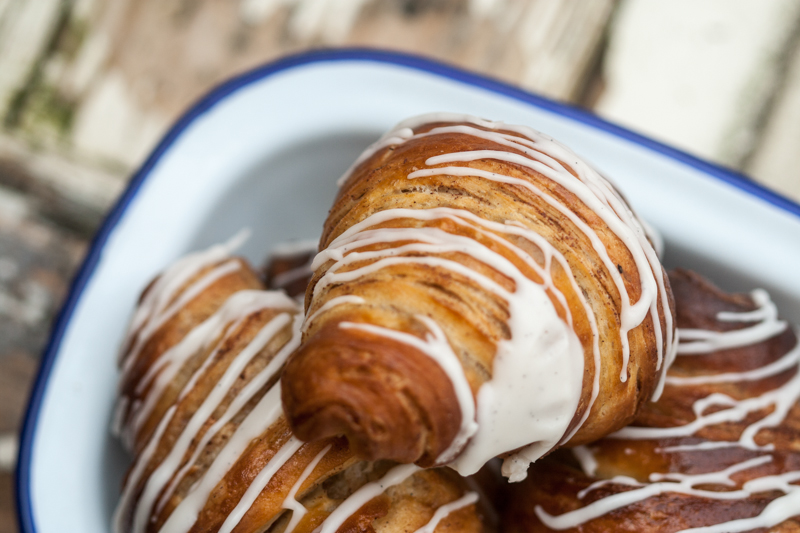
    This recipe doesn’t make traditional croissants. But more of a beautiful cross between a kanelbulle and a croissant. Soft and slightly flaky, as I only gave the dough two simple turns, as opposed to my usual croissant routine: three simple turns. In fact, a look at the insides will give it away: the membranes are thicker, and cinnamon speckles dot them throughout.

    Perhaps, if you want to, I could make some regular flaky croissants, just like the ones I grew up on, and show you too. Yes, croissants are nothing new. But I guess, in the constant chaos that surround us all, there is still some wisdom left.

    The ingredients.

    For the détrempe
    300 g strong flour
    200 g plain flour
    80 g caster sugar
    12 g instant yeast
    10 g milk powder
    10 g sea salt
    250 g cold water
    45 g butter
    , melted and cooled down

    For the butter
    300 g unsalted butter, at room temperature
    2 tbsp ground cinnamon

    For the glaze
    200 g icing sugar
    boiling water
    seeds from one vanilla pod


    twelve pm.
    Mix the flours, sugar, yeast, milk powder and salt in a large bowl. Add the cold water and butter; and mix until a dough starts to form.


    ten minutes past twelve pm.
    Transfer the dough to a clean work surface and knead for around ten minutes or until the dough feels elastic and smooth.


    twenty minutes past twelve pm.
    Place the dough back in the bowl and clingfilm tightly. Leave in a warmish place for an hour or so, or until doubled in size.


    twenty-five minutes past twelve.
    While the yeast is working in magic, work yours with the butter. In a bowl, mix the soft butter (you could flash it in the microwave for ten seconds at a time until soft but not melted) with the ground cinnamon. Perhaps a pinch of cardamom too.


    half past twelve.
    Scrape the butter onto a piece of piece of baking paper and top with another one. Roll it until you get a rough 40x30cm rectangle. Transfer to a baking tray and chill in the fridge.
    Have a cup of coffee. And kisses. And maybe, even tickles down your neck. I highly recommend the latter. That’s what dream-Sundays are made of.

    half past one.
    The détrempe is proved when it’s almost doubled in size. When you take it, it will be very smooth and elastic.

    half past one.
    Place the détrempe onto a lightly floured work surface and roll into a rough rectangle. Wrap in clingfilm and freeze for twenty-five minutes to stop the yeast. Then transfer to the fridge and let it be for a few hours.

    five o’clock.
    Tea time for some. And feuilletage for others. I can’t help but feel a little sad for the former who’ll never know the calmness only rolling dough can bring.
    Take out the butter sheet on your bench to soften it ever so slightly. Place the détrempe onto a lightly floured work surface and roll to a 40x60cm rectangle. Flour more as needed but always make sure to brush off the excess afterwards.

    ten past five.
    Place the rectangle of butter on the lower half of the détrempe – patching it as you do so to cover any naked corner – then fold the upper half over.

    fitfteen minutes past five.
    Flatten the dough with your hands to get rid of any air bubbles, and rotate counter-clockwise so that you have a “book” its spine on your left hand-side.


    twenty minutes past five.
    Roll the dough before the first turn.

    For that, I like to press my rolling pin into the dough to create some indents. This step – if done gently yet with sufficient pressure – allows to distribute the butter evenly.
    I then start rolling the dough in long movements, from the centre up and then from the centre down. Those two techniques can be applied to any laminated dough.
    If the dough starts to stick, don’t hesitate to flour your work bench and reposition the dough.

    twenty-five minutes past five.
    Once the dough has been rolled to – ideally – around seven millimetres, brush off any excess flour, and fold in three, like you would do with a letter.
    This is a tour simple [simple turn].

    Wrap the dough tightly in clingfilm and chill in the fridge for at least an hour.

    twenty-five minutes past five (of the am kind).
    I went for another simple turn as I’ve told you before. Because fluffy meant something special to me that day, or so it seems.
    Of course Karl wouldn’t wake up, so pictures didn’t happen, but here is what I did: I rolled the dough to around seven millimetres thick, then folded it in three, exactly like shown above.
    After that, I placed the dough back in the fridge – again, wrapped in clingfilm.
    If you wanted a flakier texture, I would advise to go for another tour simple [simple turn] now.

    half past six (of the am kind).
    Get two baking trays lined with baking paper.
    Roll the dough on a lightly floured surface to a rough thirty-centimetre-wide rectangle. Cut the dough in half width-wise (if that’s even a thing) and place one half onto one of the prepared baking trays. Chill while you get on with the other half.
    This will make the dough easier to handle and roll thinner, while the other part stays cool.

    Keep on rolling the dough, maintaining a width of around thirty centimetres, until it’s about four or five millimetre-thick.
    Cut triangles using a sharp knife, making sure their base is eight to ten centimetre wide.
    As you cut the triangles, place them onto the prepared baking tray; and keep in the fridge until needed.

    Repeat the rolling and cutting process with the other half of dough.

    seven am.
    Get two baking trays lined with baking paper.

    Take out a couple of dough triangle out at a time. Gently stretch them, then roll without putting any pressure on the layers. And place them with the “point” underneath on the prepared baking tray, generously spaced out.

    twenty minutes past seven.
    Layer two large pieces of clingfilm, chasing any air bubbles and lightly brush with vegetable oil.

    twenty-five minutes past seven.
    Place the layered clingfilm – oiled side down – on top of your croissants, to cover them loosely. Allow to prove at room temperature for around two hours or until wobbly and doubled in size.
    If butter starts leaking, then you might want to find a slightly cooler place to prove your croissants. If I’m at the restaurant, then 26°C is the temperature I go for (with 65% humidity for the ones of you who are lucky enough to have a prover).

    Once the croissants have proved, brush gently with a beaten egg, making sure not to put any egg-wash on the cut edges, which would prevent the rise of the feuilletage.

    Bake at 200°C for seventeen to twenty minutes. Allow to cool down slightly, then transfer to a wire rack.

    ten thirty.
    Make the sugar and vanilla glaze: mix the icing sugar with enough water to form a pourable icing; stir in the vanilla seeds, and drizzle over the croissants.

    THE END. Of life as you knew it.

  • Brioches marbrées au thé matcha

    Brioches marbrées au thé matcha

    [Marbled matcha brioches]

    With no rational reason except that those brioches looked terribly good, I decided to venture into the realm of feuilletage; once again. Although, this time, my kitchen did not come with a rolling pin.
    I could have bought one on my recent visit to Pages. I almost did in fact. But eventually got out from the shop carrying many cercles [rings], a couple of knives, a sugar thermometer, and some ramekins.

    Quite providentially, my kitchen did come with more empty wine bottles than I’m willing to admit ; let’s be honest, we had five of them sitting on the counter.
    In my defense, I must tell you they have been there for weeks.

    Armed with the one bottle that seemed fit for the occasion – read perfectly cylindrical, label removed – I went straight for the recipe. And then realised the folding instructions were in Japanese.

    Now, why did my kitchen not come with full wine bottles instead? At that point, I could have used a glass.
    Instead, I started doodling, only to realise my panic attack was pointless. A simple tour double.

    Just like for puff pastry.

    I made the dough. Left it to rise. Made the matcha filling. Chilled it. Then, I started rolling and folding, and rolling and folding.
    Somehow, my dreamlike vision of the use of wine bottles as rolling pins vanished when the filling started leaking and the dough stuck to the bottle.

    My counter ended up green, so did my fingers.
    But that’s okay.
    First, because I like green. And second, because I see no problem whatsoever in licking green fingers when they taste like matcha.

    One lesson I have learnt from this experience: get yourself a decent rolling pin girl.

    If unlike me – and probably not unlike every person around the world – you own a rolling pin, then I urge you to make these brioches. With green tea, or if you’re feeling a little more subversive, with cocoa powder.

    Brioches marbrées au thé matcha
    Adapted from Les carnets parisiens.

    Don’t be scared with all the rolling pin action here. These brioches are very easy to make, and a treat to eat.
    Soft and fragrant.
    When it comes to yeasted dough, my favourite kneading technique – which I learnt at school – is quite close from this one. I wish I could make a video to show you, but for now, the explanations of Richard Bertinet will have to do.

    I don’t do it the exact same way, but the throwing and folding are similar. Trust me, this kneading technique is a keeper.

    If you’re going to use cocoa powder instead of matcha, go for 20g of powder. And then proceed as follow.

    Brioches marbrées au thé matcha

    Makes 12 small brioches

    For the brioche dough
    300g strong flour
    60g cater sugar
    one tsp dehydrated yeast
    125g whole milk
    one egg
    50g butter, diced and at room temperature

    For the matcha filling
    80g milk
    one egg white
    50g caster sugar
    20g flour
    20g matcha green tea
    10g butter

    Make the dough. In a large bowl, combine all the ingredients except for the butter and mix until it forms a rough dough.
    On an unfloured surface, start kneading the dough incorporating the butter as you do so until it forms a smooth ball; around 8 minutes.
    Place the dough back into the bowl – covered with a cloth – and leave in a warm place for 2 hours or until double in size.

    make the filling. Bring the milk to the boil. While it’s heating, mix the white and sugar in a bowl until combined. Mix in the flour and matcha green tea, and beat until homogeneous.
    When the milk is boiling, pour it over the matcha mixture, whisking as you do so. Transfer back into the pan, and cook on medium heat until thick. Mix in the butter.
    Spread it on a baking tray lined with cling film, around 20x15cm. Chill.

    Remove any air from the brioche dough by gently patting it down, then roll it into a 30x20cm rectangle. Place the matcha filling in the middle, then fold the dough over it, sealing the extremities together. Roll into a longer rectangle, then make a tour double. Repeat the folding one more time, then roll the dough back into a 30x20cm.

    Roll the dough onto itself to form a log. Trim the ends, then using a sharp knife, slice into 3cm-thick segments.

    Butter 12 5.5cm-wide rings, and place the slices into them, cut side up.

    Cover loosely with cling film, and allow to rise for 30 to 45 minutes.

    Preheat the oven to 180°C, and bake for 15 to 20 minutes or until golden brown.